
“You’re fired!” Health Minister Horne Sacks the AHS Board

Last week Health Minister Horne out-trumped Donald Trump by firing not one but all 10 members of the Alberta Health Services Board—the board his government created in 2008 to deliver healthcare under a centralized delivery model.

One expects such theatrics from Donald Trump, after all he’s a showboat;  but not from Mr Horne, the cabinet minister entrusted with the stewardship of Alberta’s $16.6 billion healthcare system; $13.4 billion of which goes directly into Alberta Health Services.

What happened?

On June 12, 2013 Mr Horne issued a press release berating the AHS Board for ignoring his directive to rescind pay-at-risk compensation for AHS senior staff.  He’d “informed” the AHS Board Chair and members that he was terminating their appointments, effective immediately, and thanked them for their service.  Apparently the “informing” took place by email.  Ouch!  He appointed Ms Janet Davidson to take over as Official Administrator.

Now here’s where it gets sticky.  I don’t believe that Mr Horne has the power to fire the Board under these circumstances.

Minister Horne’s source of power

Unlike Donald Trump who gets his power from his uncanny ability to raise money, Health Minister Horne gets his power from legislation, primarily the Government Organization Act and the Regional Health Authorities Act (RHA).

The RHA gives Mr Horne the power to provide health services to Albertans by appointing a board to administer health services.  The Alberta Health Services Board is the only such board in Alberta.  It is responsible for promoting good health for Albertans, assessing their health needs, setting priorities, ensuring reasonable access and being responsive.  AHS Board delivers on these responsibilities through the organization known as Alberta Health Services.  Most importantly, the AHS is the “final authority” with respect to all of these matters (section 5).  Hold that thought.

“Strategic” versus “operational” decisions

Mr Horne has gone to great lengths to explain to anyone who will listen that Alberta Health (the government department run by Mr Horne) is the “strategic” arm of health service delivery and Alberta Health Services (the organization chaired by the now defunct Mr Lockwood) is the “operational” arm of health service delivery.

By happy coincidence this distinction was recently confirmed by the Health System Governance Review Task Force in a Governance Report submitted to Minister Horne in February 2013.**

Stephen Lockwood

Minister Horne buried the Governance Report so deep that no one knew it existed until ousted AHS Chairman Mr Lockwood criticized Minister Horne’s plan to conduct yet another governance review, suggesting that the Minister could save taxpayers’ dollars by simply referring to the Governance Report already in hand.  What a novel idea!

The distinction between strategic and operational decisions is critical because decisions relating to compensation are operational not strategic and therefore fall within the purview of the AHS Board, not the Minister.

That’s why the Terms of Reference for the AHS Compensation Committee give the Committee the power to recommend compensation payouts to the Board.  The Board in turn had the power to decide whether it would make the pay-at-risk payments or not.  And as noted above, Section 5 of the RHA gives the Board “final authority” over matters within its purview.

Does Mr Horne have the power to fire the AHS Board?

The RHA gives Mr Horne the power to dismiss the AHS Board and appoint an “official administrator” in its place under two scenarios:  (1) if the Minister considers the Board is not properly exercising its powers or carrying out its duties under the Act (we just agreed that the AHS Board was properly exercising its powers and duties because compensation matters are solely within the AHS Board’s purview) or (2) if for some other reason the Minister considers it is in the public interest to dismiss the Board.*** 

Would Minister Horne care to explain how it is in the public interest to fire the entire AHS Board because the Board refused to breach 99 employment contracts?

If the AHS Board bent to Minister Horne’s will and ripped up those contracts the message the government would be sending the public is this:  the government is not bound by contract law in tough economic times. 

If this were the case, there’s nothing to stop the AHS from refusing to pay construction companies building new hospitals or laundry service companies washing hospital linens or catering companies bringing in hospital food.  Indeed, all of the government agencies and government departments could easily meet their new budget targets by simply ripping up their existing contracts and starting over again.  It’s lunacy.

Power and control

Minister Horne’s beef with the AHS Board may have started with pay-at-risk but it escalated into a battle for power and control.  The AHS Board was under the illusion that it had a modicum of autonomy and it could moderate political influence on decision making.  Clearly it was wrong.

The Governance Report states that it is a “failure in governance…when the government disagrees with a decision of the AHS Board and imposes its will on the agency.” (p 24)

Fred Horne

Given Minister Horne’s rout of the AHS Board I’d go even further.  The question now is not whether Mr Horne’s imposition of his will on Alberta Health Services is a failure in governance; it’s whether Mr Horne, a cabinet minister in Alison Redford’s government, violated the Regional Health Authorities Act by dismissing the AHS Board without having the legislative authority to do so.

“You’re fired” is entertaining when it’s uttered by Donald Trump on a reality TV show.  It’s downright scary when it’s uttered by a government minister to remind government-appointed boards and agencies that when the boss says jump, the correct response is how high.

*News Release, June 12, 2013 

**Working Together to Build a High Performance Health System, February 2013

***Regional Health Authorities Act, Section 11
 

Posted in Alberta Health Care, Politics and Government | Tagged , , , , | 41 Comments

Time to get Militant with your Doctor and the College of Physicians and Surgeons

Ms Soapbox has been in a quandary all week.  She was troubled by what she’d observed at the meeting of the College of Physicians and Surgeons governing council.  Finally the penny dropped.  The College is deadlocked and incapable of living up to its mission which is “Serving the public by guiding the medical profession”.*

It’s become painfully obvious that the College is extremely reluctant to regulate doctors who provide uninsured services; let alone discipline physicians who breach the Standards of Practice and Code of Ethics by taking advantage of the public’s ignorance of how insured and uninsured services should be provided.

Sounds harsh, but consider this.  There are roughly the same number of doctors as lawyers in Alberta (approximately 7000 doctors and 7800 lawyers) but over the last five years there were twice as many complaints resulting in disciplinary action against lawyers than doctors—50 actions against the lawyers including 18 disbarments and 5 resignations and just 22 actions against the doctors.**

There are two possible explanations for this anomaly:  Doctors are more ethical than lawyers or doctors’ patients are less likely to complain than lawyer’s clients.

Are doctors more ethical than lawyers?

I have three words for anyone who thinks doctors are more ethical than lawyers:  Queue Jumping Inquiry!  Given the revelations surrounding the Helios clinic and what turned out to be a well-established queue jumping protocol, I find it hard to believe that doctors are more ethical than lawyers.    

To further complicate matters, doctors have the challenge (and the luxury) of being able to charge for insured (government-paid) services and non-insured (extra fee) services.  This confuses patients and gives doctors even more wiggle room under the Standards of Practice and Code of Ethics.

Lawyers on the other hand don’t have one foot on the pier and the other in the boat.  Virtually all lawyers work in private practice or in-house for corporations or government.  The question of who pays their bills is easily determined and there’s no opportunity for double-dipping.

Are doctors’ patients less likely to complain?

I left the meeting of the College of Physicians and Surgeons convinced that doctors’ patients are less likely to file a complaint because they’re not properly equipped to do so.

When a lawyer messes up, his client finds out pretty quickly.  The deal goes sour, the client loses his deposit, etc.  Clients are furious and fire letters off to the Law Society at the drop of the hat.

A lawyer’s client knowns what he wants to get accomplished, he just needs the lawyer to help him do it.  Doctor’s patients on the other hand, don’t know what’s wrong with them, let alone how to heal themselves.  This makes it difficult for patients to know when they’re receiving inadequate medical care.  Furthermore, the nature of the doctor/patient relationship requires patients to trust their doctors.  Consequently patients will endure a great deal of substandard care before they raise the alarm or switch doctors.

Given this state of affairs, the College must do everything possible to protect the public by enforcing the Standards of Practice and Code of Ethics.  Does it?

The College’s duty to protect

The Code of Ethics states that it is a doctor’s fundamental responsibility to “consider first the well-being of the patient”.  This principle alone would prohibit a doctor from limiting his patients to only one ailment per visit, thereby forcing patients to book three separate appointments on three separate days.   This may enhance the doctor’s ability to bill the system but it’s certainly detrimental to the patient’s well-being.

The Standards of Practice prohibit the tying of uninsured services to insured services.  (This may be illegal under competition law as well).  So a doctor can’t close his practice, ditch his patients, re-open his practice in a concierge clinic and demand that his old patients pay him an annual fee of $3000 to $10,000 for uninsured services before he’ll agree to provide them insured services.

The College is well aware of these and other abuses.  And yet it is reluctant to amend the Standards of Practice to make it crystal clear that such practices will not be tolerated.  Instead it sends the staff back to the drawing board to “clarify guiding principles that would frame any future discussions surrounding” amendments to the Standards of Practice.***

This is deeply troubling because the problem isn’t a lack of clarity.  It’s a lack of fortitude.  The College must deal with the elephant in the room.  Will it fight for public healthcare by enforcing the existing Standards of Practice and adding amendments to stop the incremental privatization of healthcare or not? 

There’s a lot of money to be made in providing uninsured services.  The College will face fierce headwinds if it disciplines physicians who provide these services improperly.  But, hey, someone has to do it.  Shouldn’t that “someone” be the College of Physicians and Surgeons, the self-regulating body empowered under the Health Professionals Act to discipline wayward physicians?

Time to get militant

At this point the College is deadlocked.  The amended Standards are under review (again).  We can’t afford to wait for the College to decide whether it will support public healthcare or turn a blind eye to the physicians sneaking privatized healthcare into Alberta through the back door.

So let’s force the College’s hand.  Let’s stand up for ourselves.  Let’s take a lesson in militancy from my little physiotherapist who challenged her doctor for writing her a prescription for over-the-counter vitamins.  (She also challenged her dentist for charging $400 for a cleaning and an X-ray and a waiter for charging her dinner companion a $10 split-meal charge when her friend only had a beverage).

The next time you visit your doctor take the Standards of Practice and Code of Ethics* with you.  Ask your doctor to explain his fees and whether he’s charging you for an insured service.  If he insists you book a second appointment to describe some of your symptoms ask him how that’s consistent with the Code of Ethics.

And if you don’t get a satisfactory answer file a complaint with the College of Physicians and Surgeons.  If we don’t stand up for ourselves who will?

* http://www.cpsa.ab.ca/

**These are high level statistics based on information available on line.  Additional information from doctors or lawyers is welcome.  

***Council Meeting Highlights, May 2013, CPSA website

Posted in Alberta Health Care | Tagged , , , , | 22 Comments

Protect the Rights of the Rich? The College of Physicians and Surgeons Grapples with Concierge Clinics

F. Scott Fitzgerald once said to Ernest Hemingway, “You know, the rich are different from you and me.”  Hemingway replied, “Yes.  They’ve got more money”.*

I was sitting in a meeting of the Council of the College of Physicians and Surgeons when F. Scott Fitzgerald’s comment came to mind.  It’s true.  The rich are different from you and me.  For one thing they don’t have to advocate for themselves; others will do it for them.

The Council Meeting

The College of Physicians and Surgeons regulates the practice of medicine in Alberta.  The College is governed by a Council—13 doctors and 4 lay people—that meets four times a year.  And bless Council’s little heart;  the public is welcome to observe their meetings.

Ms Soapbox, with her esteemed colleagues, the Whitemud Citizens for Public Health and the Consumers’ Association of Canada, attended the May 31 Council meeting.

Things were going swimmingly until Council reached Item 11.1, Concierge Clinics, then all hell broke loose (in an understated and orderly fashion, these are doctors after all).

What is a Concierge Clinic?

A “concierge clinic” is a private medical clinic that offers “a host of services to clients who pay a substantial annual fee.”**  Some services are “insured” ie. paid by the government with your tax dollars and some are “uninsured” ie. paid by the client by way of an annual fee.

(Disclosure:  I joined a concierge clinic in 2007 when I moved back to Canada and discovered, much to my dismay, that virtually no doctors in Calgary were accepting new patients).

Why is the College of Physicians and Surgeons concerned?

The Queue Jumping Inquiry exposed the fact that some doctors working in concierge clinics pushed their patients to the front of the colonoscopy screening queue.  The bad press generated by this revelation prompted the College to examine its Standards of Conduct governing the ethical practice of medicine.  Were the existing standards “robust” enough to ensure that doctors working in concierge clinics met “the College’s expectations regarding delivery of care in these settings?”**

A less delicate way of asking the question is:  Were doctors in concierge clinics complying with the standards governing the delivery of publicly funded healthcare to Albertans.

Dr Mazurek’s report to Council

Council staff presented their initial findings in March 2013**but Council was not ready to make a decision and requested an additional review of the standards in place across Canada.

Dr Mazurek conducted this review and presented her findings and recommendations to Council on May 31.  Her recommendations were based on the principles Council had (apparently) agreed to at a retreat in Feb 2013.

Suffice it to say that her recommendations kicked over a hornet’s nest (albeit in an understated and orderly kind of way).  Dr Mazurek didn’t make it past the first principle before Council members started peppering her with questions:

Why did you use the more stringent standards from Ontario and Manitoba?  Why didn’t you go with looser standards from more lax provinces?  Alberta’s standards are among the most lax in Canada.  Council had asked Dr Mazurek to tighten these standards, not loosen them even further.

Why is this a College problem?  (In other words, the government and Alberta Health Services created this mess, let them clean it up).   The College regulates the profession and disciplines its members.  It owes it to the doctors to make the standards governing their behaviour as clear and transparent as possible.

Maybe we should define bad behavior and then work our way back up to the principles.  At this point I had to resist the urge to jump up and say:  Hello!  Did you read Dr Mazurek’s Feb 21/13 memo?  You’ve already agreed to a set of principles.

And here’s the one that took my breath away—Are we introducing discrimination based on a person’s ability to pay?  (In plain English:  are we discriminating against the rich?)  This is what triggered my F. Scott Fitzgerald moment.  The rich are different.  They don’t need to attend a Council meeting to argue in favour of unregulated concierge clinics.  They simply convey their views to a Council member who happens to work at a Calgary concierge clinic and he carries their message for them.

All is not lost

The meeting dissolved into confusion as the doctors debated among themselves.  Were MRIs and CT scans “insured services” or not?  Should all doctors get “standby pay” or was that a violation of Standard 18 (9)?  Is it better to create “principles based” or “rules based” standards?  The Council President tried to push for a decision and failed.  The doctors were deadlocked.  In the end the President resorted to the tried and true tactic of referring the matter back to the staff (again) for further study.

There was one bright light in all the confusion.  It came from an unexpected source.  Dr Trevor Theman, College Registrar, admonished his fellow Councillors with this:  “I’m offended as a member of this College by some of the things I’ve seen in the press and I’m distressed that I’m not getting signals of distress from others around this table.  You set the ethical guidance for the profession—the ethical standard…”  His words hung in the air.  No response necessary.

The rich have more money, but…

The rich are different from you and me.  They have more money.  But we have Drs Theman and Mazurek who are forcing Council to recognize a simple fact–failure to tighten the standards to prevent inappropriate behavior in concierge clinics will send a devastating message to the public about who’s in charge of Alberta’s public healthcare system  (Hint: it’s not the public).

Dr Mazurek’s follow up report will be presented to Council in the fall.  Guess who’s going to be in the audience to ensure that the good doctors don’t lose their resolve!

*Deirdre N McCloskey, European Review of Economic History, 12, 138-148

**Memo to Council by Dr Karen Mazurek, Feb 21, 2013, available on the College of Physicians and Surgeons website under About Us, Council, Council Meeting Schedule, Mar 7 & 8, 2013 

Posted in Alberta Health Care | Tagged , , , , | 18 Comments

Will Platts Pop Alberta’s “Bitumen Bubble”?

Platts, a global company with a remarkably flaccid name, finds itself smack in the middle of an international price fixing scandal and I really hope the Alberta government is paying attention! 

Last week the European Commission storm troopers, sorry, inspectors, raided the offices of BP, Shell and Statoil, three of the most significant oil companies on the planet, to find out whether they colluded to manipulate oil prices by reporting false information to Platts, the most powerful price reporting agency on the planet, in a conspiracy to manipulate trade in North Sea Brent oil.

Platts was in “lock down” as EC inspectors seized laptops and files in what has been described as “the biggest trading probe since the Libor scandal”.*

What is Platts?   

Platts was founded by Warren C Platt in 1909 to provide market-based price information to the oil industry.  Over the years it grew to include coal, natural gas, electricity, nuclear energy and the renewables sectors.

The benchmark prices for crude oil, refined oil products and natural gas are set at 4 pm each day.  Platts opens a 30 minute “window” to collect data—bids, offers and trades—from 240 companies, analyzes this data for 90 minutes (these guys are uber-smart!) and spits out the daily benchmark prices for the relevant commodity.  These prices are used in billion dollar transactions in a $2.5 trillion market.**

One such benchmark is the Brent crude oil price.  It’s the holy grail for Alberta oilsands producers and the reason why the Alberta government, to use a phrase that appears in each and every government press release, is fighting “to open new markets for Alberta’s resources”.  (Sidebar:  Ms Redford omitted  the “fighting” phrase in her press release congratulating the BC Liberals on their re-election;  she also omitted any mention of Liberal leader Christy Clark…hmmm.)

The Alberta government is convinced that once Keystone XL and Northern Gateway are approved oilsands crude will flow to new markets and the so-called “bitumen bubble”—the difference between the lower Western Canada Select price and the higher Brent crude price—will disappear.

But what happens if the European Commission investigation concludes that BP, Shell and Statoil colluded to artificially inflate the Brent crude oil benchmark and the benchmark price is no longer credible?  (The EC is alleging that the collusion has been going on since 2002 when oil traded at $20 a barrel; today it’s five times that price.)**

The fate of the Brent crude oil benchmark

Before we go there, remember this:  The Brent benchmark price is already slipping.  Analysts like Gene McGillian (Tradition Energy) don’t expect Brent prices to recover any time soon:  “Overall, the fundamental picture remains weak.  We’re at multi-decade highs in crude stockpiles, multi-decade highs in US production and that’s causing some resistance [to oil price increases].  As the market tries to push higher, that resistance is going to get stronger.”***

That “resistance” may explain why some oil companies are unable to sell their oilsands assets.  In the last two years Marathon, Murphy Oil, ConocoPhillips, Koch Industries, Shell and Athabasca Oil have put oil sands assets on the market but failed to sell them.  Last year $17 billion in oilsands assets languished on the market with no takers.****Imagine the impact on the marketplace if Platts, “the main price reference for the physical oil market”** is deemed to be untrustworthy.

Is the Alberta Government paying attention? 

By wrapping itself in the “bitumen bubble” the PC government has tied Alberta’s economic viability to the Brent crude oil benchmark price.  Consequently if the Brent benchmark collapses, the differential becomes irrelevant and Alberta goes deeper into debt.

The European Commission investigation will end in one of two ways: the process to set the Brent benchmark will be strengthened or the Brent benchmark will be replaced by a different international benchmark.  Until that happens the industry will be plagued with uncertainty, further hampering its ability to deliver 30% of the revenue stream that the PC government requires to fund healthcare, education, seniors care and infrastructure costs.

And that, my dears, is the result of the government’s “hope and a prayer” strategy—hope the price of oil goes up and the difference between the Western Canada Select price and the Brent benchmark goes down; and pray that Keystone and Northern Gateway are approved.  There is no Plan B.

I’d prefer a more robust strategy, wouldn’t you?    

*Globe and Mail Online, May 14, 2013   

**Reuters Online May 15, 2013

***Daily Oil Bulletin, May 8, 2013

****Calgary Herald, May 25, 2013, C1

Posted in Energy & Natural Resources, Politics and Government | Tagged , , , , , , | 10 Comments

“Campus Alberta”: Soviet Style Research and Development Comes to Alberta

Sigh…where to start?  The barrage of bad news spewing out of the Premier’s office has been so intense that the government’s Machiavellian takeover of post secondary institutions and research and development slipped by with relatively little public outcry.

Sure, some students and academics staged protests on the steps of the Legislature but the general public doesn’t know what the fuss is about.  Is it higher tuition fees?  No.  Do the professors want higher salaries?  No.  Well what then?      

Government-driven R&D

The PC government has recognized (yet again) that Alberta’s economic survival depends on a diversified economy.  You mean we’re not going to be beholden to the oil companies anymore?  Not so fast, grasshopper.

A bit of background.  In 2010 the Stelmach government set up Alberta Innovates to fund short-term, applied research under the banners of Tech Solutions, Bio Solutions, Energy & Environmental Solutions and Health Solutions.  Three short years later, Mr Lukaszuk, Minister of Enterprise and Advanced Education, declared Alberta Innovates was, like a bad cup of coffee, not “totally satisfying”* and dismantled it.  He rolled Tech, Bio and Energy & Environment (and their $160 million budgets) into a yet-to-be-named institute and spun Health Solutions off into Alberta Health Services.

In the interests of brevity let’s call the yet-to-be-named institute the Midas Research Institute (a brilliant term coined by Jeremy Richards in the excellent University of Alberta blog Whither the U of A?)

The Midas Research Institute

Midas Research is a centralized, top-down, government-driven research and development institute created to “help” post secondary institutions commercialize their research in partnership with private companies.  Mr Lukaszuk says the research will focus on the “human, animal, agriculture and petroleum industries”.** I have no idea what a “human industry” is. 

Midas Research will spin off companies and “help start a new economy for Alberta”.  It will also generate a stream of royalties to fund post secondary institutions and benefit businesses.* Assuming of course that the creator of the intellectual property is prepared to give up his IP rights to industry, the university or the government in the first place.

Impact of Midas Research on “basic” research

Researchers are concerned about the impact of Midas Research on “basic” research—pure scientific research intended to increase our understanding of phenomena.  When asked how he intends to nurture basic research Mr Lukaszuk replied: basic science (he meant “research”) is “a good beginning” which can be used to “elevate basic science to higher levels and hopefully attract investment to commercialize the product”.**

Bottom line: there’s no such thing as “basic research”.  All research is geared to commercialization and the generation of profits, preferably within the current four year election cycle so the PCs can take credit for it.

As an aside, aren’t you glad Alexander Fleming wasn’t pursuing a government-driven/corporate R&D agenda when he discovered blue green mould growing in a contaminated petri dish;  he’d have tossed it in the trash!    

Impact of Midas Research on post secondary institutions

When Mr Lukaszuk unveiled the Midas Research Institute he also announced that 26 post secondary institutions would not receive a promised 2% budget increase;  instead they’d be whacked with a 7.2% budget cut.

As a result the $147 million originally slated to go to post secondary institutions is looking for a new home…Midas Research perhaps?

The hardship caused by this $147 million budget shortfall is immeasurable.  Five post secondary institutions have indicated they will cut or curtail 28 programs.  The Universities of Calgary and Alberta have not yet released their program cuts; but the U of A says the $67 million shortfall is close to the base funding for one large faculty or 5 small to mid-sized ones.***

Mr Lukaszuk says don’t worry, his department, nay, his very own office, will make the final decision on the cuts.  He’ll review the list of programs to be cut, check the enrolment levels and decide whether the programs can be “delivered to students in a different fashion” or at different institutions**** Oh I get it.  A course is offered if Mr Lukaszuk says it’s offered.  A course is cut if Mr Lukaszuk says it’s cut—so much for the independence and autonomy of our universities, colleges and technical schools. 

Government-dictated post secondary education and research

Mr Lukaszuk is the Minister of Enterprise and Advanced Education.  He dismantled Alberta Innovates which provided applied-research in accordance with government priorities and replaced it with the Midas Research Institute, a university/government/industry collaboration to provide applied-research in accordance with government priorities.  At the same time he imposed a $147 million reduction in post secondary funding.

It’s clear that Mr Lukaszuk’s mission is press gang our academics and researchers into serving industry.  Those who would prefer to do basic research or teach in a post secondary institution with some level of independence and autonomy need not apply to Campus Alberta.

But here’s the really sad part.  The top-down, government-driven research model doesn’t work!  Internationally renown scientist Dr Bob Church, a founding member of the Natural Sciences and Engineering Research Council, former member of the Medical Research Council of Canada and the Alberta Research Council (the list goes on), says the last time he saw this research model was in the Soviet Union in 1972.***

The model doesn’t result in wealth-creating research, but it does create an exodus of top scientists, clinicians and professionals.  And that Mr Lukaszuk is a “brain drain”, not a sustainable economic advantage.

*Calgary Herald, May 6, 2013, A4

**Mr Lukaszuk in an interview with Mike Spear, of Genome Alberta, at the Bio Buzz Conference, (Biotechnology Industry Organization) in Boston earlier this year.

***http://whithertheuofa.blogspot.ca/2013/05/cip-prognosis.html 

**** Hansard, May 13, 2291

*****Hansard, May 6, 2071

Posted in Education, Politics and Government | Tagged , , , , , , | 31 Comments

Conrad Black and Danielle Smith

Conrad Black, the Canadian media mogul and convicted felon* was in Calgary last week to have a “conversation” with the Calgary business elite (and me) over lunch at the Calgary Petroleum Club.

The big question is why does Baron Black of Crossharbour—oh let’s just call him Conrad—continue to draw sell-out crowds.  By the end of lunch and the exchange between Conrad and Ms Danielle Smith, the leader of the Opposition, I had my answer.

Before we go there, let’s set the stage.  The Petroleum Club dining room is, as you would imagine, an upscale venue.  Tables filled with glittering china and silverware were clustered in front of a stage upon which were two comfy armchairs—one for Conrad and the other for our host, Dr Roger Gibbons.

Ms Soapbox was seated at table 35, the lone woman at a table of accountants, lawyers and businessmen.  One of the accountants admitted that Conrad had been his client.  The other whipped out The Concise Oxford Dictionary in case Conrad soared off into overblown oratory.

Conrad was witty and entertaining.  He made a number of Conradesque comments.  But he also said some things that were totally out of character.  Here are the highlights:

The American and Canadian justice systems:  The American system is “rancid”.  US prosecutors enjoy a 99.5% conviction rate** in comparison to the Canadian conviction rate of 62%.   US prosecutors achieve these stellar results by coercing witnesses to “turn” on the accused.  The Canadian system is more even-handed and the defendant has a fighting chance.  I agree.

The US penal system:  Conrad says it’s not bad, at least in low security, but admits that he was not “psychologically in the place”.  He had email access and his writing career flourished.

Coleman Federal Prison

Conrad made an uncharacteristic and insightful comment:  Prime Minister Harper’s push for more prisons and stiffer mandatory sentences is ill-conceived, particularly for non-violent offenders who generally leave prison in worse shape than when they went in.  Hear hear!        

The decline of America:  America’s greatness was founded on hard working immigrants and brilliant statesmen (I’d venture a guess that Conrad sees himself in the latter category).  However the US will sink into decline if it fails to correct three flaws:  (1) complacency, (2) the utter lack of interest in anything outside their borders, and (3) the belief that they are an “exceptional” nation.  He thought the US could turn it around, I’m not so sure.      

President Obama:  Obama gets credit for being the first non-white president and for stealing “Bill and Hilary’s party” right out from under their noses.  However Obama has not shown global leadership in addressing the buildup of nuclear weapons and is “playing chicken” with the Republicans in a misguided effort to address the ballooning national debt.

Quebec:  Quebec is a “society of consultants and academics, both equally useless” (to which Dr Gibbins took mock offence).  Quebec’s “addiction” to transfer payments has eliminated the risk of secession and a federal party no longer needs Quebec to win a majority.  Probably not how Mulcair sees it.

Ezra Levant and Mark Stone:  The Human Rights Commission cases against Levant and Stone were “scandalous!”  Freedom of speech must be protected.  This principle holds for Tom Flannagan as well.  This comment elicited a smattering of applause.

Enter Danielle Smith

The most interesting conversation occurred when a woman took the microphone and said, “Lord Black, my name is Danielle Smith”.  The audience held its breath.  What’s her question?  It turned out to be innocuous—should Canada adopt a federal securities commission like the SEC?***

Conrad peered into the crowd, shading his eyes against the spotlight’s glare.  “Will you tell me your name again?” Danielle repeated her name and reminded Conrad she’d once worked for him at the Calgary Herald.  “Ah, you are indeed who I think you are”.  After a pause he complemented her on the “tremendous job” she’d done with the Wildrose and added a jab at Redford’s PCs with the observation, “Conservatives sometimes fish too far to the left”.  Clearly Conrad is not up on Redford’s recent attempts to be even more conservative than the Wildrose, nevertheless Danielle looked pleased.  

Why did I pay to see Conrad Black?

Mr Black and his ilk hold great wealth and power (even after they fall from grace).  They chair influential gatherings like the Davos World Economic Forum and the Bilderberg group.  They shape provincial, national and global policies and our politicians unabashedly seek their guidance. 

Two recent examples:  Prime Minister Harper consulted with Murray Edwards, the billionaire CEO of Canadian Natural Resources Limited, about whether a Chinese state-owned entity should take over Nexen (Mr Edwards had reservations).****

Ms Redford told Ms Smith in Question Period that she would take advice from Brian Ferguson, CEO of Cenovus, on the “bitumen bubble” spread (and the basis for her austerity budget) “well before” she’d take the Opposition’s advice.*****

I paid $250 to see Conrad Black to get a sense of where the man is going and which politicians he’s taking along for the ride.   It was worth every penny.

*Conrad was convicted of mail fraud and obstruction of justice by the US courts and served 37 months of a 42 month sentence.

**In 2011 the US Dept of Justice reported a conviction rate of 93% so Conrad isn’t far off the mark.

***Conrad’s answer was no; beef up your provincial securities commission and sell it to someone who’s business friendly and criminal hostile. 

****Globe and Mail online Dec 9, 2012

*****Hansard Apr 25, 2013, p 2046


Posted in Lectures, Politics and Government, Rich and/or Famous | Tagged , , , , , , | 12 Comments

Strike While the Iron is Hot: The Edmonton Remand Centre Labour Dispute

For years I’ve wondered whether unions had outlived their usefulness and were simply using their collective bargaining power to crank up wages and benefits at the expense of…well…who knows what.  But the wildcat strike arising out of the Edmonton Remand Centre labour dispute proved me wrong.

Edmonton Remand Centre

The Edmonton Remand Centre is the largest and most technologically advanced facility in Canada.  Planning and construction of this state-of-the-art facility, which is the size of 10 football fields, started in 2007.  Total cost?  $580 million.  In April the facility was preparing to receive the first of 1,952 inmates when two correctional officers raised safety concerns relating to design flaws and the guards’ lack of readiness to accept 800 inmates who would soon be flooding through the doors.

Their employer, the Department of Justice, reacted by suspending them.  This is a violation of the Occupational Health and Safety Act which not only obligates an employee to report safety concerns, but prohibits an employer from taking disciplinary action against an employee for doing so.*

Deputy Premier Lukaszuk further inflamed the situation by calling the complaints a personality conflict between staff and their supervisor.  This sparked wildcat strikes across the province as guards, sheriffs, social workers and clerks walked off the job in a show of solidarity.  Courthouses shut down, trials were postponed and the matter finally got the media attention it deserved.

What’s the big deal?

Before we leap to the conclusion that correctional officers are big boys who should stop whining and get on with their jobs, let’s gather the facts.

Fact #1:  A “remand” centre is a facility built to hold inmates awaiting trial.  Some are accused of violent crimes; others are considered a flight risk if they’re granted bail.  Incarceration is measured in days and months, not years and decades.

Fact #2:  The Edmonton Remand Centre is physically and organizationally constructed on the “direct supervision” model of inmate management.  Correctional officers are “stationed inside living units to maintain direct and frequent contact with inmates.”**

Fact #3:  The “direct supervision” model of inmate management is a major departure from the models that were in place for the last 33 years.  Under the prior “intermittent surveillance” and “remote surveillance” models, correctional officers had very little direct contact with inmates, relying instead on remote observation and intercom communication. They were physically separated from inmates by security barriers made of stainless steel, concrete and plexiglass.***

All that has changed.  Under the new “direct supervision” model, correctional officers are no longer separated from the inmates.  Quite the opposite.  Now a (as in ONE) correctional officer will be in direct contact with 48 to 64 cells.  His responsibilities have also changed.  He’s expected to supervise inmates, not just observe them (ie. prevent vandalism and violence instead of just respond to it).

Supervision includes influencing an inmate’s behavior by granting or withholding privileges like family visits and access to TV.

Fact #4:  This was not the first time correctional officers brought their safety concerns over design flaws to the government’s attention.  They’ve submitted pages of issues throughout the planning and construction phases and have been ignored…until now.

Is this a big deal?  You bet it is.  Stephen Saunders, a writer in the field of inmate management, describes the “direct supervision” model as a new concept that “combines principles of human behavior and facility design to create detention environments that facilitate the officer’s effectiveness”.   He notes that ”…the greatest concern about being incarcerated or seeking employment in a detention facility is personal safety…detention facilities have gained a reputation for danger and fear.”*** 

It is absolutely essential that a change of this magnitude be well thought out and carefully implemented—particularly when 800 inmates are delivered on the doorstep to be processed within 48 hours.

The Right Government Response

Mr Lukaszuk

Instead of suspending correctional officers and trivializing their safety concerns as personality conflicts or collective bargaining histrionics, the government should have investigated these concerns properly.  (It’s mildly ironic that Deputy Premier Lukaszuk would dismiss these safety concerns so quickly when he himself ran to the police in the last election complaining that a constituent punched him while he was door-knocking—the constituent was a 67 year old man dying of liver failure and on the waiting list for knee and shoulder surgery).

Instead of characterizing this event as an “us-against-them” battle (Alberta taxpayers against the union) and demanding the union pay the government $1.3 million to cover the (alleged) cost to backfill the striking employees and instead of demanding a 6 month suspension in union dues, the government should be satisfied with the $350,000 fine already imposed on the union by the courts.

Instead of trying to save face by agreeing to investigate “new and specific” safety concerns (the same ploy the government used in the Queue Jumping Inquiry) the government should follow up on the pages of concerns tabled in connection with the Edmonton Remand Centre over the last 5 years.

Strike while the iron is hot

While we’re on the topic, there is absolutely nothing wrong with striking (literally) when the iron is hot if the union has exhausted all of its legal remedies and it’s the only way to ensure that its membership will be safe.  Which brings us full circle.  The union movement was born in the Industrial Age in order to protect workers from exploitation and unsafe work conditions.  It continues to serve the same purpose today.  Doesn’t say much for how far we’ve come, does it?

*Occupational Health and Safety Act, RSA 2000, Sections 35 and 36

** Alberta Justice webpage http://www.solgps.alberta.ca/programs_and_services/correctional_services/adult_centre_operations/nerc/Pages/new_edmonton_remand_centre.aspx

***The discussion of the three models of inmate management comes from the paper “Direct Supervision Jails: A Management Model for the 21st Century” by Stephen I Saunders III.

Posted in Crime and Justice, Politics and Government | Tagged , , , , , | 11 Comments

The Face of Terrorism

I’ve been to Washington DC many times, but this trip was different.  In addition to the usual buzz created by lobbyists, bureaucrats, politicians and businessmen who had places to go and people to see, there was a sense of unease.  This feeling of foreboding was evident in the police cars parked on the street corners and the crowd control fencing encircling the White House.  It peaked with the false AP Newswire tweet that the President had been injured in an explosion at the White House which caused the stock market to nose dive.


The Boston marathon bombings were clearly taking their toll.

My American friends debated whether their country’s “experiment” with diversity had failed and whether it was time to return to the “melting pot”.  Are we all to be indoctrinated into the fundamentalist Baptist faith? 

They debated whether waterboarding was really torture.  No limbs are cut off.   And whether it was okay to torture Dzhohkar Tsarnaevthe, the suspected Boston marathon bomber, who it should be remembered is an American citizen.   

Lawmakers suggested they would have captured the Boston marathon bombers much sooner if they’d been allowed to deploy drone surveillance on the American people.

Thank god it’s not like that in Canada I thought.  We cherish our Charter rights and would never compromise our civil liberties in a knee jerk reaction brought about by fear…

…and then I came home and read the headline in Saturday’s Calgary Herald—CHANGING FACE OF TERROR.  Four faces stared off the front page;  the brothers accused of engineering the Boston marathon bombings and two men accused of plotting to derail a Via Rail passenger train.  The word “Terror” was written in bold typeface in case we didn’t get it.

Politics - Stephen Harper - CP- may 2 2012This story provided air cover for a much more important story reported the day before—the Senate and the House had passed Bill S-7, the Combating Terrorism Act.  The full name of this legislation is An Act to amend the Criminal Code, the Canada Evidence Act and the Security of Information Act.   

The fact that Bill S-7 is an amendment to existing legislation is critically important because it signals to Canadians (if they’d bother to check) that we already have significant anti-terrorism measures in place.

For example, Section 83.01(1) of the Criminal Code gives the police the power to charge suspected terrorists with offences under various conventions and protocols set by global authorities including the United Nations and The Hague.  These conventions include offences relating to aviation, maritime navigation, fixed platforms on the continental shelf, nuclear materials, hostage-taking, bombings and financing terrorism, both inside or outside of Canada.

Furthermore, the Criminal Code defines the offence of terrorism to include causing death or injury, endangering life, public health or public safety, inflicting property damage, disrupting essential services, conspiring, attempting or threatening to commit such an act or being an accessory after the fact or counseling another in the commission of such an act in order to pursue a political, religious, or ideological cause, or to intimidate the public with regard to its security, including its economic security.

That pretty well covers the waterfront, don`t you think?

So what’s the point of the new Combating Terrorism Act?

Here’s what the Legislative branch lawyers have to say.  Bill S-7 simply reinstates (and broadens) provisions in the Criminal Code to allow “for investigative hearings and recognizance with conditions/preventive arrest in relation to terrorist activity”. *

In plain English this means that we’ve entered the zone portrayed in the sci-fi thriller Minority Report.  Parliament has authorized the police to arrest someone before he’s done anything (that’s the “preventative arrest” part) and to force him to appear at a hearing and divulge any “information” he may have (that’s the “investigative hearings” part).  To be fair, before such an arrest can be made the police must get the consent of the Attorney General and, in some cases, a judge’s order.    

Presumably the Attorney General will rely on the information presented to him by the police urging him to let them make a preventative arrest.  He’ll be well aware of the fact that if he doesn’t grant his consent and heaven forbid something goes wrong, the Attorney General`s picture will be plastered all over the front page of every Canadian newspaper together with the alleged terrorists under the banner headline:  AG Soft on Terrorists!

Police State

Law Enforcement at Boston Marathon

The real question here is: Why?  Why do police need these additional powers now?  What’s changed so radically that the already expansive powers available to law enforcement under the Criminal Code are no longer sufficient?  And given the impact Bill S-7 will have on our civil liberties why hasn’t there been a more fulsome debate on these issues in Parliament and in the media? 

Surely we are not so frightened as a nation that we will gladly give up our civil liberties and enter a police state for our own protection—that is simply trading the tyranny of terrorism for something much more sinister.

*Library of Parliament Publication No. 41-1-S7-E

Posted in Crime and Justice, Politics and Government, Uncategorized | Tagged , , , , | 15 Comments

A Trip to the Mayo Clinic: Your dime or mine?

English: Mayo Clinic Rochester Minnesota - Gon...

Mayo Clinic seen from Cafeteria

This past January Mr Soapbox and my youngest daughter (let’s call her Mini) went on a pilgrimage to the Mayo clinic in Rochester, Minnesota.  Unbeknownst to them they were following in the footsteps of Ms Michele Lahey, former Chief Operating Officer of the former Capital Health Region, who’d made the trek almost six years to the day before them.

Ms Lahey was advised by her Alberta oncologist that she was cancer-free.  But her boss, Sheila Weatherill, CEO of Capital Health, told her to get a second opinion from the Mayo.*          

Mini Soapbox, on the other hand, had not received a clean bill of health by an Alberta medical specialist.  In fact she was stuck in that limbo known as “the waiting list” with more than four months to go before she could move to the next step in the diagnostic process.

The total cost of Ms Lahey’s trip was $7,232.  This included $5,215 for the Mayo Clinic, two nights at the Marriott, plus meals at one of the finest restaurants in Rochester.  Ms Weatherill magnanimously offered to charge the cost of Ms Lahey’s Mayo trip to the Alberta taxpayer by letting Ms Lahey expense the costs, thereby avoiding the need for approval by the out-of-country health services committee.

Mini Soapbox’s trip to the Mayo cost about $10,000, plus an additional $5000 for air fare, five nights at the Best Western and meals at Appleby’s.  It didn’t dawn on her anxious parents to apply to the out-of-country health services committee so that the bill could be passed on to Alberta taxpayers.  We simply paid it out of our own little soapbox pockets.

What were they thinking?

To say that Ms Weatherill and Ms Lahey displayed astoundingly bad judgment would be an understatement.  When senior executives in Alberta’s healthcare system circumvent the out-of-country review process and flaunt the rules for claiming expenses to confirm a solid diagnosis by an Alberta oncologist they demonstrate an appalling lack of respect for very system they are being paid to administer.

The Government is Accountable  

The PC government’s response to this mess is even more shocking.  The PCs started with the classic Kubler-Ross stages of denial and anger.  They skipped bargaining, depression and acceptance of responsibility to land squarely on “it’s not my fault”. 

Consider these pathetic excuses: (1) the Capital Health region no longer exists.  So what?  Its successor organization, Alberta Health Services, does.  (2) Alberta Health Services has clear transparent expense account rules.  That’s nice, how do we know they’re working?  And the most telling and feeble excuse of them all from Fred Horne:  (3) “I was not the Minister of Health in 2007.** True…but the government in which Minister Horne holds a cabinet post was in power in 2007 and is accountable for any and all transgressions that occurred on its watch.

This is a bedrock principle of corporate governance.  If successor organizations and successor officials are not held accountable for misdeeds that occurred in the past, they would simply avoid all liability by a never-ending cycle of reorganization.  Take the BP Macondo rig explosion that killed 11 people.  Using this argument, BP could avoid all responsibility by simply replacing the vice president in charge of operations and rolling the culpable business unit into another corporate entity.   

It doesn’t work that way for business and it cannot work that way for government.

What to do

Albertans must wait for the next election cycle before they can replace this government, but we’re not entirely helpless.

The opposition parties are pushing for a full forensic audit of healthcare expenses right back to 2005.  The government argues this is not necessary because, to quote Minister Horne: “We have a single health authority with a single set of rules, open and transparent rules that allow Albertans to verify that this situation could not happen and is not happening in Alberta today”.** (With that remark Mr Horne walked into another buzz-saw—under his watch Alberta Health Services reimbursed Alison Tonge, a former AHS executive, for diagnostic services provided at a private, not public clinic).

To put it simply:  All the rules, policies and procedures in the world will not instill good judgment and an ethical conscience in those who lack it in the first place.

A forensic audit of all the senior managers and executives at Alberta Health Services, including those who’ve worked their way up through its predecessor organizations, is essential to ensure that the pattern of Tory patronage has not packed the AHS with people who wouldn’t know an ethical dilemma if it smacked them upside the head.

And just to be clear, I’m not saying Ms Lahey should not be able to go to the Mayo Clinic for a second opinion.  It’s her life and if she needs additional assurance so be it.  But the cost of her piece of mind should come out of her own pocket book, not ours.

Mini Soapbox’s visit to the Mayo

Welcome Art at Mayo
(photo credit “Mini”)

And how is Mini?  She received excellent care at the Mayo.  The doctors, nurses, staff and volunteers (many of them former Mayo employees) were kind, courteous and efficient.  She has a treatment plan and is well on the way to good health.  Thank you for asking.

*Ms Weatherill disputes Ms Lahey’s version of the facts but took one for Team PC and paid the $7,232.  

** Hansard, Apr 16, 1828.

Posted in Alberta Health Care, Politics and Government | Tagged , , , , , | 12 Comments

Ms Soapbox’s Great Adventure—Off to the Leg (it rhymes with “edge”)

Last week Ms Soapbox was introduced to the Legislative Assembly by Liberal MLA, Laurie Blakeman, the oldest (as in longest-serving, not age!) opposition MLA.  Ms Blakeman noted that Ms Soapbox was a lawyer but said the House wouldn’t hold that against her.  Ms Soapbox stood to receive the “traditional warm welcome” of the Assembly.  The MLAs thumped their desks and waved, warming the cockles of Ms Soapbox’s heart!

The Caucus Meeting

When Liberal MLA, Dr David Swann, invited me to attend a Liberal caucus meeting I leapt at the chance.  In less than 10 minutes I was booked on the 6 a.m. (groan) Red Arrow motor coach;  apparently they’re not called busses any more.

Jonathan, the chief of staff, greeted me at the Legislative Annex and fortified me with muffins that we filched from the snack table reserved for MLAs in Committee.         

We settled into the caucus meeting.  Party leader Dr Raj Sherman and Jeff, the communications guy, were running late due to an interview with Rutherford.  The MLAs and staffers are an animated bunch…so much so that Ms Blakeman (did I mention that she’s the oldest serving opposition MLA) was forced to reel them in with stern looks and threats to confiscate their cell phones.  Dutifully we turned our attention to the white board.

The first topic: finalizing questions for Question Period.  What are the right questions?  Who’s going to ask them?  What are the other opposition parties asking?  What’s the press interested in today?  Who gets the first question, the second, the third?

This is not a trivial exercise.  Question Period is an opportunity to hold the government to account but only if the opposition can bring the issue to the public’s attention.  The best way to engage the public is to grab a media headline.  Hence the questions are phrased in delicious little sound bites that play well in the media.  The opposition doesn’t expect a decent answer from the government (although a foot-in-mouth response is always welcome).  It’s the question, more than the answer, that’s important.

With question period settled, the meeting turned to other things.    

The Tunnel, Library and Cafe

After caucus we entered the eye of the storm—that moment of serenity when MLAs disappear into their offices to do some real work before the tempest hits.

David took me to the Leg through the underground tunnel.  Who knew there was a tunnel connecting the Annex to the Leg?  An escape route in case disgruntled Albertans storm the ramparts?     

We emerged in the rotunda; smack in the middle the Vaisakhi Day celebration marking the 314th anniversary of the foundation of the Sikh community.  Music, food, men in turbans, women in sparkling saris, children everywhere.  Is every day this exciting at the Leg? 

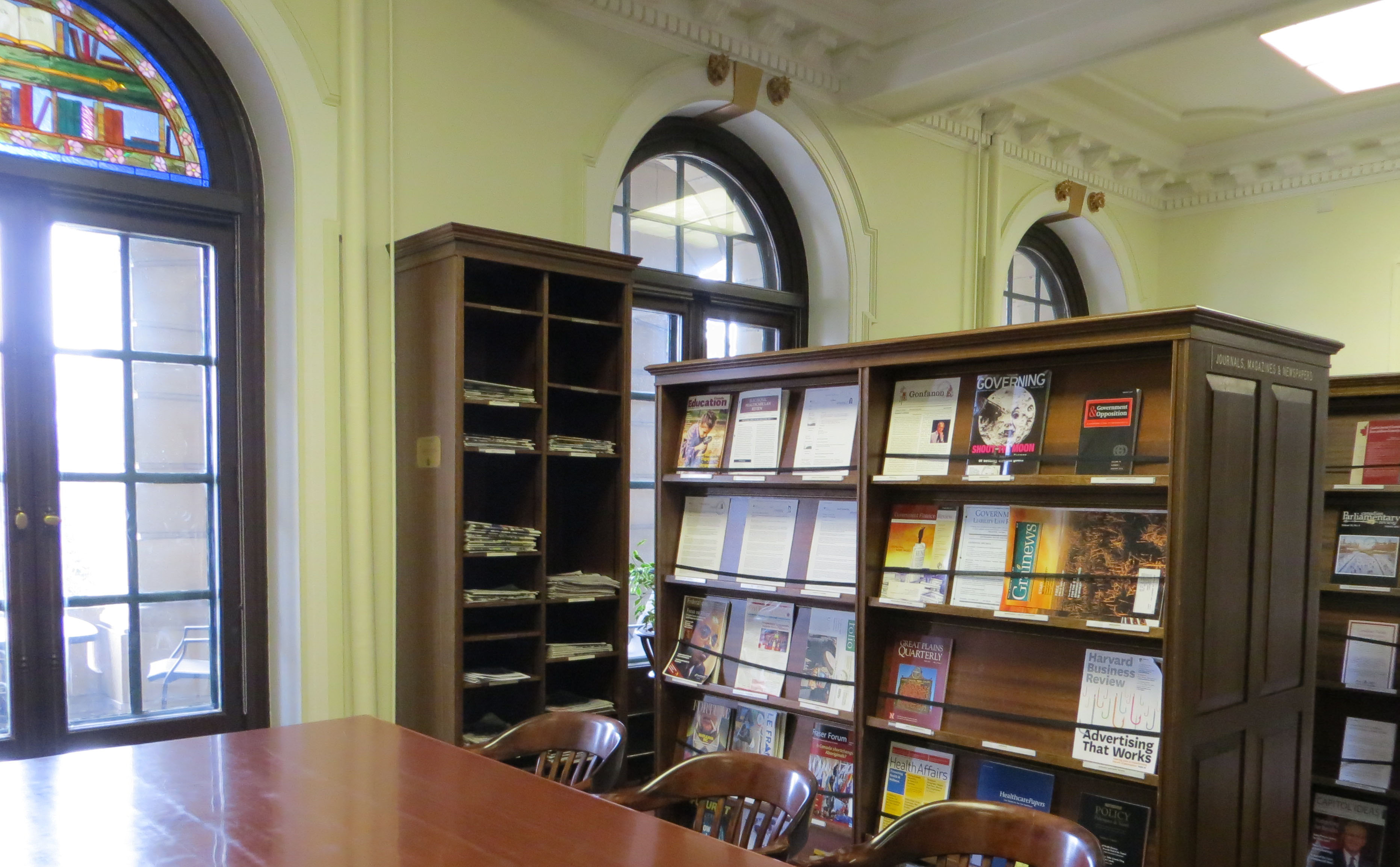
We ducked into the Library, a lovely room with tall windows, dark furniture and old IMG_0211 croppedfashioned stacks, but alas, no people.  Blame it on the Internet.  Then off to lunch at the Leg Cafe where a good-natured bear of a man told us where to find the best pizza in Calgary.

The Visitors Gallery

David dropped me at Security next to the Visitors Gallery.  I relinquished my briefcase and purse but they had to prise my cell phone out of my hand.  Then it was off to the metal detector.  Odd that the metal detector is on the second floor, giving disgruntled Albertans armed with tomatoes free access to the MLAs just outside the Assembly Hall.    

I took my place the front row and after Laurie’s delightful introduction, listened while the oldest opposition MLA in the Leg introduced the lady sitting beside me—Dr PearlAnn Reichwein,* a university professor deeply concerned about the changes being inflicted on Alberta’s 26 institutions of higher learning.

Following the introductions, the Assembly moved to the best part of the agenda—Question Period!

Question Period

Question Period is a blood sport.  TV doesn’t do it justice.   The opposition parties were in fine form, badgering the government over revoking veterans’ hospital parking passes, delisting generic drugs without providing replacements, the carbon tax (or lack thereof) and insufficient post secondary funding.

The government responded with excuses and platitudes, demonizing the opposition as the “extreme left” and “extreme right”.  Meaning that the PCs are the “moderate centre”?

And so it went, the opposition baiting the PCs and thumping their desks in appreciation of each other’s questions, the PC ministers rising one by one, like lumbering bears, trying to defend policy decisions that defy explanation.  At one point the opposition gaffawed so loudly that the Speaker scolded everyone.  Decorum broke out…for all of 2 minutes.  God, I love Question Period.

Reflections on the Red Arrow

Tucked into the back of the motor coach, watching the safety video narrated by my passenger service representative, I reflected on the day.

The PC dynasty is crumbling.**Only a miracle will save it now.  The Wildrose will likely form the next government.  The big question is whether it will be a minority or majority government.

IMG_0228This is where you come in.  Do you want to balance a Wildrose government with a progressive option?  Then contact your favourite progressive MLA and find out what you can do to help out now.  Ask to meet with caucus.  If they truly want to serve Albertans, they’ll find a way to accommodate your request.

*In one of those Casablanca moments (“Of all the gin joints in all the towns in all the world, she walks into mine”) I discovered that PearlAnn was the daughter of a friend I’d met through the Whitemud Citizens for Public Health.  Pure serendipity. 

**Here’s a great Youtube video that sums up Albertans’ frustration with the PCs:  http://www.youtube.com/watch?v=IPlo1nNJGyE&sns=em

Posted in Politics and Government | Tagged , , , , , | 8 Comments