
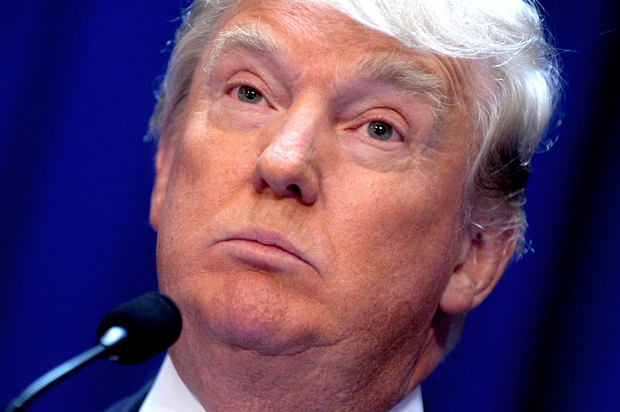
We’re so focused on Donald Trump’s race-baiting rhetoric that we’ve almost forgotten that if elected this man will have the nuclear codes at the tips of his stubby little fingers.
This is a serious concern for 50 Republican security officials who signed a letter saying Trump does not have the temperament to be president and commander in chief.
The former heads of the CIA, NSA, Homeland Security and countless other agencies say Trump can’t tell the difference between truth and falsehood, doesn’t encourage conflicting views, lacks self-control, is impetuous and can’t tolerate personal criticism. They say “all of these are dangerous qualities in an individual who aspires to be president and commander in chief, with command of the US nuclear arsenal.”
No kidding!
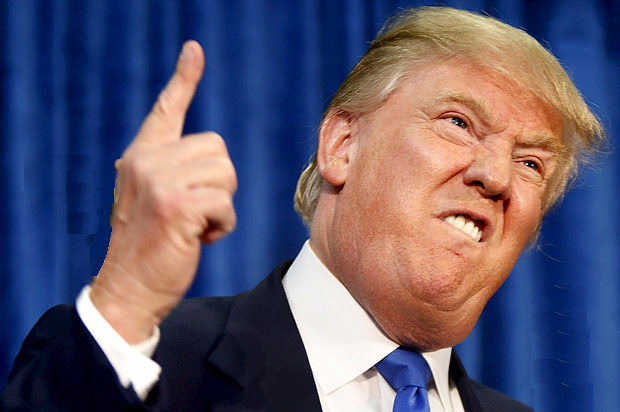
Donald Trump’s stubby little finger
And yet some military advisors downplay the concern. They’re confident that the “institutions” surrounding the presidency will prevent a lunatic president from lobbing 925 nuclear warheads at a real or perceived enemy.
Institutions
Thomas Karako, a senior fellow with the International Security Program and Missile Defense Project at the Center for Strategic and International Studies, says Americans (indeed the world) should have faith in the institutions that are “larger than any man or women” who occupies the Oval Office.
What institutions?
The President does not need the approval of Congress to order a nuclear strike. The only “institutions” standing between him and the metaphorical Big Red Button are the Secretary of Defense and the Chairman of the Joint Chiefs of Staff.
Both of these individuals are appointed by the President.
The chain of command goes from the President to the Secretary of Defense to the Chairman of the Joint Chiefs of Staff. The Secretary of Defense can authentic a nuclear strike order but he can’t veto it.
No need to worry says Thomas Karako. The military (ie. the Chairman of the Joint Chiefs of Staff) is not obligated to carry out an order unless it is lawfully given.
Lawful orders
One of the many principals established at the Nuremberg trials was that military personnel have a duty to refuse to carry out illegal orders.
This, like many lofty principles, turned to dust 22 years later at My Lai, Vietnam.
On Mar 16, 1968, Second Lieutenant William Calley led the men of Charlie Company on a sweep through several hamlets searching for enemy soldiers. They came upon elderly men, women and children preparing for market day and slaughtered them—before and after a lunch break. An estimated 350 to 500 civilians were murdered.
Many of Calley’s men said they were just following orders.
However Huey helicopter pilot Warrant Officer Hugh Thompson and his crew refused.
Thompson landed his helicopter three times to stop the carnage. The first time he confronted Lieutenant Calley who refused to back down. The second time he landed his helicopter between the soldiers and Vietnamese civilians to block the soldiers’ line of fire and pick up the wounded. The third time he plucked a small child out of a ditch.
Thompson reported what he’d seen up the chain of command and received a medal. He also received death threats and dead animals on his lawn from soldiers who said he was disloyal.
The massacre was only fully investigated after another soldier, Specialist Ronald Ridenhour, wrote to 30 members of Congress—all but three ignored his letter.
The duty to disobey an unlawful order was overridden in the field by the duty to follow orders and not rat on your fellow soldiers.
Catch 22
Do “institutions” have more integrity then men in battle?
Under Thomas Karako’s scenario if a lunatic president gives a nuclear strike order, the Secretary of Defense and the Chairman of the Joint Chiefs of Staff will assess its lawfulness.
If the Secretary of Defense decides the order is illegal he can resign and the decision will fall to his second-in-command and so on down the line.
If someone lower down in the food chain cracks and relays the order to the Chairman of the Joint Chiefs of Staff the Chairman will have a few minutes to mull it over. If he decides the order is “unlawful” he can raise his concern up the chain of command, not to the Secretary of State who just quit but the lunatic president himself.
It’s the perfect Catch 22.
But all this is moot. If the president believes he’s protecting the US against an actual or imminent attack and orders a nuclear strike, he’s made a constitutional order. The military must obey or stage a military coup.
A piece of advice
John Noonan is a Republican, a former Air Force missile launch officer and national security adviser to two Republican presidential campaigns. He says instead of worrying about whether an attack on the US is real or Trump is grandstanding Americans should ensure he doesn’t assume power.
Excellent advice. Because when Trump says the military is “not gonna refuse me” he’s probably right.
Sources: Military Ethics Course offered by FutureLearn
http://www.vox.com/platform/amp/2016/8/3/12367996/donald-trump-nuclear-codes
http://www.nytimes.com/2016/08/05/science/donald-trump-nuclear-codes.html?_r=1










 Susan on the Soapbox