What Would It Take to Make you Plead Guilty? Alberta Revamps Traffic Court

What would it take to make you plead guilty to a crime you didn’t commit?  One hundred dollars?  One thousand dollars?  Need more information?

Okay, what if the crime isn’t serious?  And if you plead guilty you can avoid the hassle of driving downtown, parking in an expensive lot, going through airport-style security and lollygagging around in the court house waiting to file your not guilty plea?  Still not sure?

Well how about this?  If you exercise your right to plead not guilty and the judge finds you guilty, your fine will double.  Does that make a difference?

You bet it does.  You’ve just been coerced into pleading guilty by the threat of extra punishment if you dare to plead not guilty.  And that, my friends, is a violation of a bedrock principle of criminal justice—the right to a fair trial.

The Justice Minister, Jonathan Denis, doesn’t see it this way.  In his mind this perversion of your right to a fair trial is nothing more than a “discount”; no different than paying a parking ticket early to save a few bucks.*

This is absolute nonsense.  A parking ticket is issued when you’ve overstayed your parking.  You know you’re guilty.  It’s simply a matter of when you’re going to pay the fine.  In the traffic court case, you think you might be innocent and you want to fight the charge.  But the Justice Minister is going to punish you if you got it wrong.

The underlying rationale

Mr Denis says he wants to save money and clear the gridlock in traffic court by moving traffic court out of downtown Calgary and Edmonton to who knows where.  He’s concerned about the poor schmucks who have to find their way downtown, pay for parking, fight their way through court house security and long queues in order to pay fines or enter not guilty pleas.  Wouldn’t it be lovely if Mr Denis’ colleague, Health Minister Horne, had the same desire to help us avoid the gridlock in the ER and the queues for surgery?  But I digress.

I’m all for saving money, but there’s only one reason to penalize Albertans for exercising their right to a fair trial and that’s to reduce the number of cases coming before a traffic court judge.  If you can reduce the number of cases you can reduce the number of judges, court rooms, prosecutors and administrators, sound familiar?

Charlie Pester, a former police officer who represents defendants in traffic court, is worried that the government will replace traffic court judges with administrative tribunals that aren’t bound by the rules of evidence.*

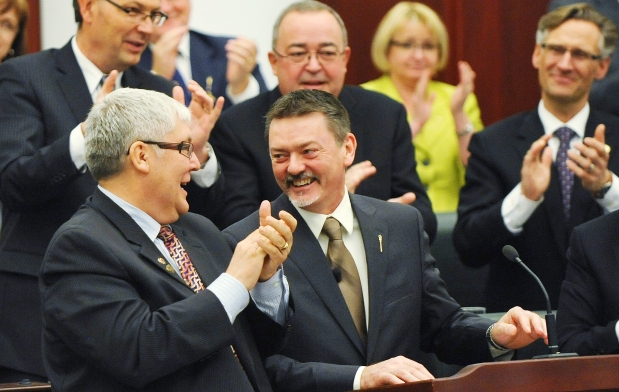
Wildrose MLA, Heather Forsythe is also concerned.  She asked the Justice Minister to confirm whether his ADM told traffic prosecutors that the government would reduce or eliminate traffic courts and traffic prosecutors.** He gave the classic lawyer’s response:  “…to the best of my knowledge there is no such plan being considered at this juncture”—which means that at tomorrow’s juncture, there may indeed be such a plan.

This isn’t a trivial concern.  The government can eliminate judges, prosecutors and defence counsel in a heartbeat by expanding the powers of the Alberta Traffic Safety Board, an administrative tribunal already in existence under the Traffic Safety Act.

A tempest in a teapot?

At this point you’re thinking, what’s the big deal?  This is traffic court! 

Right, and there’s the rub.  The Traffic Safety Act is a complex piece of legislation with over 200 sections that cross reference other statutes including the National Defence Act and the Criminal Code.  The Justice Minister says 218,000 criminal charges and 1.9 million traffic violations have issued under the Act.***

The Alberta Traffic Safety Board has tremendous power.  It can hold you in contempt or issue a bench warrant if you fail to show up (section 29).  Both will land you in jail.  It can suspend or permanently revoke your licence (s 30 and 31).  This can impair your ability to earn a living.

A factor the Board will consider when deciding whether to suspend or revoke your licence is your past conviction record (s 33) – that would be all those times you decided to plead guilty in order to avoid the hassle of driving downtown, parking in an expensive lot, getting through security and waiting in line to plead not guilty.

And depending on the charge you could face a fine of up to $25,000 and, if you fail to pay, 6 months in prison.  

Lastly, and most importantly, the Board’s decision is final and not subject to appeal (s 47).

Guilty is not always guilty

The Traffic Safety Act lets a judge (assuming he’s still there) find you innocent even if you’re guilty if you can show the offence couldn’t be avoided (s 161).  My daughter was ticketed for being in an intersection on a red light.  She couldn’t complete a left turn because a pedestrian steamed into the crosswalk against the “don’t walk” light.  My daughter disputed the offence before a traffic court judge.  Her evidence was the traffic camera photo that showed her car in the intersection and the pedestrian stopped dead in the cross walk yelling like a lunatic.  The judge found her not guilty.  Would my daughter have bothered to fight the charge and risk a substantially higher fine if she lost?

The Roman philosopher Seneca said “Every guilty person is his own hangman”.  What kind of Justice Minister coerces innocent Albertans into pleading guilty and hanging themselves simply to save a few bucks?

*Calgary Herald, Mar 20, A9

**Hansard, Mar 13, 2013, p 1548

***Hansard, Mar 18, 2013, p 1631

Posted in Crime and Justice, Politics and Government | Tagged , , , | 18 Comments

Alberta Health Services Executive Bonuses: The joy of friends in high places

Ogden Nash

To paraphrase Ogden Nash (actually Mr Nash did not utter this famous phrase, but for some reason we all think he did), “Spring has sprung, the grass is riz, I wonder where my bonus is?”

It is indeed bonus time.  Executives in the private sector watched their bonuses shrivel as the oil and gas industry slid into the abyss but the 100 or so senior executives at Alberta Health Services (AHS) can rest easy.  They’re being shielded from the “fiscal reality” plaguing the rest of us.  Their bonuses are intact.

It’s called “pay-at-risk” for a reason

Premier Redford and Health Minister Horne strongly “suggested” that the AHS cancel the executive bonuses this year, but Stephen Lockwood, Chairman of the AHS Board, refused.  He said it would be “unreasonable” to change compensation contracts after more than 90% of the fiscal year has passed.

“These people have already done the work and it would be wrong from many perspectives to not compensate them as per their terms of employment….We’ve already said that pay at risk is eliminated moving forward, but we are honouring our commitment for work that has already been completed.”*

Clearly Mr Lockwood is confused.  Whether or not an employee finishes 90% of the fiscal year is utterly irrelevant.  Unlike regular pay, “pay-at-risk” is not guaranteed and is not owed to an employee unless he meets specific “pay-at-risk” targets 

As my kids would say “That’s why it’s called “pay-at-risk, duh!

Have the AHS executives earned their “pay-at-risk”? 

Did the AHS executives meet their “pay-at-risk” targets?  Let’s start with Dr Chris Eagle, the CEO of Alberta Health Services.

Dr Eagle’s “pay-at-risk” targets include (1) providing a safe accessible healthcare delivery system (measured in reduced wait times in the ER and for hip, knee, heart and cataract surgeries and radiation therapy), (2) improving staff and physician engagement, (3) engaging with local Health Advisory Councils and (4) creating a new organizational structure.

In the real world, targets (3) and (4) are freebies.  “Engaging” local councils and “creating” a new org structure are in and of themselves pointless—what’s required is effective engagement and an effective org structure in order for these targets to count.

Back to the first two targets:  wait times and improving staff and physician engagement.  Dr Eagle missed all of his wait time targets—with the possible exception of treating and discharging patients from emergency within 4 hours—so the wait time targets are a “fail”.  Physician engagement is sitting at an abysmal 38%—so that’s another “fail”.  Consequently Dr Eagle’s “pay at risk” payout (excluding the two freebies) should be zero.

If Dr Eagle’s payout is zero then the payout for all his senior managers’ payouts will also be zero because Dr Eagle’s targets should cascade down and form part of the “pay-at-risk” targets of his senior managers.

That’s the way “pay-at-risk” compensation works in the private sector.  Unfortunately that’s not how “pay-at-risk” compensation works for the PC government.

Last year AHS paid its senior staff $2.4 million in bonuses; $480,000 of which went to the AHS executive team.  Dr Chris Eagle met just 63% of his targets and walked away with an extra $90,000 on top of his $580,000 salary.** 

In any other organization, a university for example, 63% gets you a “D”.  Only in government is a “D” worth $90,000.

But what’s really alarming is that in the real world Dr Eagle’s targets (reducing wait times, engaging with physicians) would be part of his day job for which he gets paid a $580,000 salary.  Rethinking Alberta’s healthcare delivery system, eliminating physician bullying and stopping queue jumping—now that would be a legitimate “pay-at-risk” target.

Is “pay-at-risk” a term of employment?

When AHS Chairman Lockwood refers to abiding by “terms of employment” and “honouring our commitment” he implies it would be unfair or even illegal to eliminate “pay-at-risk” for this fiscal period.

While it’s true that “pay-at-risk” is a term of employment, this sudden desire to do the right thing rings hollow given that other AHS employees are not afforded the same “commitment”.  Mr Lockwood appears to be just fine with the AHS decision to fire healthcare workers and reduce the hours of their overburdened colleagues, notwithstanding the terms of their employment.

But the ultimate hypocrisy comes from the lips of Health Minister Horne who said “Regardless of how people feel about the decision of the AHS board…It’s a decision for the AHS board…I don’t have the authority to interfere with someone’s contract of employment.”***

Recall that the last Health Minister fired Dr Eagle’s predecessor over the objections of the AHS Board.  This Health Minister ran roughshod over at least three (count ‘em, three) agreements in principle he’d signed with the Alberta Medical Association.  He’s arbitrarily reduced doctors’ compensation by $275 million and has repeatedly misled the AMA in the last year of contract negotiations.****

And now Minister Horne has had a fit of conscience…?

*Calgary Herald Online Mar 27, 2013

**Calgary Herald, Mar 29, 2013, A10 

***Calgary Herald, Mar 28, 2013, A4

****AMA President’s Letter to Premier Redford Mar 22, 2013  http://bit.ly/165g8lT


Posted in Alberta Health Care, Politics and Government | Tagged , , , , , , | 19 Comments

The Price of Justice in Alberta: One Free Crime

On March 17, 2013, Alison Redford’s PC government broke the back of justice…and none of us saw it coming.

English: Frankfurt on the Main: Gerechtigkeits...

Lady Justice, or Justitia, is the personification of the justice system.  Her blindfold symbolizes objectivity, her scales symbolize the balance between truth and fairness and her double-edged sword demonstrates that reason and justice that can be wielded for or against a party.

But this isn’t enough for Ms Redford and her justice minister, Mr Denis.  They’ve saddled Justitia with a new prop—an empty sack—which the goddess must now fill with money.  The only way Justitia can fill the sack is to throw away her scales and double-edged sword. But she’d better keep her blindfold.  She won’t want to see the injustice that will be perpetrated in the name of  “streamlining” the administration of justice and ”rehabilitating” less dangerous offenders.

At this point you’re thinking; Ms Soapbox has well and truly lost it.  But stick with me and I’ll walk you through this.  

“One Free Crime” Or A Gross Miscarriage of Justice?

Yes, the Wildrose “One Free Crime” coupons were extreme (ya think?) and yes, the PCs demanded an apology, but there’s no getting around the fact that the PCs are pushing a plan not to prosecute first and second time offenders who commit “less serious” crimes.

So what’s a “less serious” crime Mr Justice Minister?  “We’re talking shoplifting, we’re talking things like vandalism, typically young people, typically as their first offence.”* 

Okay, let’s talk shoplifting.  Shoplifting is a criminal offence, it’s not a traffic violation.   If the accused, say a teenage girl, is arrested, she’s taken to the police station, searched, fingerprinted and photographed.  She’s given a court date; and if the prosecutor proves beyond a reasonable doubt that she committed the crime, she’s convicted.

The judge uses his discretion to fit the punishment to the girl’s circumstances.  Is she a first time offender?  A repeat offender who shows no remorse?  And so on.  He can impose a penalty ranging from an absolute discharge, to alternative measures like a rehabilitation program or community service, to a fine or jail time.  If the girl is lucky and gets a discharge she’ll avoid a criminal record.  If not, she’ll be barred from certain jobs and from travelling to certain countries.

In other words, shoplifting is a big deal and a teenager just might think twice before swanning into a Shopper’s Drug Mart with her little pals to swipe a tube of lipstick.

But the Justice Minister sees the situation differently.  Instead of prosecuting these first and second time offenders he wants to put them into “rehabilitation programs”.

And there’s the essence of the problem—in order to make his plan work the Justice Minister has to run roughshod over Lady Justice.       

The Justice Minister’s “Solution”

Pause for a second to consider how the Justice Minister’s plan will work on the ground:

One: a shopkeeper catches a teenager with a tube of lipstick in her pocket and calls the police.

Two: a police officer shows up and needs to figure out whether the girl is an “offender”.  This means that the officer must decide whether the girl is guilty of shoplifting and a decision normally made by a judge just fell into the hands of a police officer. 

Three: the officer must determine whether this is the girl’s first or second “offence”.   The only way to be sure that the girl isn’t lying about whether she’s ever done this before is to create a province-wide registry of teenagers who’ve been accused of shoplifting but who have not been charged by the police (no privacy concerns there).

Four: After the officer checks the yet-to-be-created registry and determines that this is the girl’s second offence he must decide whether to charge her or let her go.

Five: the girl knows that she might be able to sweet-talk the officer into letting her go and does whatever she thinks is necessary to make her case.

Six: if the girl talks the officer out of formally charging her with shoplifting the officer will trigger the rehabilitation process and force the girl to attend a rehabilitation program.

Seven: this is a “good result” because it “rehabilitates” the girl who knows that she has one more “free pass”.

Eight:  the shopkeeper’s respect for Alberta’s judicial system knows no bounds (yeah, that was pushing it).

What’s really behind the “One Free Crime” plan? 

The Wildrose argue the PCs are “soft on crime” but I have a more cynical view.  The PCs are simply doing what they always do.  They’re taking care of corporate Alberta at the expense of everyone else.  Last week the doctors got it in the neck.  This week it’s the criminal justice system.

The PCs have not set aside enough revenue in the provincial budget to pay for the police, prosecutors, courtrooms, administrators and judges, let alone construct the prisons required to handle a population that’s increasing by 100,000 a year.

So instead of living up to their Safe Communities promise which stated “It’s time to reinforce existing laws, introduce new ones to tackle pressing issues and make sure the courts are dealing with offenders quickly and appropriately” and developing a long term crime reduction and prevention strategy, the PCs have chosen to tear the criminal justice system apart by decriminalizing “offenses” (until they’ve been committed at least once before) and giving the police and bureaucrats the power to “convict” citizens and send them into rehabilitation.

Take another look at Justitia.  Her gown is shredded, her scales are bent and her sword is broken.  She’s hanging her head in shame.  We must protect her.  Please write to the Premier, the Justice Minister, the opposition party leaders and your MLA.  Tell them that the One Free Crime plan is a travesty of justice and must be stopped.

*Global News Online Mar 12, 2013 

**Keeping Communities Safe, Three year Progress Report 2008-2011, p 5


Posted in Crime and Justice, Politics and Government | Tagged , , , | 7 Comments

Redford’s Keystone Ad in the New York Times: The St Patrick’s Day Blunder

So it’s come to this has it?  Premier Redford has officially abdicated responsibility for the Canadian natural resource strategy to her communications director, Stefan Baranski, who persuaded Ms Redford to place an ad in today’s New York Times.  

The ad, entitled Keystone XL: The Choice of Reason, was meant to counter the Times “just say no” editorial that urged President Obama to reject the Keystone XL pipeline*.

The Times’ position in a nutshell was this:  A president who has repeatedly identified climate change as one of humanity’s most pressing dangers cannot in good conscience approve a project that — even by the State Department’s most cautious calculations — can only add to the problem.*

Mr Baranski advised Ms Redford to go with the Keystone ad after the Times turned down the government’s request for a guest column similar to the one Ms Redford posted in USA Today. 

This is an extremely risky move on Ms Redford’s part—and that’s why pipeline and oilsands executives who woke up this morning expecting to celebrate St Paddy’s day with green eggs and ham are on their blackberries instructing their communications departments to prepare a statement in case the media calls for a reaction.

The ad was a really bad idea.  Here’s why:

One:  The ad will not persuade the Times to soften its position.  The fact that the only way Ms Redford could get the government’s position into the Times was through a paid ad proves that this issue is no longer open for debate as far as the Times is concerned.

Two:  The ad is pitched to the wrong audience.  Rather than changing the minds of Times readers, it gives the 346 readers who commented on the Times editorial another kick at the can.

Three: The ad is a sanctimonious mishmash that is both offensive and patronizing to Americans and Albertans alike.  Its headline: Keystone XL: The Choice of Reason implies that those who oppose the pipeline are unreasonable (I’ll give Mr Baraski credit for resisting the urge to call them “demonizers”—a term used by pipeline supporters to trivialize those who dare voice an opinion contrary to their own).

Four:  It refers to Alberta’s strong environmental policy, ignoring the fact that Alberta has seriously undershot its annual greenhouse gas emissions targets and is allowing oilsands producers to proceed with 27 high-risk and experimental end-pit lakes in the Athabasca boreal region.**

Five: It lauds Alberta’s development of clean technology but sidesteps the elephant in the room—coal, not hydro or natural gas, generates over 70% of Alberta’s energy.

Six:  It hits a quasi jingoistic note by urging Americans to buy from a “neighbor, ally, friend” and not “unstable foreign regimes”, while blithely ignoring the fact that the Redford government vigorously supported the CNOOC takeover of Nexen notwithstanding the US government’s reservations.

Seven:  The Redford government wraps itself in the American flag by highlighting pipeline-related job opportunities for the middle class (did you get that Mr President, we like the middle class) and returning war veterans (that one made my dad, a WW2 war veteran, laugh out loud).

The Keystone ad is a really bad idea because instead of communicating the right message (whatever that may be) to the right audience (US senators, congressman, and regulators) it has communicated a half-baked message to the wrong audience.

As a result, people will re-read the Times editorial, the 346 commentators and their friends will have another opportunity to voice their concerns, and the oilsands producers and TCPL, the owner of the Keystone pipeline, will hunker down in their glass towers waiting for the all-clear siren to sound.

Keystone XL demonstration, White House,8-23-20...

Keystone XL demonstration, White House,8-23-2011 Photo Credit: Josh Lopez (Photo credit: Wikipedia)

It’s the government’s job to develop a natural resource strategy and use the tools it has at its disposal—the ability to make laws and to form critical relationships with other federal, provincial and state governments—for the benefit its citizens.  These tools help grease the wheels of commerce.  As an aside, a good government will balance the benefit of greasy wheels for some against the cost of greasy wheels for all.

It is not the government’s job to stamp its tiny foot in a fit of pique and run an ad in a newspaper when the editorial board refuses to let it run a guest column.  The “so there!” strategy may make Mr Baraski amd Ms Redford feel better for a nanosecond but it does nothing to serve the greater interests of the people of Alberta.

*http://www.nytimes.com/2013/03/11/opinion/when-to-say-no-to-the-keystone-xl.html?_r=1&

**Pembina Institute quoted in Daily Oil Bulletin, Mar 14, 2013

Posted in Energy & Natural Resources, Politics and Government | Tagged , , , , , | 8 Comments

Budget 2013 (If you want to play with the Big Boys, you play by Big Boy Rules)

 Opening new markets across Canada and around the world has become job one for this government.”—Finance Minister Horner on the 2013 Budget priorities, Alberta Hansard p1440.

That simple sentence tells you all you need to know about Budget 2013 and how your tax dollars are going to be spent in the coming years.  What it doesn’t explain is why the government thinks that it’s in the oil and gas business.

But I’m getting ahead of myself.

On March 7, 2013 I dragged myself out of bed                                                                            (I had the flu) to watch Finance Minister Government deliriously happy Horner deliver the “transformational” budget.  What I saw was Mr Horner unfurling a baffling budget that would plunge Alberta into debt and the PC caucus go all dewy-eyed as he invoked the legacy of Peter Lougheed (really guys, this is wearing a little thin).

Mr Horner set out three priorities:*

  1. Investing in Alberta families and communities by investing in schools, health facilities and roads.  Isn’t that their job?  They weren’t planning on investing in BC families and communities by any chance were they?   
  2. Ensuring that the government lives within its means by “challenging every dollar this government spends.” That’s definitely their job.  I’d hardly expect a budget priority that said we’ll waste the taxpayers’ money at every opportunity.    
  3. Ensuring that Alberta’s resources—food, technology and especially oil and gas, get to market for the highest possible price.  A glimmer of hope for agriculture and technology that sputtered and died under Mr Horner’s relentless focus on oil and gas and his pitiful defense of the government’s forecasting fiasco of 2012.        

The PCs were deliriously happy with Mr Horner’s brilliant speech.  The rest of us were stunned.

Budget 2013 is all about the coddling the oil and gas industry—at the expense of the young, the old, and the sick and those who educate and care for them.  The government is under the delusion that it is capable of playing with the Big Boys instead of being played by them.

Big Boy Rules

Given that the government doesn’t own oil and gas, or the companies that extract it, or the companies that transport it, it’s impossible for the government to achieve its #1 priority—getting our natural resources to markets for the highest possible price.  That’s industry’s job, not the government’s.  But pause for a moment to consider what would happen if government pulled on its Big Boy pants and played by Big Boy rules.

First Rule:  Deliver Results

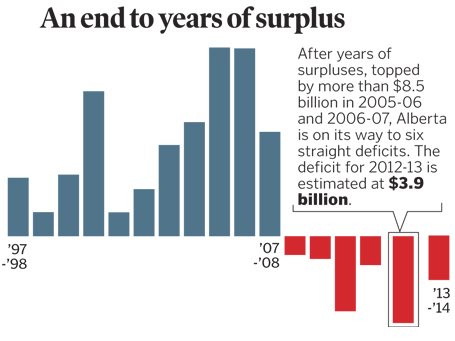
Big Boys deliver consistent results or die.  Consider this government’s tBudget 2013 Bar Chartrack record.

If the government were a business its shares would be in the tank and it would have been ousted by its shareholders in 2011.  ’Nuff said. 

Second Rule: Develop A Robust Business Strategy

The only way an executive leadership team (the Premier and Cabinet in this case) could possibly hold on to their jobs with its appalling track record would be to come up with a creative new business model—a transformationalbudget might do the trick.

Ms Redford hasn’t proposed a new tax structure or a new royalty structure or a new anything (other than debt), so what’s her strategy?

Are you ready for this—it’s hope!  In the words of renowned economist Jack Mintz:  “There is really no plan in this budget except for hope—hope that prices come back and they have money coming back in.”**

Third Rule:  Don’t Do Something Stupid

When times get tough (say for example you’re sitting on a $2 billion deficit when you promised to break even) an executive leadership team has to resist the urge to do something really stupid while it’s waiting for the markets to rebound.

Ms Redford and her team must have missed the memo.  They’ve decided that the only way to avoid drowning in the rising deficit is to take on more debt—something in the $8 to $12 billion range.  They say this makes sense because interest rates are low.

To which Mr Mintz replies:  “There’s no such thing as a free lunch.  A province like Alberta should not be taking on gross debt”.*** Period.

Fourth Rule: Be Honest With Your Shareholders—especially when times are tough

Big Boys have to disclose the financial health of their businesses in clear, unambiguous language.  It’s the law.   Failure to do so results in fines to the company and jail time for its executives.

Budget 2013 is a marvel of opacity.  Instead of presenting one budget Mr Horner presented three:  an operating budget, a capital budget and a savings budget.  This obscures the total amount of the deficit and the only way to figure it out is to ask (good luck with that).  The government says the all-in deficit is $2 billion.  The opposition parties put it closer to $5 billion.

That’s a material difference and enough to invoke the ire of the securities commissions in the Big Boy world, but not in the world of politics.

A Transformational Budget

A truly transformational budget would have restructured the revenue model instead of saddling Albertans with billions in debt.  It would have eliminated government waste and corporate welfare and made the Big Boys pay their fair share of taxes and royalties.

It would have provided a framework for fair negotiations with public servants instead of drawing a line in the sand and daring the doctors, nurses, and teachers to cross it.

It would have provided incentives to diversify our economy.  It would have encouraged curiosity-driven education to underpin non-resource based businesses, instead of forcing universities and colleges to push a curriculum that feeds the oil and gas industry.  Above all it would not put the interests of the oil and gas Big Boys over that of Albertans.

A transformational budget needs political courage—something this government sadly lacks.

Ottawa entrepreneur John Kelly said it best:  “When the horse is dead.  Dismount”.   The PC horse is dead, luckily there are a number of horses waiting in the paddock—pick one and ride!

*Hansard, p1439

**Calgary Herald Mar 8, 2013, D1 

***Calgary Herald, Mar 8, 2013, A3 

Posted in Politics and Government | Tagged , , , , | 16 Comments

*hack hack cough cough*

Susan on the Soapbox is sick.  Stay tuned.     

Professor Matthew Hay ... assailed by the furi...

Professor Matthew Hay … assailed by the furies of typhoid, measles, influenza, whooping cough and scarlet fever (Photo credit: Wikipedia)

Posted in Uncategorized | 14 Comments

And Now…A Message from your Premier-In-Waiting: Mr Lukaszuk

We interrupt our regular programming—the PC spin on the cause of the $4 billion budget shortfall—to bring you an important public service announcement from the Premier-In-Waiting, Mr Lukaszuk.

Mr Lukaszuk steps up to the microphone and says:    Listen up you pesky union types, and this includes all you doctors who aren’t in a union but who cares, from now on all collective bargaining will go through me.  Put that in your pipe and smoke it.

Thomas Lukaszuk, MLA Deputy Premier

Thomas Lukaszuk, MLA Deputy Premier (Photo credit: dave.cournoyer)

OK he wasn’t quite that blunt, but that was the gist of it.    

Last week Mr Lukaszuk announced that a newly created cabinet committee will analyse, scrutinize and negotiate every single collective bargaining agreement in the province.  A lead negotiator will be appointed soon.

Mr Lukaszuk gave four reasons for this bizarre move.  The Cabinet Bargaining Committee, chaired by Mr Lukaszuk of course, will: (1) provide a co-ordinated approach to offset changes in ministries and fluctuating conditions, (2) make the government’s costs more predictable, (3) make the government more prudent when it negotiates a settlement and (4) allow for “fairness” by “treating all public sector employees equally.”*   

They say the devil is in the details, but in this case the devil is in the broad strokes because Mr Lukaszuk’s rationale makes absolutely no sense.  Let’s break it down:

Co-ordination?  Yes there’s a sense of dislocation (and sometimes relief) when a minister leaves a ministry, but surely the institutional knowledge in that ministry, starting with the deputy minister and percolating all the way down to the mail room clerk, doesn’t vapourize with the defunct Minister.  Fluctuating conditions?  I’m not sure what this refers to but if it’s the impact of a healthy or weak economy on pay scales, what’s the Committee going to do about it?

Predictability?  Grafting the Cabinet Bargaining Committee onto the collective bargaining process does nothing to make the government’s costs more predictable.  A better approach would be to follow the private sector example–plan for contract negotiations at least a year in advance, identify the contentious issues, forecast the anticipated monetary impact and develop a game plan.  This is called a union strategy and it’s high time the government developed one. 

Prudency?  Frankly I have no idea what this means and would challenge the government to give us an example of an imprudent settlement.

Fairness and equality?    Fairness means free from discrimination or bias—does this mean that all unions will be treated the same?  Equality means being equal in quantity and amount—does this mean all increases will be the same?  Really???

How will the Committee evaluate and compare non-monetary demands like the Alberta Medical Association’s demand for joint decision making and the Alberta Teachers Association’s demand for a cap on teaching hours at 1200/year?

OK maybe that was too hard.  Let’s take an easier example.  How will the Committee equalize monetary demands?  Should all pay increases be the same, say 8.1%;  that would be consistent with the 8.1% pay increase the MLAs gave themselves recently.** Or if 8.1% is too high, Mr Lukaszuk’s Committee could roll back the MLAs’ increase as a gesture of good faith (stop laughing!). 

All this talk about co-ordination and prudency is PR puffery.  While Mr Lukaszuk is extolling the value of the Cabinet Bargaining Committee vetting every single collective agreement his colleague Jeff Johnson, the Education Minister, is urging the teachers to settle their contract in the next 10 days.  Either Mr Johnson is blithely unaware of Mr Lukaszuk’s edict that all settlements must run through the Committee or he doesn’t want to get bogged down in more red tape.

There is only one reason for Mr Lukaszuk’s Cabinet Bargaining Committee.  The Premier is in trouble.  She says the $4 billion budget deficit as a “spending” problem, not a “revenue” problem.  Since she’s not about to restructure her revenue model the only way she can reduce the deficit is to make deep cuts in the public sector.   And she doesn’t think her ministers are up to the task. 

She’s right about Health Minister Horne.  He’s botched the negotiations with the doctors so badly that the parties are barely on speaking terms.  Ms Redford is peering into the deficit gloom and sees the United Nurses of Alberta and the Alberta Union of Provincial Employees on the horizon.  These are well organized unions with very capable leaders.

Ms Redford is cornered and needs the Deputy Premier to knock a few heads together.  Mr Lukaszuk is in the catbird seat.  He knows that if he delivers the unions on a silver platter the word “Deputy” might drop from his job description and if he doesn’t, it was all Ms Redford’s fault.

Either way, it’s going to be a brutal year for Albertans.

*Calgary Herald, Feb 23, 2013, A4

**MLAs doubled their taxpayer-paid annual RRSP contribution from $11,485 to $22,331

Posted in Alberta Health Care, Economics, Education, Politics and Government | Tagged , , , , , , , , | 6 Comments

The “Tone at the Top” from two perspectives: Richard Nixon and the AHS

When Richard Nixon told David Frost than an illegal activity is not illegal “when the president does it” he confirmed what we’d all suspected: the “tone at the top” as far as the 37th President of the United States was concerned was hopelessly corrupt.

Richard Milhous Nixon, 37th President of the U...

Richard Milhous Nixon, 37th President of the United States (Photo credit: Wikipedia)

Most breaches of good governance are not as dramatic as Watergate, but the consequences of poor governance, even on a small scale, can be devastating.

Bearing that in mind, let’s turn our attention to the governance of Alberta Health Services (AHS).

The “tone at the top” at AHS struck a sour note last week when Albertans opened their newspapers and saw two contradictory headlines:  “AHS in forefront of health-care achievements”—a puff piece by the Chairman of the AHS Board rebutting allegations that AHS executives and managers were wasteful and inefficient and “Control expense gaps, auditor tells AHS”—a story about the Auditor General’s report on AHS’s sloppy governance practices.*

The Auditor General’s report focused on expense claims, travel claims and AHS corporate credit card expenses (P-cards).** The AHS ran up a whopping $100 million in the space of 17 months.  Even the Auditor General was “taken aback at how large the sum was.”* To be fair just a small percentage of this amount, not the entire $100 million, was improperly claimed or improperly recorded and paid out.

I don’t know what it is about auditors, but the Report is a dry slog (yes that was sarcasm).  It does however lead to some interesting conclusions.

High tolerance for a lack of controls and non-compliance

The AHS, a $12.6 billion corporation, has serious gaps in its financial controls process and doesn’t appear to be concerned about it.  These include:

–        ridiculously high limits on P-cards.  What could possibly justify a spending limit of $900,000 a year?  Is the executive buying an MRI facility?

English: The "C of Red" in Calgary p...

The “C of Red” in Calgary prior to game 3 of the Calgary Flames’ National Hockey League playoff series against the Chicago Blackhawks, in Calgary. (Photo credit: Wikipedia)

–        approving expenses without any business justification.  In 2011 and 2012 Carewest, a long term care facility, expensed 2 Calgary Flames season tickets and 275 Calgary Stampede admission tickets.  In 2012 it expensed 40 grandstand show passes and 10 rodeo tickets.  Carewest says the tickets were resold to staff and residents.  There is no supporting documentation.  The Auditor is investigating. (I should hope so!)

–        the misuse of P-cards to purchase capital assets like computers (so much for cost savings generated by centralized purchasing).

Centralization?      

The consolidation of the regional health regions into the AHS brought $3 billion in purchasing power under one roof.  This gave the AHS tremendous bargaining power.***

Too bad they don’t know how to use it.

AHS has yet to centralize travel to save costs on hotels, airlines and ground transportation.  It’s failed to set up a competitive bid process to find the most efficient way to transport patients.  And when it does use its bargaining power, AHS blunders into bad deals.  Here’s an example.

The AHS signed contracts with two large service providers that allowed them to charge $6.1 million in travel expenses without producing a single receipt to substantiate the cost.  Travel costs are paid as a percentage of the contract fee and there’s no mechanism to cap travel costs if they are excessive.  Anyone see an opportunity to pad the bill here?

$3 billion in purchasing power means nothing if you lack the skills to apply it properly.

Country Club Mentality

The senior executives at AHS are showered with perks—club memberships, allowances for personal, financial and tax advice, professional development and vehicle allowances.  These perks are unauditable because the financial audit group has no way to check whether the allowance limits have been exceeded.  Why?

Where is the Chairman of the Board of Directors?

So how did Mr Lockwood respond to the Auditor General’s report?  He didn’t.  Instead he popped up in the press with a two pronged message.

He defended the need for 81 senior executives at AHS.  They “put in long hours, days and nights keeping a complex health system on track”.  Join the club!  The rest of us also put in long hours, days and nights doing our jobs.  And we do it in environments that demand a higher degree of rigor, accountability and dare I say it, integrity, than the AHS.

He pointed to an “improved rate for patient satisfaction”… without mentioning that it had only gone up by 2% (it’s now 64%) and is described as “relatively unchanged from 2010” by the Health Quality Council of Alberta who conducted the survey.****

This is a disappointing response.  The AHS has staggered from scandal to scandal since it was created in 2008.  Instead of being defensive or glossing over problems, it’s time to call the Board of Directors and Chairman Lockwood to account.  They govern the AHS.  It’s up to them to set the “tone at the top”.

The “tone” must ring with accountability and integrity.  The health and well being of all Albertans depends on it.

*Calgary Herald, Feb 13, 2013, A3 and A15

**Report of the Auditor General of Alberta Feb 2013

***Speech by Ken Hughes, then Chairman of the AHS Board, to Calgary Chamber of Commerce, March 2011

****Satisfaction and Experience with Health Care Services.  A Survey of Albertans 2012

Posted in Alberta Health Care, Uncategorized | Tagged , , , , | 11 Comments

Who do you trust? Premier Redford or Alberta’s Doctors?

“How can you trust a man who wears both a belt and suspenders?  The man can’t even trust his own pants.”—a line from the spaghetti western Once Upon a Time in the West.

once_upon_a_time_in_the_westIf the government’s attacks on Alberta’s doctors are any indication, anyone up for contract renewal this year will have a more luck trusting their own pants than trusting the government to negotiate in good faith.

(Non)Negotiations with the doctors  

A quick recap, negotiations have dragged on since Mar 2011. You’re forgiven if you lost track of all this, it’s been almost 2 years. 

By Nov 2012 the government had signed and discarded two “agreements in principle”.  Then Health Minister Horne surprised everyone with his “best offer”.   It reflected the “value” the government placed on the doctors and Alberta’s “fiscal reality”;  which at that time was a distant rumble on the horizon.  The $6 billion bitumen bubble had not yet sprung from the fertile imagination of Ms Redford’s speech writer.

What Mr Horne failed to say was that the “offer” was an edict with no input from the doctors and stripped out the very thing the doctors had been fighting for—the right to participate in decision making.

Mr Horne’s “offer” coincided with the kick-off of the government’s “blame-the-doctors, shame-the-doctors” campaign,*a concerted effort to discredit Alberta’s doctors by flooding the media with misinformation.

Twisting the “facts” to divide and conquer

The Premier’s and Health Minister’s statements might, in another context, be considered unfair practices.  They include:

  • The “best offer” is around $181 million, oh and by the way Alberta doctors are paid 20% to 29% more than the rest of Canada’s doctors  (not true, they are paid 14% more and guess what, so are the rest of us)
  • In order to meet the doctors’ demands we’d have to resurrect the healthcare premium.  (This is killing a fly with a sledge hammer because it would bring in an extra $1 billion in revenue to cover the doctors’ $50 to $60 million inflation increase).

The doctors reacted as one would expect.  They reached out to Albertans with summits on key issues like Redford’s plan to replace Primary Care Networks with Family Care Clinics at five times the cost.  Meanwhile Dr Giuffre, president of the AMA, challenged the premier’s misinformation with data from Stats Canada and CIHI.  The government lambasted the AMA for going to the press but the doctors refused to be swiftboated.

Who do we trust?   

How do we decide who to trust?  It’s easy.  Test the veracity of the doctors’ case by going to the AMA website.  Ask yourself:  does the statistical information make sense?

But what about Health Minister Horne?   We’re in luck.  We can test his honesty by reviewing the transcript of his evidence in the Preferential Access (Queue Jumping) Inquiry.  True, Mr Horne’s testimony relates to queue jumping not doctors contracts, but it’s enlightening not because of what he said but how he said it.  Giving evidence under oath is the ultimate litmus test.

The highlight is Mr Horne’s answers to questions about the “Duckett memo”; a memo prepared by the former CEO of Alberta Health Services in which he warned that queue jumping would no longer be tolerated.  The “Duckett memo” surfaced in 2011.  The media and the opposition parties had a field day.

English: Stephen Duckett, CEO, Alberta Health ...

Stephen Duckett,ex-CEO, Alberta Health Services (Photo credit: Wikipedia)

Mr Horne was asked a very broad question, was there “discussion within the ministry” of the memo.  Nope. (1504)**

Really?  This answer troubled Justice Vertes who asked (1520): ”Did I understand you correctly to say that there was no discussion about that Duckett memo when it arose in the media?”  “None that I was involved in, sir, in my capacity…”  Mr Horne was an MLA with additional duties as a parliamentary assistant to the Health Minister but what does that have to do with anything?    

Justice Vertes found Mr Horne’s answer “somewhat surprising”.  He said he’d have thought that the accusations “would have been quite the topic of conversation” within the health ministry.

Finally Mr Horne buckled. “Okay.  I’m sorry, I thought you meant sort of like a formal discussion in association with my role, so no But, you know, in terms of general discussion about—about it with people, yes.  Certainly people were talking about the memo.” (1520-21)

Hallelujah!  The truth at last.  After evading the question twice, Mr Horne was forced to admit that yes, there had been discussion about the Duckett memo, he’d just sorta misunderstood the question (Oh you’re asking whether there was any water-cooler talk, not whether I had a formal discussion in association with my role as parliamentary assistant to the health minister).  Good grief, this isn’t the Watergate inquiry.

So do I trust the politician who “misunderstands” a question (twice) in order to avoid answering it or the doctors who publish statistical data on an open website?  Three guesses.

What does this say about leadership?

Good leaders lead by creating consensus and alignment, not conflict and animosity.  The premier’s “blame the doctors, shame the doctors” strategy turned the AMA contract negotiation into a personal attack on the doctors leading to a “I win/you lose” outcome.

It signals what we can expect from this government in the coming year.  Crush the doctors, and the nurses, teachers, and public servants will fall into line.  We’ll still have a $6 billion hole in our revenues, Albertans will learn to live with substandard healthcare, education and infrastructure, but corporations can rest assured that their tax and royalty structures will not be touched.

To paraphrase Sophocles, trust dies but mistrust blossoms…it’s great for the lawyers but it’s no way to run the richest province in Canada.

*AMA President’s Letter Feb 6, 2013

**All page references from the Hearing Transcripts

—Health Services Preferential Access Inquiry

Posted in Alberta Health Care, Politics and Government, Uncategorized | Tagged , , , , , | 8 Comments

Zen and the Art of Political Corruption

Aurelio Zen is a Venetian policeman headquartered in Rome.  His reputation for integrity is a serious handicap to promotion within a treacherous political environment.  His creator, Michael Dibdin, uses the Zen series to illustrate the inequity of a corrupt society where moving ahead with anything depends on who you know and what you can do to further their ambitions.  The underlying theme—that corruption is acceptable and commonplace—is frightening to those without the power to pull in favours to achieve their goals.

Zen_titlecard

Opening Credits, courtesy of BBC

Right, let’s set aside Zen for a moment and turn to the latest Tory brouhaha—the Chief Electoral Officer’s finding that the PC party and some of its constituency associations violated the Election Finances and Contributions Disclosure Act 45 times since March 2010.

Section 35 of the Act makes it illegal for political parties to (1) accept direct contributions from a “prohibited corporation” (eg school boards, post secondary institutions, charities, provincial or municipal entities) or (2) accept indirect contributions from a prohibited corporation made by their employees and reimbursed by the corporation.

Of the 45 violations, 24 were direct contributions by a prohibited corporation and 21 were indirect contributions by employees of prohibited corporations.  In both cases tax dollars intended to fund a public entity were siphoned off into the Tory re-election war chest.   

The PC party is prepared to repay $17,000 in illegal direct contributions and has hinted that it may even voluntarily repay up to $100,000 in illegal contributions collected prior to Apr 2010, but it is bucking the Chief Electoral Officer’s ruling that it must return the illegal indirect contributions and wants those funds back.

Now here’s the part that would pique Zen’s interest.  The total amount of indirect contributions is only $6900!  An amount that pales in comparison to the $17,000 of illegal direct contributions let alone the $100,000 voluntary repayment.

What gives?

Kelley Charlebois, executive director of the PC party, says it’s a matter of principle (chortle, sorry, editorial guffaw). He argues that the PC party didn’t know that the $6900 came from illegal indirect contributions and therefore it’s up to the donor, not the party, to pay it back.

He appears to be relying is on “finders keepers” principle or perhaps the “possession is 9/10ths of the law” principle, as opposed to the “rule of law” set out in section 35 of the Act.  The only way Mr Charlebois can succeed with his argument is if he can show that the party did not know or ought not to have known that the contributions came from prohibited corporations.

As an aside, under corporate law even if a corporation did everything possible to prevent an act of fraud it still has to pay the fine and “disgorge” (a quaint legal word for “return”) the ill gotten gains.  So the gosh-I-didn’t-know-it-was-happening excuse doesn’t cut it.

If Zen were on the case his next step would be to interview the employees of the prohibited corporations to get their side of the story.

Bill Robertson, the Mayor of Okotoks, says municipalities knew they couldn’t make direct contributions to PC party events, but it was widely believed that it was OK to reimburse officials who attended party fundraisers.  “That was the way you lobbied your provincial counterparts. That was common practice.  That was what everybody did”.* 

English: Detail from Corrupt Legislation. Mura...

Detail from Corrupt Legislation. Mural by Elihu Vedder. Library of Congress

Larry Spilak, the Reeve of the MD of Foothills, is even more strident.  “Why are you going to the premier’s dinner?  You’re going to support your residents.  You’re going to have an opportunity to speak to the premier, to speak to the ministers about the issues in your area…public funds, but for the public good.  It’s a very necessary thing in my opinion.”* 

I see.  Instead of picking up the phone and setting up a meeting with Doug Griffiths the Minister of Municipal Affairs, it’s acceptable to take taxpayer dollars out of a public entity’s bank account for a PC fundraiser.  Furthermore, this fundraising/lobbying effort is “common practice” and a “necessary thing”.  At this point Zen would raise a skeptical eyebrow.

There is only one explanation for PC party’s fierce defense of its right to keep the $6900 in illegal indirect donations, and in the process throw some small time public officials under the bus—there’s one heck of a lot of money at stake.

Zen would now start looking for the wild card.  He’d focus on the yet-to-be-completed investigation of the $430,000 contribution from Mr Katz.  You’ll recall the PC party divided Mr Katz’s generous contribution into smaller contributions of $30,000 or less and identified them as separate donations from Mr Katz’ corporation and family members.

True, the $430,000 Katz donation doesn’t violate the law against accepting contributions from a “prohibited corporation” but it may well violate section 19(1) which prohibits the PCs from accepting a contribution they knew or ought to have known would exceed the legal limit on donations.  In this case the Chief Electoral Officer can make the PCs pay it back and that would be one heck of a hit to the bottom line!  

Zen has his own definition of corruption which gives him some latitude to fast track a buddy’s building permit (he is Italian after all) but Albertans live by a stricter definition—corruption is an impairment of integrity, virtue, or moral principle; this includes obeying the law.  Period.

One final point, if the concept of indirect contributions is so difficult to grasp then the Chief Electoral Officer would have uncovered violations not just on the part of the PC party but also by the Wildrose, the Liberals, the NDP, the Alberta Party and the Greens.  And yet, not one of the other parties or their constituency associations violated this prohibition.

I wonder what Detective Zen would make of that.

*Calgary Herald, Feb 2, 2013, A4

Posted in Politics, Politics and Government | Tagged , , , , , , | 12 Comments