
Suing the Catholic Church is like throwing Jello at the wall, it’s a mess but not much sticks.
Thousands of Canada’s First Nations, Metis, Inuit and Inuvialuit joined in a class action seeking compensation for the abuse they suffered in Canada’s residential schools.
On Nov 20, 2005, this class action was settled in the largest payout in Canadian history.
The federal government agreed to pay $1.9 billion to claimants who attended residential schools prior to Dec 31, 1997—and while $1.9 billion sounds like a lot of money it works out to about $24,000 per survivor. Survivors who suffered egregious abuse retained the right to make claims for additional compensation.
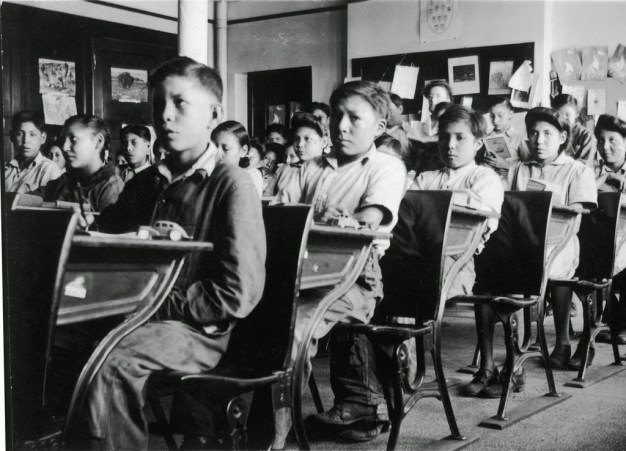
Children at a residential school
The feds also agreed to establish the Truth and Reconciliation Commission, endow the Aboriginal Healing Foundation and fund the commemoration of the “legacy of Indian Residential Schools”.
The Anglican, Catholic, United and Presbyterian churches agreed to a financial settlement. All but the Catholic Church fulfilled their part of the bargain.
The Catholic bargain
The Settlement Agreement obligated 50 Catholic entities to pay out $79 million as follows:
- $25 million in unspecified “in kind” services – the entities delivered the full $25 million
- $29 million in cash to be paid into the Aboriginal Healing Foundation – the entities delivered $27.4 million arguing that the remaining $1.6 million was eaten up by legal and administrative fees
- $25 million from a national fund raising campaign – the entities raised $3.7 million, $21.3 million is still owing
Bottom line: the Catholic entities agreed to pay $79 million. They paid $56.1 million. They’re $22.9 million short and there’s nothing anyone can do about it.
How did this happen?
The Catholic Church
The Catholic Church is the largest Christian institution in the world but does not exist as a legal entity.
It is led by the Pope, who takes his place in the hierarchy first set down by Jesus. The Pope is the head of the College of Bishops. The College of Bishops is made up of individual bishops who are responsible for a diocese. The diocese is made up of a number of parishes which are led by a priest.
(Certain bishops are elevated to the College of Cardinals who advise the Pope and select the Pope’s successor when he dies. This is a never ending source of intrigue for all concerned).
Brothers, nuns, hermits and friars live in communities organized according to Rome’s rules. They do God’s work and are not part of the official hierarchy.
As recently as 1997 God’s work included running residential schools.
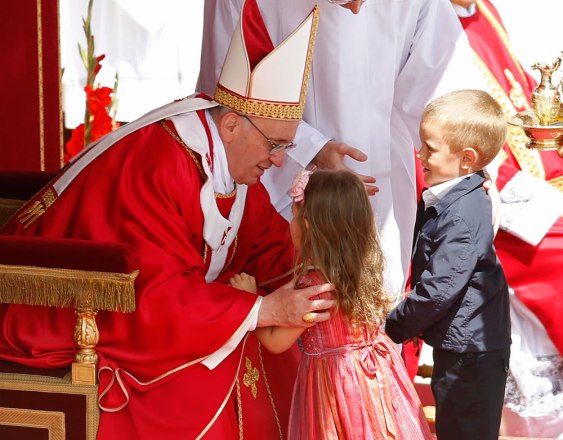
Pope Francis and the children
Given that the Catholic Church is not a legal entity the Settlement Agreement was signed by a hodge podge of incorporated and unincorporated entities including Episcopale corporations, bishops, dioceses, oblates (lay people and priest spreading the gospel) and nuns.
Other than delivering the required $25 million for “in kind” services, the Catholic entities fell far short of their financial obligations.
“Miscommunication” and “best efforts”
The federal government sued the Catholic entities to make them to cough up more cash. Along the way the feds made a mistake.
There was a “miscommunication” between the government and church lawyers which a Saskatchewan court said released the Catholic entities from their outstanding $56.1 million financial obligations in return for the payment of a paltry $1.2 million.
Lawyers for the survivors could argue that Catholic entities’ lawyer took unfair advantage of the government lawyer or that the government lawyer’s screw up should not bind the survivors.
Lawyers for the Catholic entities could argue they met their “best efforts” obligation to raise $25 million by running a professional Canada-wide fund raising campaign for seven years and even though it was a fiasco the Catholic Entities Church Agreement specifically states that not raising the $25 million, in and of itself, is not a default under the agreement.
Lawyers could argue a lot of things but that would simply reinforce the survivors’ view that the Catholic Church is not sincere about reconciliation.
Moral Imperative
William Gladdis said you get the law in this world and justice in the next.
The Catholic Church seems to agree with him.
The fact the Church acknowledged it harmed the children entrusted to its care and is now standing on its legal rights to avoid compensating the survivors is nothing short of tragic.
But the Church has one last chance to redeem itself.
Perry Bellegarde, the National Chief of the Assembly of First Nations, is going to ask the Pope to apologise for the Church’s role in residential schools and to rectify the Church’s failure to fix it.
Soon we shall find out whether the Pope will bring justice to the survivors in this world or make them wait until they reach the next one.
Sources:
http://www.residentialschoolsettlement.ca/settlement.html










 Susan on the Soapbox