Is this Premier Redford’s “Bill Clinton” Moment?

Last Wednesday Premier Redford defended herself against the Opposition’s allegation of conflict of interest with this bold statement: “I was not the Justice minister at the time that the government made that decision.”*

English: Monica Lewinsky, from her government ...

Monica Lewinsky ID, Secretary of Defense. (Photo credit: Wikipedia)

Some of us are wondering whether Ms Redford just painted herself into the same corner that Bill Clinton found himself in after his dalliance with Monica Lewinsky.    

It took less than 10 minutes for Ms Smith to set up the conflict of interest allegation and for Mr Anderson to spike it across the aisle.  It took less than 2 minutes for the Premier to explode.

Her display of righteous indignation did nothing to assuage the Opposition who’ve demanded an ethics investigation (with the NDP insisting that the Premier step down until it is completed).

What the heck happened?  Did the Wildrose fabricate a crisis or is there something seriously amiss with Ms Redford judgment?

Two Allegations of Misconduct     

The conflict of interest allegation rests on the argument that Ms Redford made the decision to award the Tobacco litigation case (legal fees expected to be $2 billion if the lawyers win or settle) to the JSS Barristers consortium.  JSS Barristers is a Calgary law firm that includes her ex-husband and political advisor, Robert Hawkes.

This allegation morphed into something more serious—that Ms Redford “misled” the House when she insisted that she did not make the decision to award the Tobacco litigation to JSS Barristers and that the decision was made by Verlyn Olson six months later.

A Litigator’s Perspective

This mess will be hashed out in the court of public opinion long before the Ethics Commissioner makes his ruling, so let’s analyse from a litigator’s perspective.  (Just give me a moment to slip into my barrister’s robe and charming horsehair wig.)

A litigator would ask the two questions:  Did Ms Redford make the decision to award the contract to JSS Barristers?   If the answer is yes we can move on to the second question—was her decision a conflict of interest?

Note:  If the answer to the first question is yes, the Premier has a serious credibility problem.  But if the answer is no, her credibility is intact, the allegation of conflict of interest is irrelevant and we can all go home.

A “Smoking Gun” memo

The Opposition is relying on a Dec 14, 2010 memo from Ms Redford, then Justice Minister, in which she refers to a committee’s assessment that all three of the law firms bidding for the Tobacco litigation contract would be up to the task.

Ms Redford says: “Considering the perceived conflicts of interest, actual conflicts of interest, the structure of the contingency arrangement and the importance of a “made in Alberta” litigation plan, the best choice for Alberta will be the International Tobacco Recovery Lawyers.”  The International Tobacco Recovery Lawyers consortium includes her ex-husband’s firm, JSS Barristers.

The Opposition says the memo is evidence that Ms Redford made the decision to award the contract on Dec 14, 2010.

Ms Redford vehemently disagrees, both in the House (see above) and in the media:  “I did not select any law firm…There was no decision…until well into June…I stand by what I said”.**

Unfortunately for Ms Redford the Justice Department disagrees:

  • A Justice Department briefing note from Jan 2011 says:  “Shortly before Christmas, Minister Redford selected the International Tobacco Recovery Lawyers”***  
  • Last Wednesday Justice Minister Denis said “There was a rigorous process it went through.  She did make the final sign-off on it.”****He later back-tracked: “[Ms Redford] agreed to begin negotiations, [Justice Minister Olson] finalized the contract after months of negotiations…”***

In true Clintonesque fashion we can now start squabbling over what the words “the best choice will be”, “Redford selected” and “final sign-off” mean, and whether commencing negotiations on a formal contract comes before or after the decision is made to award the contract.    

Or we can use our common sense.  Did Ms Redford make the decision to award the tobacco contract to the JSS Barristers consortium?  Yes.  Does she have a serious credibility problem?  Yes.

Conflict of Interest?

Forget the ex-spouse angle; nothing prevents Ms Redford from sending work to an ex-spouse.  However the Conflicts of Interest Act does prohibit her from “improperly” furthering his “private interest”.

The Tobacco litigation contract could further Mr Hawkes’ private interest as a partner at JSS Barristers because all partners will get a share of the $2 billion Tobacco litigation fee (assuming that JSS Barristers compensates its partners the same way as other law firms).  Further Mr Hawkes could be up for an additional bonus if the firm views him as a “rainmaker” for bringing in the file.

However, Ms Redford’s conduct would only be “improper” if Mr Hawkes was her political advisor on Dec 14, 2010–the day she decided to award the contract to his firm.  Given that Ed Stelmach did not announce his resignation until Jan 25, 2011 it looks like Ms Redford is in the clear.

The Redford’s Clintonesque predicament

The evidence so far supports the allegation that Ms Redford was indeed the “decider” (to borrow a phrase from George Bush Jr) notwithstanding her protestations to the contrary.  The evidence does not support the allegation that Ms Redford put herself in a conflict of interest when she awarded the Tobacco litigation to Mr Hawkes firm, JSS Barristers.

Regrettably Ms Redford was so focused on clearing herself of the conflict charges that she painted herself into a corner by denying that she’d made the decision to award the litigation contract to JSS Barristers.

Ms Redford has no recourse now but to follow in Bill Clinton’s footsteps and argue that what she said is not what she said and the meaning of plain English words are not what they seem.   This will be a tough slog because while she might have Mr Clinton’s chutzpah, she certainly doesn’t have his charm.

*Hansard, Nov 28, p1109

** Calgary Herald, Nov 30, 2012, A4

***Calgary Herald Nov 29, 2012, A4  

****Calgary Herald Nov 28, 2012, A4

Posted in Politics and Government | Tagged , , , , , , | 15 Comments

Through the Looking Glass

On Apr 23, 2012, the day that Alison Redford’s PC government was re-elected, Albertans fell down a rabbit hole.   On Nov 24, 2012, they crashed through the Looking Glass and their rate of descent is rapidly approaching terminal velocity.

Wildrose Alliance leader Danielle Smith reacts...

Wildrose leader Danielle Smith  (Photo credit: Wikipedia)

What’s so special about Nov 24?  That’s the day that Don Braid, a columnist I respect even when we disagree, described the Wildrose Party “a slavering pit bull of an opposition” and slammed them for using Question Period as a free negative campaign.  He said their behavior transformed the Alberta Legislature, once the “…most muted, decorous Canadian legislature…[into one] as raucous as Quebec’s, B.C.’s or the federal Parliament”.

Are you kidding me???

I’ve been reading Hansard for 5 years (yes, I know, I need to get a life) and I can assure you that there’s no change in how any of the opposition parties use the few minutes allotted to them in Question Period.  Furthermore there’s no change in how the PC government rebuffs them—sarcastic vacuous responses are still the order of the day.

When all else fails, they resort to name calling.  The recent episode where Deputy Premier Lukaszuk called Danielle Smith a “bottom-feeder” is typical.  He defended his comment by saying it “was not directed at the Leader of the Official Opposition but actually was a more general application and was aimed at all members of the Official Opposition.* 

We’ve come to expect bowery boy behavior from Mr Lukaszuk.  What surprises me is that Don Braid would overlook it when he called the Wildrose slavering pit bulls.  But then again, we’ve fallen through the Looking Glass and things are not what they seem.

Having said that, something wonderful is happened on the Opposition side of the House; the Wildrose MLAs are working with the other opposition MLAs to raise the quality and intensity of debate.

The debate over Bill 2 (the Responsible Energy Development Assurance Act) which merges a number of energy statutes under one regulator is a good example** All of the opposition parties supported Bill 2 subject to a critical amendment that would require the regulator to consider the public interest test before he approved a project. 

Mr Bilious (NDP) spoke in favour of the Wildrose amendment to restore the public interest test by saying it gives all Albertans a way to consider the impact of a project on the economy, the environment and social policy.***

Mr Anglin (Wildrose) argued that “..the public interest actually plays a very important role in the whole process of our legislative makeup, of our legislation, even dealing with individual property rights…It’s always that balance that we have to measure.”***

Mr Hehr (Liberal) spoke in favour of the amendment by arguing that our oil and gas reserves had to be developed in a socially responsible, economically friendly way that benefits the long-term interests of Alberta.*** 

All of the opposition MLAs asked the PCs a simple but critical question:  Why did the government eliminate the public interest test when it had been in previous incarnations of this legislation for decades?

Here’s the PC’s response.  Remember we’re on the other side of the Looking Glass so brace yourself for arguments that are incoherent and wrong under the law.****

Mr Hancock:  The public interest test was removed because the whole act is an act in the public interest therefore it’s not necessary.

Ms Delong:  It was removed because it is “extremely dangerous to private property rights.

Mr Hughes, the Energy Minister in charge of this Act, was all over the place:  It was removed because it’s confusing and “we’re seeking greater clarity in this act, Bill 2 so we’re not including it in this act”.  It doesn’t matter if it’s removed because it will continue to exist in the other acts that this regulator will administer.  It might be put back in the form of a regulation.

Just to recap, once you find yourself on the other side of the Looking Glass the answer to the question:  why was the public interest test removed from the Act is this:  it’s evil, it’s confusing, it’s unnecessary because the Act itself is in the public interest (which we’ve just said is evil and confusing), it’s unnecessary because the Act will regulate other acts which include the public interest and/or if it is necessary the PCs might put it back in the form of a regulation.

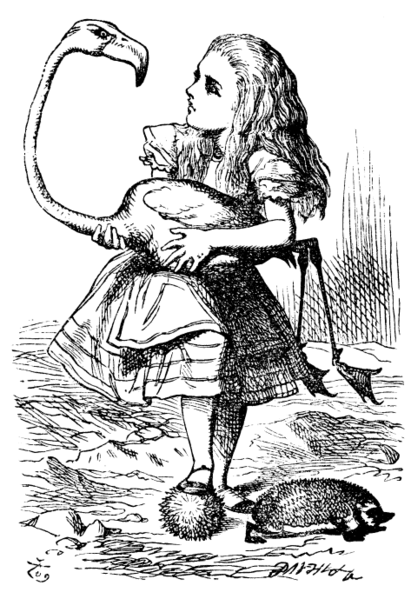
Alice in Wonderland (Photo credit: Wikipedia)

Got that?  No?  Perhaps it’s time to take a page out of Alice in Wonderland.  Alice burst into tears when she whacked her head on the ceiling after eating the EAT ME cakes that turned her into a giant.  Her tears became a sea that swept up all sorts of strange creatures.  She and the creatures managed to crawl out of the sea but could not get dry.  The Dodo suggested a Caucus-Race, which consists of everyone running in a circle with no clear winner.  This was pointless but Alice managed to frighten the silly creatures away by talking about her “moderately ferocious” cat.

Given the PCs over-reaction to the Wildrose, I suspect they see a moderately ferocious cat (not a slavering pit bull) on the opposition side of the aisle and like Alice, I’m really glad it’s on our side because here in Wonderland we’re going to need all the help we can get!

*Hansard Nov 19, 2012 p 710

**Hansard Committee of the Whole, Nov 19, 2012, starting at p 731  

***Bilious p 737,  Anglin p 736, Hehr p 744

****Hancock p 737, Delong p 741, Hughes p 743

Posted in Energy & Natural Resources, Politics and Government | Tagged , , , , , , , , | 6 Comments

The Baby Whisperer vs the Bully Boy

Dr Michael Giuffre

In this corner we have Dr Michael Giuffre, the new President of the Alberta Medical Association (AMA).  He’s a pediatric cardiologist who was dubbed the Baby Whisperer by a frantic parent after he’d soothed a screaming baby.

In the opposite corner we have the Health Minister Fred Horne, a health consultant turned politician.  We’ll call him the Bully Boy in recognition of his skill at the all out frontal assault.

Fred Horne

Fred Horne (Photo credit: Wikipedia)

The latest round of the AMA contract negotiations started on a high note.  Instead of pointing the finger of blame Dr Giuffre extended an olive branch.  He said the AMA wanted to be a “willing partner” with the government and Alberta Health Services in the decision making process before decisions were made and policies put in place. 

The Baby Whisperer’s gambit was reasonable…but hopelessly naive.

The applause had barely died down at Dr Giuffre’s installation dinner when Minister Horne fired the first volley—he tabled the government’s “best offer” (translation: take it or leave it because it ain’t getting any better than this).**

But wait, that’s not all—the “best offer” came with strings attached.  Certain preconditions had to be met before the government would deign to continue negotiations. ***The AMA dutifully presented its response to the preconditions at a meeting with the Minister…who refused to consider them.

Apparently the negotiations were over.  The next morning Minister Horne announced a “my way or the highway” unilateral settlement offer.

The Baby Whisperer and the AMA were furious and with good reason.    

Firstly, the government reneged on not one but two agreements in principle.  In the private sector when two companies sign an agreement in principle, one can’t back out simply because he feels like it.  That’s called bad faith and it’s grounds for a lawsuit.

Secondly, the Bully Boy is framing this dispute as a fight over money when it’s not.  He said the government’s offer reflects “…the value we place on our physicians and the fiscal reality facing our province”.****

What Minister Horne doesn’t say is that the doctors had already accepted a 0% pay increase for 2012 and 2013 and a cost of living adjustment (COLA) increase for 2014 under the original agreement in principle.  When it became obvious that the AMA would be problematic in the April 2012 election the Bully Boy unexpectedly dropped an additional $181 million into the AMA’s lap—a $12 per head increase (from $50 to $62) for each patient in a primary care network and a 2% increase in insured services fees.  Both of which were welcome but did little to offset skyrocketing overhead costs.

With the election safely behind the them, the health minister tore up the agreement in principle. The result:

  • the government’s promise to allow consensus-based decision making?  Gone.  It’s replaced by ministerial authority over virtually everything.
  • the references to primary care networks (PCNs)?  Gone.  The government wants to replace PCNs with 140 Family Care Clinics (FCCs) at 5 times the cost with no input from the AMA.
  • the 2.5% fee increases promised for 2011-12 and 2012-13?  Gone.
  • the two programs that support community doctors?  Gone within 2 years, creating a $30,000/year drop in compensation with a vague promise that funds will be recouped somehow.  (I’m sorry but the “trust me” rationale just doesn’t cut it anymore).
  • the pre-election bump of $12/patient for primary care networks (PCNs)? Gone in 3 years.

Furthermore fees will be adjusted downward without a transparent process for how these fees will be reviewed and adjusted.

And all of this will take place without any input from the doctors.

But never mind, the Cost of Living Allowance continues until 2016.

The Baby Whisperer learned a harsh lesson.  Bully Boys don’t play by the rules.  Minister Horne acts like he’s got the AMA on the ropes and to some extent he does because he knows that the doctors won’t abandon their sick and dying patients in order to make a point.

Nevertheless it’s time for Dr Giuffe to take that olive branch he so generously extended and whack the Health Minister upside the head.  How?  By following Dr Slocombe’s lead and engaging with Albertans in a media campaign to educate us on the issues and get our support.  What is fee relativity?  Why is it important? Are PCNs better than FCCs?

Meanwhile here’s what you can do.

Send Mr Horne and Ms Redford an email with a copy to the others.  Tell them you’re appalled by the government’s bad faith in this round of contract negotiation with the AMA and unless the government returns to the bargaining table with a more palatable offer, you’ll vote against the PCs in the next election.

This won’t be 100% successful but it’s a way to show the government that the Baby Whisperer has friends and we’re not going to let the Bully Boy pummel our doctors any longer.  Bullies win only if we don’t stand up to them.

Here are some email addresses:

Fred Horne: edmonton.rutherford@assembly.ab.ca

Alison Redford: calgary.elbow@assembly.ab.ca

Raj Sherman: edmonton.meadowlark@assembly.ab.ca

Brian Mason: edmonton.highlandsnorwood@assembly.ab.ca

Dr Giuffe: president@albertadoctors.org

*Installation Remarks Sept 22, 2012

**Calgary Herald, Oct 25, p A5

***AMA President’s Letter dated Nov 9, 2012

****Alberta Gov’t Press Release Nov 16, 2012

Posted in Alberta Health Care | Tagged , , , | 9 Comments

Remembrance Day: Ask the Question WHY?

My friend was paying for a coffee when a young barista asked him a question that left him speechless:   “Why are all the men wearing red flowers on their jackets?”  Are you serious?  Um yes…So my friend gave her a 20 second history lesson:  WW1, Flanders Fields, poppies on Remembrance Day to mark the sacrifice of the 125,000 Canadian soldiers who lost their lives in the first and second world wars, the Korean war, Afghanistan and other peace keeping activities.

How did she not know this?  Had she forgotten?  Did she not learn it in the first place?

Then I recalled my trip to the Dutch Resistance museum and realized I was being too harsh.  The young barista should be applauded for asking the question “why”.

The Dutch Resistance museum is a beautifully designed building in the Plantage district of Amsterdam.  The first thing you see upon crossing the threshold is a large sign that says:  Ask The Question.  Then Ask It Of Your Friend. 

Dutch Resistance Museum, Amsterdam
Dutch Resistance Museum, Amsterdam (Photo credit: Wikipedia)

What is the question?  The visitor is left to figure that out for himself as he moves through the exhibits.

Germany bombed Rotterdam on May 14, 1940.  Eight hundred people died, 80,000 became homeless.  Germany threatened to continue bombing unless the Dutch surrendered.  The Netherlands capitulated five days later.

At first the occupiers were friendly.  They set up a seemingly benign governing structure and made “minor” bureaucratic changes in the interests of greater efficiency.

Government employees were required to fill out forms declaring their ancestry.  Some Jews balked—why this information necessary?  Others argued that refusing to provide the information could be interpreted as a lack of pride in one’s heritage, what harm could it do?  All the Jewish employees were fired a few months later.

More rules followed as the oppression increased in intensity.  Everyone over the age of 14 had to carry an identity card.  The identity cards of Jews were emblazoned with a large “J”.  Jews were banned from public transit and public spaces including parks, swimming pools and cinemas. They were segregated in Jewish districts and Jewish schools.  They had to wear the Star of David.  Eventually they were ordered to leave the Netherlands and go to work in German factories and labour camps.  Some refused and went into hiding.  Others complied.

A walk through the museum is a walk through time.  Exhibits include photographs, Nazi posters, video clips, newspaper articles, contraband radios, mock ups of prison cells and the tiny little fragments of ordinary people’s lives.

The “Adapt” exhibits reflect Dutch attitudes at the onset of the occupation (if we work with the Germans it will be fine in the end).  By 1943 the exhibits change to “Collaboration” exhibits, which include heartbreaking photographs of the betrayer and the betrayed, and “Resistance” exhibits, which demonstrate the ingenuity and resourcefulness required to forge ID cards and food coupons, hide one’s neighbours and communicate with the Allies on handmade radios while staying one step ahead of the Germans.

Ask The Question.  Then Ask It of Your Friend. 

As I moved through the exhibits, the question became clear.  What would you do:  adapt, collaborate or resist?

I am grateful that I live in a different place and in a different time, in a world that exists because hundreds of thousands of Canadian soldiers fought in WW1, WW2, Korea and Afghanistan to protect the ideals on which our democracy is based.

As a result of their sacrifice, we are not faced with the Dutch question, whether to adapt, collaborate or resist, we’re faced with the barista’s question…why?   Why is the government taking these steps and making these laws?

Here are two examples:

Why did the Redford government eliminate the “public interest” test in Bill 2, a piece of legislation intended to streamline the regulatory process for energy producers?  The “public interest” test is the only way to balance the legitimate interests of landowners and environmentalists with the economic interests of oil and gas companies who want to develop our natural resources at breakneck speed—and now it’s gone.

Why is the Harper government creating new guidelines for the “net benefit” test, which will determine whether a Chinese state-owned entity can take over a Canadian energy company, behind closed doors and signing the China/Canada trade agreement (FIPA) in secret without first consulting with the Canadian people who’ll be subject to this agreement for the next 31 years?

These questions go to the root of our democratic process.  We’ve asked these questions many many times.  We can honour the memory of the thousands of Canadians soldiers who died protecting the democratic rights of others by continuing to ask these questions.  It’s the only way to ensure we will never be faced with the Dutch question:  Should we adapt, collaborate or resist?

God bless the little barista who had the courage to ask the question:  Why are all the men wearing red flowers on their jackets?  The most important question is:  Why?

Posted in Politics and Government, Uncategorized | Tagged , | 8 Comments

How The Tories Took Away Our Voice: The Responsible Energy Development Act (Bill 2)

While we’ve been frothing about the government’s refusal to admit that there’s something fundamentally wrong with a political party accepting a $430,000 campaign donation from a single benefactor, Redford`s government is quietly going about its business—eliminating our right to stop an energy project even if it’s not in the public interest.

If Bill 2, the Responsible Energy Development Act, is passed Albertans will have no say on whether a project should go ahead; all they can do is fuss about the details when it does go ahead.

How did Albertans lose their voice with respect to the most important industrial activity taking place in our province?  The same way we lost our voice with respect to the delivery of healthcare—the government “streamlined” the legislation by “gutting” it.

This process took almost 3 years.  (The Morton/Stelmach slap-down and ensuing PC leadership race derailed things for a year).

In the spring of 2010 the government declared that Alberta’s regulatory framework for oil and gas development was uncompetitive.  In political circles that’s called “framing the question”—there was no evidence to indicate that regulations were indeed making the industry uncompetitive; the government simply declared it so.

Energy Minister Morton (Fred or Ted or whatever his name was) appointed three parliamentary assistants to a task force:  Diane McQueen, Energy assistant (now Environment Minister), Cal Dallas, Environment assistant and Evan Berger, Sustainable Development assistant.

Between Apr and Nov 2010 they consulted with “invited” stakeholders, including NGOs, 19 Alberta government departments, 47 First Nations, 3 Treaty Associations and 10 industry associations made up of all of the oil and gas heavy hitters.

Not to be cynical, but I’d wager that the input from “stakeholders” like the Town of Beiseker or Ducks Unlimited didn’t carry nearly as much weight as input from the industry participants who, for some reason, got twice as much air time as the rest of the invitees.

In Oct 2010 the task force unveiled its “preferred” option to the stakeholders.  Apparently they were delighted (although given what we now know about Bill 2 I suspect the non-industry stakeholders had no idea what the task force was talking about).

A glossy report was published in Dec 2010.  It said that Alberta had an urgent need to “enhance” its regulatory system to keep the oil and gas sector competitive (we’d come full circle).

The report made 6 recommendations.  One was the creation of a single Regulator that would pick up the responsibilities of the Energy Resources Conservation Board, Alberta Environment and Sustainable Resource Development.

This recommendation was a Trojan horse.  It sounds like “streamlining” but actually results in “gutting” because it eliminates the Energy Resources Conservation Board and the Energy Resource Conservation Act which requires the ERCB to consider whether a project is in the “public interest” in each and every case.

The “public interest” is based on the social, economic and environmental impacts of a project.  It can be as narrow as a farmer’s concerns about the impact of an oil well on his crops and livestock or as broad as the cumulative effects of an oil sands upgrader on air and water quality and a community’s ability to provide services and infrastructure

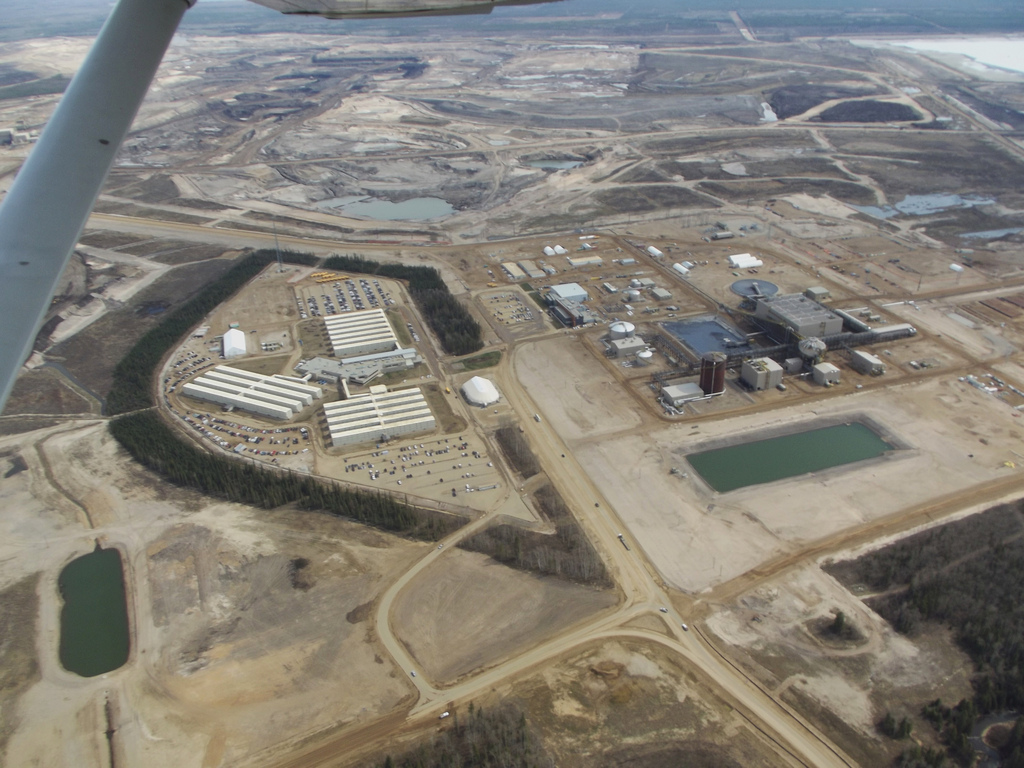
Shell Albians sands north east of Fort McMurray Photo credit jasonwoodhead23

A consideration of the “public interest” weighs these competing interests—if a balance is not achieved the project must be rejected—however the Regulator’s ability to make that decision has vapourized.

If the new Regulator can’t consider the “public interest”, who can?  Why the government of course.

The “public interest” is now a matter of policy to be decided behind closed doors by government officials and industry representatives.  And if they decide it’s in the “public interest” to exploit Alberta’s natural resources at breakneck speed, so be it.  It’s not up for public debate in front of the Regulator.

Bill 2 allows the Minister (we’re not sure who but likely it will be Energy, not Environment) to force the Regulator to make decisions that are consistent with the government’s policies for energy resource development, land management, environmental management and water management.**

And just in case the Regulator is not clear on what those policies are in a specific case, Bill 2 has created a new government-appointed board of directors, complete with CEO, that is responsible for the “general management” of the Regulator’s affairs*** (Welcome to Superboard 2, The Sequel).

The Alberta government has regulated energy resources since 1938.  Whether a project is in the public interest or not has been a threshold question for the Regulator for decades.  Not one of Alberta’s premiers, including the polar opposites Lougheed and Klein, found it necessary to relieve the Regulator of its duty to consider the public interest, let alone smother the Regulator with direct input from the Minister and his hand-picked board of directors.

Bottom line:  the government doesn’t trust the Regulator to interpret the “public interest” appropriately.  Perhaps it doesn’t want to take the chance that an arms-length Regulator might act in the best interests of all Albertans, not just those who make hefty contributions to the party in the dying days of an election.

*”The ‘Public Interest’ in Section 3 of Alberta’s Energy Resources Conservation Act: Where Do We Stand and Where Do We Go From Here?” by Cecilia A. Low, Canadian Institute of Resource Law, Sept 2011

**Section 67(1)

***Sections 5 and 6

Posted in Energy & Natural Resources, Politics and Government | Tagged , , , , , , , | 10 Comments

Welcome to the Noodle Bed: Alberta’s Healthcare Delivery System is Reorganizing…Again!

When former premier Stelmach said he was willing to let local hospitals make decisions like buying light bulbs for their own operating theatres I thought he was kidding.  Turns out I was wrong.

This week Stephen Lockwood, chairman of the Alberta Health Services board, unveiled a pilot project at Rocky General Hospital which will move some decision making authority to the local level.  Mr Lockwood described the pilot as “fine tuning and refining”*an organization that had recently moved from one province-wide zone to five regional health zones, after shrinking from 17, to nine, to one (the AHS).  (Think: accordian).

Dr Chris Eagle, CEO of Alberta Health Services, praised the decentralized decision making model:   “Decisions should not be passed up and down the AHS organization chart.  That is bureaucracy.  Decisions will be made as close as possible to where health care is delivered, many at the level of a self-managed operating unit.*        

Mr Lockwood provided an example of why this change is necessary:  “If you need a parking pass for a long term care patient, should the site be able to make the decision immediately?  I feel they should.  Right now there’s a bit of red tape between the request and the decision.”** 

He’s kidding right?  The AHS monolithic org structure has been in place since 2009 and they’ve just now figured out that it might be a good idea to let a local hospital issue a parking pass….??? 

The problem isn’t the centralized decision making model—private sector companies have successfully used centralized (and decentralized) decision making models for decades—the problem is that Health Minister Fred Horne does not trust healthcare professionals to make the right (read: political) decisions and as a result will not relinquish control over meaningful decision making to doctors, nurses and other healthcare professionals who would, in biz-speak, add value to the decision-making process.

Mr Horne proved as much this week when he announced his “new deal” to settle the contract dispute with Alberta’s doctors who’ve been without a contract since Mar 2011.  Mr Horne described the deal as “the government’s best offer” (translation: take it or leave it because it ain’t getting any better than this”).*** 

Minister Horne made a big deal of the $181 million pay raise he’d promised the doctors just before the election.  “That money is still there…so we’ve certainly held true to our word about the money being there”.  Interestingly, the doctors had not asked for a pay raise—they’d already settled for 0% raises for 2012 and 2013 and a cost of living increase for 2014.  Many viewed Mr Horne’s unexpected “gift” as an attempt to buy the doctors’ silence in the run-up to the 2012 election.

What Mr Horne didn’t say about the “new deal” was that his agreement to allow doctors to be part of the decision-making process was off the table.  With the election safely behind Ms Redford, Minister Horne quickly reneged on his promise to allow consensus-based decision-making, replacing it with “ministerial authority” for every meaningful decision.

And this is why doctors were guarded when Mr Lockwood and Dr Chris Eagle announced the decision-making pilot at Rocky General.  The doctors wanted more details but got none because “that would defeat the purpose of allowing leaders at every level of RGH to create a model from the ground up”.* 

That’s one way to look at it.  However given Minister Horne’s flat out refusal to allow doctors to participate in meaningful decision making, doctors involved in the Rocky General pilot project are being asked to throw darts at the dart board until they find the line between routine decisions that they’ll be allowed to make and meaningful decisions that are off-limits.

I certainly hope that the line moves a few inches away from decisions like ordering light bulbs and issuing parking passes—but I’m not holding my breath.

Let’s face it, the Ministry of Health is a centralized stovepipe command-and-control organization with Fred Horne at the top, Stephen Lockwood and Dr Eagle somewhere off to the side and layers and layers of bureaucracy below them.  It’s like a lasagna with too many noodle beds.  A gooey sticky mess.

Sadly, when politicians micromanage and second guess healthcare professionals trying to carry out their duties we’re all stuck in the noodle bed—a place stuffed with re-heated ideas and unpalatable results.  This lasagna org structure is well past its “best before” date.  Time to toss it out and start over.

*Oct 16, 2012 memo from Dr Eagle to AHS

**Calgary Herald, Oct 24, 2012, p B9

***Calgary Herald, Oct 25, p A5     

NOTE:   The lasagna analogy comes from David Baldacci’s book, Zero Day—a terrific airplane read.


Posted in Alberta Health Care, Politics and Government | Tagged , , , , | 9 Comments

Hanging By A Thread…Or Why I Like Paying Taxes

We’ve just spent three and a half days tethered to the house next door.  All of our drinking, cooking, showering and flushing water came to us through a blue rubber hose that snaked across my neighbour’s yard, went up over the fence and curled into a knotted mess in a window well where it connected to a tap that had been jury rigged to flow backwards.  Our comfort hung by a thread.  A kink in the hose (or a dog enjoying a rubbery chew) would bring life in the Soapbox household to a screeching halt.

It all started innocently enough when two City water trucks and a pile-driver converged on the fire hydrant outside our house.  Apparently fire plugs are not as tough as they look and this one had to be replaced.

A squad of men wearing reflective clothing cordoned off half of the block—orange cones and wooden barriers all over the place.  You’d think they were disarming a nuclear device.

And then it started.  The pile-driver attacked the earth around the fire hydrant.  My century old house shuddered with every blow.  A thought flickered…should I stockpile some water?  Nah, they’d tell me if they were going to shut it off.

Blithely I set out on my weekly trek to the local library and Mr Soapbox had a nap (proving that he really can sleep through anything).

When I returned I reached for a glass of water—you guessed it, nothing, nada, nary a drop.

Right—time for a chat with the water guys.  I caught the attention of a burly man wearing wrap-around sunglasses.  I have no water, I said, when will you turn it back on?  He looked at me, Ah…we just noticed the ditch filling up with water.  Ah…we don’t know where it’s coming from (my house perhaps???) Ah…we don’t know how long the water will be off.  And then he fled back to the man-pack staring intently into the ditch filling up with my water.

Right—time to send in Mr Soapbox.  In a flash he was out the door and heading for the man-pack.  Two seconds later they were standing around looking into the hole.  Don’t you love it when they do that?

After bonding with the water guys Mr Soapbox came back with the full story.  The pile-driver had shattered our water line.  If they couldn’t repair it by 6 o’clock, they wouldn’t be back for 2 days because they don’t work on Sundays.  But not to worry, they’d send out the water truck, complete with big red buckets so that we could haul our own water whenever we needed it.  How reassuring.     

I sent Mr Soapbox to the local Co-Op to buy up all the water he could find and called my daughter to schedule an appointment at dawn with her shower.  I left a message because she was having a shower.  What torment…

To add to the misery Sam the sprinkler guy appeared to shut off the outside sprinklers and blow down the system.   Wait…!   The sprinklers are shooting a fine spray of water all over the back yard!  I grabbed a bucket but it was too late, the sprinkler system was dry.

At 6 o’clock the water guys fessed up.  The water line had not been repaired.  They would return on Monday and we’d be without water for the weekend.  But they had a solution.  They could hook us up to our neighbour’s water line if the neighbour consented.

Our neighbour on our right greeted the water guys with a question—when were they going to turn on the water, she wanted a shower (don’t we all?) and yes she’d be happy to let us tie into her pipe…unfortunately, the City water guys shattered her coupling last year and it couldn’t take the strain of supplying both households.

Our neighbour on our left was out of town but the house-sitter, who’d just popped out of the shower (really?) was sure they wouldn’t mind if we hooked up to their water supply.

And that’s how we became tethered to our neighbour’s house for three and a half days.  We would have been off her system a day earlier but the water guys refused to turn our water back on because … Ah….they didn’t want to take off their boots to enter our house (What??)  Ah…it’s a union thing (you’re joking, right?) 

The next day a different water guy (in boots) entered our house and turned on the water.  It ran at full pressure for 5 minutes and dried up.  They’d failed to clear the dirt out of the pipe when it shattered and silt (bugs? leaves?) had been carried into our system when it was re-pressurized.  This water guy cleaned out the water-filter and ran the taps for 30 minutes to clear out the sludge.

The Soapbox family found this experience extremely frustrating.  At first I blamed the water guys.  Anyone who works in the oil and gas industry will tell you that running a pile-driver right up to an underground pipe is stupid, if not dangerous.  They always hand-dig the last few feet because the “as-built” drawings are never 100% accurate.  Refusing to turn on our water because someone didn’t want to remove his boots or was it a union problem (does the union prohibit the removal of footwear?) added to the Keystone Kops factor.

But eventually I focused my anger at the right target—the municipal government.  Like all Calgarians we pay taxes for basic services.  Unlike most Calgarians I like to pay taxes.  It’s the only way to fund the infrastructure we need to deliver water, heat, electricity, and sewage disposal to our homes, to clear our streets and provide the amenities we require to live in a civilized society.

The same holds true at the provincial and federal levels.  We need provincial and federal regulatory bodies and ministries like food inspectors to protect our food supply, fisheries scientists to protect the marine environment, and banking regulators and the competition bureau to safeguard our financial sector and our ability to compete.

We pay for these services with our tax dollars.  We have every right to expect municipal, provincial and federal governments to spend our tax dollars wisely.  The level of incompetence the Soapbox family witnessed from the simple replacement of a fire hydrant is but a drop in the bucket (if you’ll pardon the pun) that Albertans and Canadians have endured as a result of the government’s reluctance or inability to act in the public interest.

In our case it was simply an inconvenience.  In the case of the elderly woman living in a long term care facility who was attacked by another resident while asleep in her bed, it is unconscionable.

This has to stop.

We pay taxes because we’re all in this together.  No one, particularly the disadvantaged, the sick or the elderly should suffer needlessly at the hands of a Keystone Kops government that can’t be trusted to spend our tax dollars wisely.

Posted in Politics and Government, Uncategorized | Tagged , | 6 Comments

The Philosophy of Will Mac: Its Application to CNOOC’s Takeover of Nexen

William McElcheran is a Canadian artist best known for a series of bronze sculptures called “The Businessmen”.  Calgarians will be familiar with “The Conversation”—two life-sized chubby businessmen complete with hats, overcoats and brief cases, deep in conversation outside the Hudson’s Bay store (pictured below).

My relationship with Will Mac got off to an inauspicious start when I tripped over a parking median and landed flat on my face on the tarmac.  I was so focused on ensuring that my little Will Mac sculpture was safely tucked into the back seat that I almost cracked a cheekbone.

Our purchase, “Aspirational Businessman”, is a round-faced businessman looking into the middle distance—his future perhaps?  So how is this relevant to what we normally talk about on the Soapbox?  Well, today’s topic is businessmen.

McElcheran approaches businessmen with bemused wariness, like bumblebees trapped in a pickle jar.  They’re entertaining as long as they don’t get loose.

Art critic Gerhard Finckh* describes McElcheran’s businessmen more harshly: “When a businessman no longer stops to contemplate the consequences of his actions because he is hounded by the idea of maximum profit, when his actions are devoid of moral considerations [we may call him] a “sweet fool”.  [But] when his business transactions become a real threat to society and are recognized as such…those who did not oppose him right from the start, are transformed [into]“bitter fools”. 

At first, I thought Finckh’s comments were overly melodramatic…but that was before Nexen’s shareholders and the Harper  government entered the twilight zone trying to convince us that CNOOC’s takeover of Nexen was a “net benefit” to Canada.

Ironically, this PR exercise emerged at the same time as the Canadian subsidiary of another Chinese state-owned entity, Sinopec, was convicted of health and safety violations arising from the deaths of two temporary Chinese workers in Fort McMurray, and Ottawa banned Huanwei Technologies, a Chinese telecommunications giant, from bidding on a government communications contract because Huawei might pose a security risk (!).

Here in Alberta Premier Redford is working hard to calm our fears.  She’s imposed two “conditions” that would make the takeover acceptable to Albertans (well, to the PCs).  First; half of the company’s board of directors and management team must be Canadian and second; CNOOC must agree to comply with our environmental laws.

With respect to Redford’s first condition, it would make more sense to demand that half of the management team be the existing team.  This would ensure continuity and alignment between the old and new management teams.  Unfortunately, the odds of existing management staying with the “new” Nexen are slim to none (and Slim just left town).

Nexen’s senior executives have signed change of control agreements that entitle them to 24 months’ severance and other benefits upon a change of control (being taken over by a Chinese state-owned entity certainly qualifies).

The dollar value of these agreements is staggering.  The interim CEO,  Mr Reinhart, is entitled to  $5.1 million in severance plus the $3.4 million commuted value of his pension plus the value of his Nexen shares, TOPS,  STARs and PSUs (don’t ask, just know that they are all calculated off of the share price which just went up by 60%).  Furthermore, these numbers reflect Mr Reinhart’s entitlement at the end of 2011.  That amount will increase substantially by the time the CNOOC takeover is finalized in early 2013.  The other senior executives are entitled to smaller payouts but the amounts are still in the millions.

Like all smart businessmen, the senior executives will consider the pros and cons.  If they stay they’ll end up working for a branch office of the Chinese government.  If they leave they’ll collect millions and move on to other lucrative jobs in the oil patch.

Three guesses what will happen.  The existing management team will run for the exits and be replaced by other managers who are willing to work (with less autonomy) for the “new” Chinese state-owned Nexen.   These managers may be skilled but it will take time to replace the experience that walked out the door en masse.

This brings me to Ms Redford’s second condition:  CNOOC must agree to comply with our environmental laws.  The fact that the Alberta government feels compelled to ask a company operating in Alberta to obey our laws shows how little faith the Redford government has in CNOOC.

Her concern is justified given China’s appalling environmental and human rights record and the fact that the new managers just hired by CNOOC will be responsible for enforcing compliance on the part of their bosses in China.  

How did we get ourselves into such a pickle?

The blame rests squarely on the shoulders of the federal government.  Its lack of foresight about the role of foreign investment in the development of our natural resources has left all Canadians exposed to the actions of businessmen who equate “net benefit” to Canada with a 60% bump in share price.

Luckily the majority of Canadians refuse to become “bitter fools” (to use Finckh’s terminology).  They’ve expressed their opposition to CNOOC’s takeover of Nexen at every opportunity.  We’ll know in 30 days whether they’ve succeeded.

******

*William Mac The Businessman, 1991, p 64

**Nexen 2011 Management Proxy Circular

Posted in Energy & Natural Resources, Politics and Government | Tagged , , , | 2 Comments

There’s something about Justin…

Photobucket
Justin Trudeau is like litmus paper.  Mention his name at a dinner party and the conversation erupts as people declare themselves to be in the “pro” and “anti” camps.  The “anti” camp (usually men) roll their eyes and complain that the charity boxing match with Senator Patrick Brazeau was “grandstanding”.   The “pro” camp (usually women) laugh indulgently and give him credit for chutzpah.

Then we get serious.  Can Trudeau lead the Liberal party?  If he wins the leadership race will he be able to hold his own against Harper and Mulcair?

The men are dismissive—he’s too young and inexperienced, he’s making his move too soon, he’s only got one chance to become leader, why blow it by running too early?

The women disagree.  Trudeau is young, energetic, charismatic…and shrewd.  Consider the dynamics of that now famous charity boxing match.  Brazeau was a martial arts expert and the three-to-one favourite to win.  If Trudeau got clobbered we wouldn’t be surprised, he was outclassed by a superior athlete.  If Trudeau won, it would be his Rocky moment.  Either way he showed physical courage by getting into the ring and it didn’t matter what happened as long as he didn’t get killed.

The same holds true for the Liberal leadership race.  If Trudeau loses, it’s because he’s young and was outperformed by a more experienced candidate—he’ll learn from that experience and come back even stronger the next time.  But if he wins, it’s Trudeaumania all over again.  He’s got absolutely nothing to lose.

To be fair to his critics, the most commonly voiced objection to Trudeau’s run for the leadership is that he lacks experience.  He just hasn’t lived long enough to understand the problems that beset Canadians today.  Implicit in that objection is a complete disregard for Trudeau’s success at wrestling the riding of Papineau from the grasp of the Bloc Quebecois in 2008.

Papineau is a riding “…of halai butchers and Haitian grocers, brick triplexes and Quebec designer boutiques…”* Trudeau won the riding twice.  Why?  Because he works hardHe shows up at community meetings, he understands the issues of an ethnically diverse riding and makes sensible proposals.*  Trudeau has the common touch and he listens.  In other words, he’s a good MP.

Is being a good MP enough?  Maybe not, but one thing is clear, the Liberal Party cannot afford another uninspiring leader like the overly earnest Stéphane Dion or the academic Michael Ignatiff.

And in today’s post-financial meltdown, bank scandal ridden world the Liberals don’t need an investment banker like the Mark Carney, the head of the Bank of Canada.  Any voter looking for a political leader with a focus on the maintaining the health of the private sector need look no further than Mr Harper.

It’s too early to say that Justin Trudeau will win the Liberal party leadership in April 2013, but he’s certainly started out with a bang.   The first stop of  his leadership campaign was Calgary–a savvy move given how much Albertans despise the Liberals and Pierre Eliot Trudeau.  Thirty-two years after the passage of the National Energy Policy most Albertans will still vote for a bale of hay (or Rob Anders) rather than waste a vote on a Liberal candidate.

Trudeau tackled this thorny issue head-on.  He assured Calgarians that (unlike Thomas Mulcair) he would never use “…the wealth of the west as a wedge to gain votes in the east”. **

Trudeau also discussed the most contentious issue facing Canada today:  the future of the oil sands.  He said:  There is not a province in this country that would find 170 billion barrels of oil and leave it in the ground.  We must bridge the gaps between those who are indifferent to the destruction of our natural environment and those who would shut it down completely”. 

Granted, bridging the gap will take patience, cooperation and transparency, but recognizing the need to bridge that gap is a critical first step that has not been suggested by either Mr Harper or Mr Mulcair.

Finally, Trudeau knows how to connect with a crowd.  He looked at the 400 odd liberals packed into the basement at the Dashmesh Seniors’ Centre in northeast Calgary and said:  “You’re not here because it makes you popular.  You’re not Liberals in Calgary because it helps you network.  You’re here because you believe”.

“You believe”.  Grand words that would sound corny coming from anyone else, but not easily dismissed if they spring from the recognition that politics in the 21st century must change.  Governments must address the inequities created by the “corporatization” of the public service and the pain that’s caused to the young, the sick and the elderly all across Canada.  Governments must shift the balance of power between the 1% who make the key economic decisions and the 99% who are dragged along in the undercurrent.

Ultimately that’s what the Liberal leadership race is all about—who is best qualified to gather up the ragged band of liberal voters scattered across this country and unite them under an optimistic banner that gives us hope for the future.

OK, I’m turning the soapbox over to you…what do you think?  Are the guys around the dinner table put off by an energetic young man making his move (howls of derision from the guys), are the women bedazzled by his charm and good looks…or is there something about Justin Trudeau that will land him front and center on the political stage? 

*Globe and Mail, Sept 29, 2012 online

** Calgary Herald, Oct 4, 2012, pA3

Posted in Politics | Tagged | 10 Comments

The CNOOC Takeover of Nexen: Net Benefit to the 1%

Many Canadian opposed to CNOOC taking over Nexen are reluctant to say so lest they be labelled economically naive or xenophobic.   I’m neither so let me tell you why my spidey senses are tingling:

#1 CNOOC is a state owned entity

The China National Offshore Oil Corporation is a state-owned oil company.  Its president is appointed by the government.  China’s government has an appalling reputation in human rights and environmental protection.

CNOOC says not to worry.  It will create a Canadian subsidiary (let’s call it CNOOC-Canada) which will be bound by Canada’s health, safety and environmental laws.  This is good because nothing focuses an executive’s attention more sharply than the prospect of jail time.  But words are cheap…and in this case don’t address the fact that the executives directing CNOOC-Canada strategy reside in China, well beyond the reach of Canadian laws.

Remember Sinopec, another Chinese state-owned entity?  Sinopec battled the Alberta courts right up to the Supreme Court of Canada to avoid prosecution for 53 health and safety violations arising from the deaths of two temporary Chinese workers and injuries to four others.  Sinopec’s argument:  it had no presence in Canada.*

Sinopec was ultimately unsuccessful but the case wasn’t a complete loss.  It laid out a blueprint for a smart lawyer to do a better job of insulating a Chinese state-owned entity from its Canadian subsidiary so that Chinese state-appointed executives will have a stronger immunity argument the next time around.

Bottom line:  CNOOC’s commitment to comply with Canadian health, safety and environmental laws is meaningless when CNOOC’s “directing minds” are safely tucked away in China.

#2  Why does CNOOC want to own 100% of Nexen?

China invested $18 billion in the Canadian oil and gas industry in the last 2 years by buying minority interests in Canadian companies.  This time it’s going for the whole enchilada.  Why?  Because that’s the only way China can lock up OrCrude and Buzzard.

OrCrude is a technology that improves productivity and reduces the cost of oil sands operations.  Nexen has the exclusive right to OrCrude technology in Canada and most of the world—a worthwhile prize.

Buzzard is a mid-sized oil field resting under the North Sea about 60 miles northeast of Aberdeen.  It plays a decisive role in setting global oil prices.**Nexen holds a 43% stake in Buzzard and is its operator—another worthwhile prize.

Bottom line:  The only way to capture the crown jewels is to buy the company that owns them.

#3 What is the “net benefit” to Canada?

CNOOC needs Investment Canada approval in order to complete the takeover.  This means convincing  Investment Canada and Mr Harper that the takeover is a “net benefit” to Canada.   

A “net benefit” is defined as one that improves the Canadian economy, boosts productivity, creates  jobs, uses services, doesn’t negatively impact competition in Canada, contributes to our ability to compete globally and is compatible with Canadian industrial, economic and cultural policies.  Pretty comprehensive, eh?

Well,  I’m hard pressed to see how the takeover of a Canadian company by a company owned by the Chinese government will be a net benefit to Canada.

Nexen isn’t on the brink of bankruptcy—it was one of the few energy companies to report an increase ($109 million) in year-over-year cash flow this quarter—so the CNOOC takeover won’t save Canadian jobs or add Canadian jobs.  In fact if CNOOC adopts the Sinopec model it will import temporary Chinese employees to work in here.  Zero benefit to Canada.

As a state-owned entity CNOOC has unlimited access to government financing.  This gives CNOOC a competitive advantage over Canadian energy companies who access financing through the debt and equity markets and enhances CNOOC’s ability (not ours) to compete here and abroad.  Zero benefit to Canada.

CNOOC promised to list CNOOC-Canada’s shares (now valued at $15 billion) on the Toronto Stock Exchange.  So instead of investing in Nexen, a Canadian company, we can now invest in Communist China.  Furthermore, CNOOC-Canada’s profits, in the form of dividends, will flow back to the Chinese government, not to Canadian shareholders.  Zero benefit to Canada.

So what am I missing?  To paraphrase Hal Kvisle, ex-CEO of TransCanada Pipelines, it’s the share price premium stupid.   OK, I took some liberties there, what Mr Kvisle actually said was “The point is there’s this huge premium to the share price.  It’s a huge infusion of capital into the Canadian financial system—we’re selling the company for a great return for the shareholders and I think the net benefit to Canada is right there.  It’s obvious and it’s financial”. *** 

Well, Mr Kvisle, the last time I looked the word “shareholders” was not synonymous with the word “Canada”.

So I will join Conservative MPs Rob Anders and Ted Menzies to urge Industry Minister Christian Paradis and Prime Minister Harper to turn down CNOOC’s takeover of Nexen.  At first I felt I was in strange company but then I looked around and saw NDP MPs Tom Mulcair and Peter Julian right there beside me.  Won’t you join us?

Oh and by the way, we’re not saying no to foreign investment in the oil sands; we’re saying no to a foreign takeover of the oil sands.

*Financial Post, July 27, 2012

**Daily Oil Bulletin, Aug 9, 2012

***Calgary Herald, Sept 21, 2012, online


Posted in Energy & Natural Resources, Politics and Government | Tagged , , , , | 7 Comments