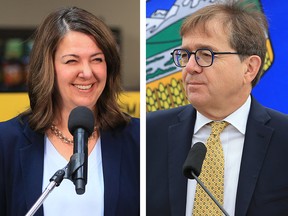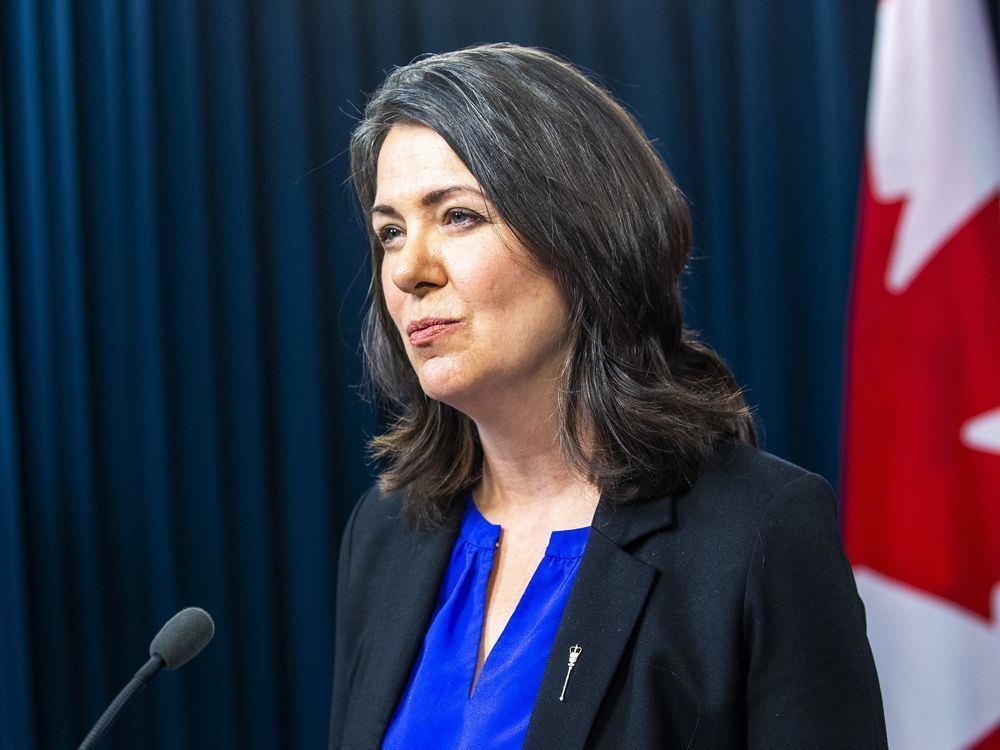
Danielle Smith’s Alternative Reality

Albertans live in an alternate universe.

How else can we explain last week’s press conference where Danielle Smith pilloried the draft electricity regulations which are designed to ensure Canada’s electrical grid is running on 100% clean energy by 2035* and unveiled a national advertising campaign of print, radio, TV, social media, billboards and bus wraps urging Canadians to contact their MPs to oppose these regulations.

Apparently, she’s unaware of the July 2023 Abacus poll that showed 71% of Canadians support the regs. And that even here in Alberta a slim majority are in favour of the regs.

Apparently she’s unaware that Canadians have their own provincial and territorial governments and premiers to represent them in these negotiations.

Or maybe she’s very aware and is simply trying to scare Canadians into supporting her position by conjuring up images of people freezing in the dark—that will teach those “eastern bastards.” Oops, forgot, we’re all “eastern bastards” now.    

Ideologically driven?

Smith characterized the regs as unrealistic, disastrous, and designed to serve narrow ideologically driven goal.

This would be the same goal that drove the US to invest $370B under the Inflation Reduction Act (IRA) to shift to cleaner energy and reduce the GHGs that exacerbate climate change. A goal that will draw billions in clean energy investment away from Canada and into the US.   

Pace and cost of implementation

There was a lot of talk about the high cost of converting Canada’s electrical grid to clean energy, but no discussion about what it would cost to convert Alberta’s grid. Nor was there any effort to put these costs into perspective by considering them in relation to the billions spent on subsidizing the fossil fuel sector and the trillions of dollars that will be spent addressing the impact of climate change on the economy and society in the future.

Smith said the pace of shifting to clean electrical energy generation by 2035 was not “commercially” feasible, noting that Alberta is more reliant on natural gas-fired generation than other provinces. This may be a valid point, but she undermined her argument when she set out her case for sticking with 2050. (See below).

Investment

She said the regs would harm investment in gas-fired power generation…then she mentioned Ontario, where Doug Ford is adding an additional 1500 megawatts of power from gas-fired plants. She said she supposed they’re taking the risk they’ll be fully abated by 2035. Yes, I suppose they are, and maybe we should too.  

Alberta’s non-compromise

When pressed for details on what a compromise with the feds might look like—would she be satisfied if the feds loosened some of the restrictions on natural gas backup generators and gave Alberta more authority to make decisions relating to peakers—her answer, when she finally gave it, was no.  

Smith said she wants “alignment” with Alberta’s position, namely that Alberta is committed to net-zero by 2050 and will get there however it pleases. In other words, Smith is not prepared to bend. There’s no room for compromise.

And that’s when it got interesting.

Her rationale for her position, 2050 or the Sovereignty Act, was nothing more than a recitation of the bullets listed on the Pathways Alliance website:

  • We’ll push ahead with carbon capture and storage (CCS). This is Pathways Phase 1: 2021 – 2030: where it says it will build a CCS network to capture 10 to 12 million tonnes of CO2/year.
  • We’ll expand CCS and invest in alternative energy (Pathways Phase 2: 2031 – 2040)
  • And “the last mile” will be technological innovations like air capture (Pathways Phase 3: 2040 – 2050).

If the feds don’t like it Smith is preparing a motion to invoke the Sovereignty Act. She appears to think this is a formidable threat and one that she’s reluctant to use.

She said, “Hopefully, no one ever has to see it. Hopefully…we’re able to come to a peaceful resolution with our federal counterparts.”

Peaceful? What’s Smith expecting, that the minute she files her motion the feds will go to DEFCON 5?

The opposite is likely the case. The feds, like many Albertans, have been waiting for Smith to deploy the Sovereignty Act, the act that made her the leader of the UCP, because they’re convinced it has the durability of wet tissue paper.

[Incidentally Jason Kenney was not afraid to challenge the fed’s jurisdiction to pass the carbon tax. It was the first thing he did upon coming into office. Smith’s reluctance to follow suit with the centerpiece of her leadership campaign speaks volumes].  

Bottom line

The clean electricity regs are part of Canada’s effort to achieve net-zero by 2050. It’s a goal that is shared by the US, the UK, France, Germany, Italy, Japan, and the European Union. We’re not going to get every step right, but we’ll never get there if we don’t start now.   

The fact that Alberta is appealing to Canadians to reject the clean electricity regs, coming on the heels of Alberta telling Canadians it’s claiming 53% of the CPP fund and prepared to screw up their right to a dignified retirement, is mind blowing.   

Alternative reality anyone?

*The regs are draft and include exceptions for days when the clean energy sources are not enough to meet demand. If this exception isn’t enough in Alberta’s climate, then Smith should make the case for a suitable exception, she should not urge the rest of Canada to reject the regs.

Posted in Climate Change, Danielle Smith, Disasters, Economy, Energy & Natural Resources, Environment, Law, Politics and Government | Tagged , , , , , | 72 Comments

The $334 Billion Assumption or Why Smith’s APP is a Non-Starter

Well that inspires confidence.  

When LifeWorks respectfully submitted its report to the Smith government outlining how Alberta could move from CPP to an Alberta Pension Plan, the executive summary was signed by someone who preferred to remain anonymous, hence their signature was “Redacted to protect privacy.”

Perhaps Anonymous was worried about having to justify the preposterous assumption that Alberta, which made 16% of the contributions to CPP, was entitled to 53% ($334 billion) of the fund when it waltzes out the door.

This is extremely problematic because everything in the LifeWorks report—the assertion that APP will result in higher pension benefits and lower contribution rates while saving Albertans $5 billion/year—hinges on the $334B assumption being reasonable.

It’s not.

The CPP Investment Board stated that Alberta which contributed 16% can’t “legally, realistically or morally be allowed to claim more than half the assets.”

The economist, Trevor Tombe, says claiming 53% of the fund is “transparently unreasonable” noting that if BC and Ontario adopted Alberta’s math, the three provinces would withdraw 128% of the fund.

Instead Tombe suggests Alberta’s share of CPP would range from 16% ($100B) at low end to 25% ($150B) at the very high end. His preferred estimate is 20% of CPP’s assets.

Given this gap between reasonable and out to lunch, the question of how much Alberta will take out of the CPP fund will be determined by the Supreme Court of Canada. And that will take years.  

Would Albertans be better of with an APP?

Tombe says an APP offers scope for a “modestly lower contribution rate” by employers and workers, but that’s offset by much higher demographic and economic risk. For example, if Alberta experiences balanced migration in and out of the province, two-thirds of that “modest” benefit will evaporate.

The LifeWorks report outlines a number of medium to high risks of failure relating to the transition from CPP to APP. This risk is lowest if Alberta sticks with the existing CPP resources and systems to manage APP; the risk (and cost) is much higher if Alberta uses Alberta public service providers or the private sector to invest and administer our pension funds.

Smith says she wants an APP because then her government could control the fund, however the CPP Investment Board is an independent body, it’s unclear it would agree to administer APP if Smith insists on controlling APP’s investment strategy.

Even if CPP agreed to administer APP on these terms, the UCP government’s track record when it comes to investment strategy is pitiful–$1.3B lost on Keystone XL, $3B lost by AIMCo, God knows how much money down the drain with the privatization and de-privatization of DynaLife, the list goes on.

Finally, the fact that Smith will likely invest our pension funds in the fossil fuel energy sector should scare the bejesus out of us.  

Pension experts like Keith Ambachsheer say if your economy is dependent on the health of a particular industry, and you also put your retirement savings into that industry, you’re putting yourself in double jeopardy. Instead, you should adopt a diversified investment strategy, one that won’t tank if/when that sector goes into decline.

Why are they doing it?

When Smith was running in the last election, she assured Albertans that “no one is touching anybody’s pension.”

She’s reneged on that promise and is pushing Alberta into an APP which in Tombe’s analysis could be “modestly” better than CPP but puts our pensions at greater risk.

So why is she doing it?

Is she trying to get back at the federal government? If so, she’s managed to alienate her conservative buddies, Pierre Poilievre, Doug Ford and Scott Moe with her claim on 53% of the CPP fund.

Is she trying to keep the fossil fuel energy sector happy? Isn’t her government’s munificence in the form of tax breaks and subsidies enough? (Incidentally the executives running these companies don’t care what happens to CPP, it’s pocket change in their multi-million dollar investment portfolios).

Is it a way to keep the Free Alberta/TBA folks happy? Good luck with that.

Is it a smoke screen to divert attention away from her government’s failure to fix healthcare and education?

Whatever the reason, the minute Smith tabled the anonymous, unrealistic LifeWorks report, she demonstrated she cannot be trusted with our pensions.

A referendum on this issue is coming. Vote wisely.

Posted in Alberta Health Care, Danielle Smith, Energy & Natural Resources, Politics and Government | Tagged , , , , , , | 70 Comments

Political Leadership in Crisis

“We’d like to know why we have not heard from you. Surely the suffering of our children merits more communication than a single tweet.” – Open letter to Danielle Smith from the parents and supporters of children infected in the E. Coli public health crisis  

The only thing worse than Danielle Smith’s tweet in response to the worst pediatric E Coli outbreak in Canadian history was the press conference she held eleven days after the outbreak had been declared.

There was so much Smith could have said starting with the acknowledgment that the E Coli outbreak could have been prevented if the proper food handling and hygiene practices had been followed. Instead (after choking up at the mic for a minute or so) she focused on deflecting blame from herself and her government.

Where were you?

Smith said she was AWOL for 11 days because:

  • Politicians can’t direct investigations or interfere with public health orders. The suggestion that a premier making a public appearance on the day the outbreak was declared to express sympathy and support for those infected and their families would be misconstrued as a premier interfering with the investigation or the public health orders is ludicrous.  
  • She didn’t have answers earlier. Neither did Churchill during WW2, but he still managed to go on the air with his “we will fight on the beaches” speech to support the British peoples. When Smith finally did show up she still didn’t have answers, but she did offer $2000/child compensation to the affected families. Perhaps she hoped this would settle them down. It didn’t. Smith’s decision to sit on the sidelines for 11 days shows an appalling lack of courage in fraught circumstances.
  • Her priority was getting care for the kids and conducting the investigation.  This excuse mirrors the first one. Does she even understand her job? She was not sitting in a conference room 24/7 telling the CMOH and AHS what to do. She’s the premier, she  operates at a level higher than that..
  • People don’t want politicians showing up at disasters and hindering emergency workers from doing their jobs. True, but consider:  (1) this was a preventable crisis, not a natural disaster, the victims were in hospitals, not scattered across an earthquake zone and (2) no one is suggesting Smith should have done a photo op in an ER while a child writhes in agony in the corner. To use this as an excuse is callous and insulting.

The public has a right to expect their premier to show up in a public health crisis, to provide a political response commensurate with the immediate and effective response from the CMOH and AHS. It’s called political leadership.

Closing the kitchen?

Dr Joffe, the CMOH, acknowledged that people are concerned that a kitchen with a number of public health violations was allowed to continue to operate. He assured us there were no delays or gaps in inspecting this facility. Smith went further, saying there’s a deficiency in the Public Health Act that doesn’t allow AHS to permanently close a facility.*

The inference we’re expected to draw is that the government did everything it could under the existing laws.

This is a smoke screen.

The issue isn’t whether the public health inspections were carried out on schedule or whether AHS lacks the power to permanently close the kitchen; it’s that notwithstanding inspections which found violations in 2021 and 2022 and 2023—of the 4 violations in 2023, 2 were critical—the inspectors did not issue a Close Order at any point along the way which could have closed the kitchen before 339 people, mostly children, were infected with E. coli.   

The real issue is this: how critical does a critical violation have to be, how many critical violations does an inspector have to find (over how many months or years) before an inspector is prepared to close down the owner and/or operator of a commercial kitchen?  

Or to put it in terms the UCP government will understand: how does the Smith government balance lives vs livelihoods when a bias toward livelihoods may endanger children.

The public deserves an answer.

A public inquiry

Over 1000 people signed the open letter to Danielle Smith expressing shock and disappointment at her handling of this crisis. In their letter they said, “We trusted not only our daycare facility but that the government itself had regulations in place that were keeping them safe.”

This trust has been broken and the only way Smith can restore it is to call a public inquiry into the E. coli crisis.

*Under the existing laws and regulations an inspector has the power to close down a facility indefinitely. The AHS Calgary Zone Emergency Orders include a facility that’s been subject to a close order since 2017.   

Posted in Alberta Health Care, Danielle Smith, Economy, General Health Care, Politics and Government | Tagged , , , | 83 Comments

Aug 3: The day Danielle Smith kneecapped wind and solar energy  

The low point of my summer (and there were many with this UCP government) came on Aug 3 when Danielle Smith announced a 7 month moratorium on wind and solar renewable energy projects—a decision that paralyses more than 100 projects valued at $33 billion—ostensibly to address policy concerns that could have been addressed without imposing the moratorium in the first place.

This decision appears to be driven by the UCP’s ideological devotion to fossil fuels (in this case natural gas powered electricity) which trumps the UCP’s ideological belief in the free market (wind and solar energy generation became a profitable business without any help from the government whatsoever).   

Premier Smith

And that’s why it’s so disconcerting.

It’s bad enough to be at the mercy of a right wing ideological government; it’s even worse to discover that its ideology is not internally consistent.  The free market trumps everything…except when it involves certain renewables in which case we’ll kneecap it. Is there anything else on the kneecapping list investors should be aware of before they come knocking on our doors?

Smith paraded a bunch of excuses for the moratorium which turned out to be overblown. The regulators and the rural municipalities did not ask for a moratorium. The consultation did not include anyone in the wind/solar sector, and not all landowners are dead set against wind/solar projects.  

We also learned from business leaders, economists, and other stakeholders that the moratorium is a really, really bad idea because it harms Alberta’s ‘open for business’ reputation by creating regulatory uncertainty, increasing investor risk, and driving investment to other jurisdictions competing with Alberta to attract wind/solar projects.  

Perceptions of the best

To get an idea of how Smith’s decision could impact the perception of Alberta as a good place to invest I turned to a recent study conducted by US News and Wharton, an ivy league business school.

The study ranked 87 countries on the following attributes: Adventure, Agility, Cultural Influence, Entrepreneurship, Heritage, Movers, Open for Business, Power, Quality of Life, and Social Purpose.

Canada was ranked the second best country in the world—Switzerland was the best and the US came in at No. 5—scoring high in Agility, Entrepreneurship, Quality of Life, and Social Purpose. Neither Canada, nor the US made it into the top 10 for Open for Business.

It’s interesting to speculate on whether Alberta, which considers itself Canada’s economic driver, would score as well as Canada on these four attributes:

Agility: this is the ability to adapt and respond to obstacles.  An agile jurisdiction is efficient in its actions, adopts and accepts modern solutions and is adaptable to change. Screeching to a halt and slapping a 7 month moratorium on a $33 billion industry which could position Alberta as a global leader in the profitable wind/solar energy sector is not adapting to change, it’s dragging the province backward.

Entrepreneurship: the ability to develop industries that can compete globally in the digital age. These jurisdictions are seen as innovative with enterprising citizens. Oops, missed this one too. Instead of creating a thoughtful regulatory environment and providing incentives to promote the wind/solar sector, Smith disrupted the marketplace by creating a barrier to entry (temporarily), and increasing regulatory uncertainty and investor risk. This damages Alberta’s reputation as an innovative, entrepreneurial jurisdiction.

Quality of life: broad access to food, housing, good education, health care and employment. Includes intangibles like job security, political stability, individual freedom and environmental quality. There is much we could say here, but we’ll focus on environmental quality. Alberta had an opportunity to improve environmental quality and contribute to the mitigation of climate change; instead it stamped its tiny foot and said, nope, not happening.  

Social purpose: a strong position on human rights, the environment and religious freedom. Being seen as the most progressive, inclusive and committed to social justice. Let’s see: progressive, inclusive, committed to social justice??? I don’t think so.

Capricious and out of sync

Not only is Smith at loggerheads with her own Minister of Affordability and Utilities, Mr Neudorf who admitted this policy review could have happened without imposing the moratorium, she blindsided major corporations like Microsoft, Amazon, Royal Bank, Telus, Cenovus and McCain Foods, who are seeking renewable electrical energy.

One can’t help but feel sorry for McCain Foods who made a big splashy announcement in March 2023 touting McCain’s investment of $600 million, the largest in its corporate history, in its Coaldale plant. This investment would include wind turbines and solar panels, providing 100% renewable electricity to the site. McCain is one of the hundreds of entities who wrote to the AUC questioning the wisdom of the moratorium.

Then there’s Mark Wiseman, the chair of AIMCo, who published an article in the Globe & Mail on Aug 12, nine days after Smith imposed the moratorium.

In Wiseman’s view investment in energy transition is the “inevitable megatrend for investors.” Those who see the future will be rewarded; those who don’t will be left behind.

He described the global transition to a lower-carbon economy as a leap from grey to green to gold.

Sadly, Alberta’s share of this gold will find its way to other jurisdictions because unlike Wiseman who believes an “investment is ultimately an act of faith in the future” Smith’s faith is blinkered by an ideology that puts oil and gas above everything else.

Posted in Climate Change, Danielle Smith, Economy, Energy, Energy & Natural Resources, Environment, Politics and Government | Tagged , , , , , , | 59 Comments

A Letter to Protest Moratorium on Renewable Energy Projects

Dear Readers: It’s August.We should be enjoying what’s left of summer but with the Smith government it’s one stupid thing after another.

Premier Smith

Smith’s decision to impose a 6 month moratorium on new renewable energy projects was the last straw. Yesterday I sent a letter of protest to Smith, Nathan Neudorf (Minister of Affordability & Utilities) and a host of other UCP cabinet ministers to tell them (politely) they’d lost their minds.

Here’s the letter:

I am a lawyer with 30 years of experience in Alberta’s energy sector (oil, natural gas, petrochemicals and pipelines) including more than a decade as General Counsel, VP Law. I am deeply concerned that the Smith government’s decision to halt new wind and solar power projects for six months will cause irreparable harm to Alberta’s economy, its effort to mitigate climate change and its reputation as a leader in renewable energy development.

Specifically I’m concerned about:

  • Economic harm: the moratorium puts at risk $3.7 billion in investment and 4,500 jobs at a time when the U.S. is bending over backwards to attract such investment and create such jobs.
  • Government interference in the free market: the renewables energy sector has found unprecedented success without the government’s help, but the sector is facing increased risk and uncertainty as a result of the government’s interference in the free market. Frankly it looks like the government is picking winners (traditional fossil fuels) and losers (renewable energy). Why?
  • Government interference in private contracts: these projects are the result of extensive negotiations between private landowners and private companies. When an agreement is reached, it is formalized in a binding contract which is reviewed by the AUC. The AUC allows intervenors who object to the project to make submissions. After reviewing the evidence, the AUC makes a decision. This moratorium undermines the regulatory process.
  • Lack of respect for business: The media reports the government consulted with 200 stakeholders but not one renewable energy company. The CEOs of these companies would have had to explain to their lenders, investors, shareholders and employees why their government treated them so shabbily. Speaking from personal experience in the traditional energy sector I have never seen a government treat any sector with such disrespect.
  • Lack of respect for Albertans: The moratorium hobbles the renewable energy sector at a time when we need it most. This damages Alberta’s reputation as a leader in renewable energy.   
  • Rationale: The government’s press statement said the moratorium was necessary to address certain policy issues. The AUC letter attached to the statement lists two: (1) the development of power plants on high value agricultural lands and (2) the lack of mandatory reclamation security requirements. The AUC suggests these issues could be addressed by “a dedicated period of engagement…followed by government direction.” The AUC did not ask for a moratorium until the inquiry is completed. (NOTE: the government appears to have mischaracterized the AUC letter in the link provided in its press statement).
  • Additional rationales: The government’s press statement lists three additional issues: (1) impact on Alberta’s pristine viewscapes, (2) development on Crown lands, and (3) impact on Alberta’s generation supply mix and system reliability. All of these are important and should be examined, but none of them require an immediate moratorium on new renewables projects.
  • And yet another rationale:  After a couple of days of blowback, Premier Smith added another reason for the moratorium. She blamed it on the federal government saying the feds don’t want Alberta to build any more natural gas plants. Assuming this is true, it’s irrelevant because Premier Smith can argue building natural gas plants is solely within provincial jurisdiction or she can invoke the Sovereignty Act  and ignore any federal law or policy she deems to be harmful to Alberta. Delaying new renewal project applications by six months has no bearing on Smith’s courses of action.   
  • Climate change targets: Alberta has an opportunity to work with the federal government to meet the fed’s 2035 emissions targets and avail itself of the $40 billion the feds have earmarked to ease that transition. The moratorium creates instability and uncertainty that will undermine the growth of Alberta’s renewable energy sector, this will decrease our chances of meeting the 2035 targets and torpedoes our ability to get a piece of the $40 billion on offer.

The government’s press statement was headlined “Creating Certainty For Renewables Projects” but the decision to halt new renewables projects did the opposite. The UCP government touts itself as an open-for-business, no-red-tape type of government and yet when it comes to renewable energy it slapped a “closed for business” sign on the door.

As an Albertan with a long history in the energy sector, I expect better of my government.

Sincerely….

I’ll let you know whether any of our government representatives deigns to reply. In the meantime, it wouldn’t hurt for everyone to send a note to the premier at: premier@gov.ab.ca and Nathan Neudorf at  au.minister@gov.ab.ca

Posted in Climate Change, Danielle Smith, Energy & Natural Resources, Environment, Politics and Government | Tagged , , , | 105 Comments

Summer Break

Dear Readers:

The government is on break and so are we.

However if you’d like to share your thoughts about politics (or anything else for that matter) please feel free to post them here.  

See you soon.

Susan

Posted in Vacation | 62 Comments

Harper’s Handshake  

Recently former prime minister Stephen Harper tweeted about the “importance of centre-right parties strengthening their collaboration”  The tweet was accompanied by a photo of Harper shaking hands with the Hungarian prime minister, Viktor Orbán, The “centre-right” party Harper was referring to was Orbán’s Fidesz.

Think about that for a moment.

Harper is suggesting the Conservative Party of Canada collaborate with Viktor Orbán. A man who came to power in 2010, who by 2014 declared his government would build an illiberal  “workfare” society similar to Russia, China and Turkey.

Over the years Orbán has eroded the rule of law and the judiciary, he’s cracked down on media freedom and civil society. He’s gone after Muslims and attacked same-sex marriage. He’s hardly the type of leader Canadian conservatives should emulate.

Mr Harper and Mr Orban

So why is Harper tweeting out photographs of the handshake?

Why Orbán

The International Democratic Union, an alliance of right wing parties, describes its chairman, Stephen Harper, as the “creator” of the modern Conservative Party of Canada.

Harper was the CPC’s first and most enduring leader (he reigned from 2004 – 2015) and it’s been downhill ever since.

Over the last 8 years the CPC has had 5 leaders: interim leader Rona Ambrose (2015 – 2017), Andrew Scheer (2017-2020), Erin O’Toole (2020 – 2022), interim leader Candice Bergen (2022) and Pierre Poilievre (2022 – present).

The CPC is frantically looking for the secret sauce to catapult the party back into power and keep it there. So far, nothing—not even Poilievre’s make over—is working.

So prominent Canadian conservatives like Harper have followed in the footsteps of their British counterparts, conservative MPs and thought leaders, who pose cheek by jowl with Orbán, praising his “effective immigration policies” and lauding his “interesting early thinking” on the “limits of liberalism.”

Just so we’re clear here. Orbán has limited liberalism to the point where he’s promoting an illiberal Christian democracy that he says rejects multiculturalism and immigration while also being anti-communist and standing for Christian values.

Is this really where Harper and the CPC want to take Canada?  

Why the handshake matters

Historian Timothy Snyder says, “In the politics of the everyday, our words and gestures…count very much.”

A handshake is a symbolic gesture, especially if the people pressing the flesh are a man who was once the most powerful politician in Canada and a European politician who’s leading the charge away from democracy.

All Canadians should pay attention, because Snyder also says the symbols of today enable the reality of tomorrow.

Tomorrow’s reality

Where might collaboration between the CPC and the likes of Orbán lead us?

A comparison of where the two countries rank on the Economist Intelligence Unit’s Democracy Index is instructive.

The Index ranks countries in four tiers: full democracy, flawed democracy, hybrid regime, and authoritarian. These tiers are based on five measures: electoral process and pluralism, civil liberties, the function of government, political participation and political culture.

In 2022 the Index ranked Canada as one of the world’s strongest full democracies with an overall score of 8.88/10. Our functioning government score was 8.57/10 and our civil liberties score was  8.82.

Hungary on the other hand was ranked as a flawed democracy with an overall score of 6.64/10, a functioning government score of 6.79 and civil liberties score of 6.76.

It’s ironic that the conservatives who scream the loudest about protecting their civil liberties would entertain collaboration with a political party that erodes civil liberties.

Bottom line

Harper can shake hands with Orbán all he likes, but if he thinks Canadians are going to let the Conservative Party of Canada or any party for that matter destroy our democracy, they’ve got another thing coming.

Oh, and you know those other countries Orbán likened Hungary’s illiberal democracy to, their civil liberties scores are: Russia 2.35, Turkey 2.06, and China .59.

So no thanks. [insert appropriate hand gesture here]

Posted in Politics, Politics and Government | Tagged , , , , | 121 Comments

Canada Day

The Soapbox family had a wonderful Canada Day and we hope you did too.

We had a celebratory dinner with family and friends. We started with drinks and snacks on our sunny, windy patio then moved back inside for Mr Soapbox’s famous jambalaya and my neighbour’s delightful Canada Day Rice Krispie cake. The Canadian flag was represented in white icing, raspberries, red licorice, and Swedish berry jujubes (it went surprisingly well with Cointreau).

We spent the evening talking about everything but politics.

It was marvelous.  

We dedicated July 1 to remembering how lucky we are to live in this amazing country, knowing that tomorrow and the next day and the day after that we’d focus on making it even better.

Happy 156th birthday Canada!  

Posted in Celebrations, Culture | Tagged | 42 Comments

A “Reset” to Alberta-Ottawa Relations (Chortle)   

When Danielle Smith and her team met with federal ministers Jonathan Wilkinson and Dominic LeBlanc to discuss energy and climate change measures, there was some talk that Smith may be open to a “reset” of the Alberta-Ottawa relationship.

Unfortunately, some of her cabinet ministers missed the memo.

Danielle Smith and Jonathan Wilkinson

Take a look at the Alberta government’s statement on the ministers’ meeting to discuss the federal infrastructure spending plan.

The Feds’ Plan

The objective of the Feds’ plan is to invest $180 Billion in infrastructure across Canada over 12 years.   

How?

By working with the provinces, territories, municipalities, Indigenous partners and stakeholders to direct funds into 5 investment streams: public transit, green infrastructure, social infrastructure (like affordable housing) trade and transportation routes, and rural and northern communities.   

What’s not to love?

Especially if you’re the Alberta government interested in resetting your relationship with Ottawa.  

The Whistler meeting

The meeting was held on June 21, 2023 in Whistler BC. It was co-chaired by the Federal Infrastructure Minister, Dominic LeBlanc and the BC Minster of Transportation and Infrastructure, Rob Fleming.

LeBlanc described the meeting as “a very positive step in making sure that those programs are the right ones for the whole country, that we have long-term, predictable funding and the flexibility to respond to different priorities.”

Fleming said “meetings like this remind us that, while our challenges may differ between provinces, we are united in our desires to build a better future.”

The infrastructure ministers of Ontario and New Brunswick said the meeting had been productive.

What did Alberta’s ministers say?

Alberta’s response  

Infrastructure Minister, Peter Guthrie, and Transportation & Economic Corridors Minister, Devin Dreeshen issued a joint statement.

Guthrie said Alberta would continue to advocate for a flexible federal funding plan “to ensure it respects provincial jurisdiction. I suppose if it doesn’t Alberta could invoke the Sovereignty Act to reject the billions on offer.

Guthrie also urged the Feds to reconsider their one-size-fits-all model because it won’t address Alberta’s unique needs; then in the next breath Guthrie acknowledged that the Feds had given assurances to incorporate flexibility into the funding plan. So this is what, a strawman objection?  

Dreeshen wanted greater representation on the Vancouver Fraser Port Authority Board.

How he expected the Feds to achieve this is a mystery given that the Authority’s 7 to 11 board members are appointed pursuant to the Canada Marine Act which requires:

  • 16 municipalities to jointly appoint one director
  • the BC government to appoint one director
  • Alberta, Saskatchewan and Manitoba to jointly appoint one director
  • the Feds to appoint one director, and
  • the rest are appointed by the Feds on the advice of the port users advisory committee (ie. they’re effectively appointed by the Authority).

The principle that the Feds should respect provincial jurisdiction applies to all provinces, not just Alberta. As such Dreeshen should start negotiating with Saskatchewan, Manitoba, and  BC (and BC’s 16 municipalities, as well as the port users advisory committee) to ensure they’re onside before he presses the Feds to interfere with the Authority’s nomination process.  

Dreeshen also wants the Feds “to step up and ensure proactive action to stop any labour disruptions that would block gateways that Alberta relies on to get our products to market.”

This one is a puzzler.

The only “labour disruptions” affecting Alberta’s “gateways” that Alberta has the jurisdiction to ask the Feds to interfere with are those within Alberta’s borders—disruptions like the 18 day illegal blockade of the US border at Coutts which resulted in a loss of $220 million in economic activity, for example.  

Is Dreeshen actually inviting the Feds to take “proactive action” to prevent a Coutts trucker blockade or anything like it from happening in the future? If so, what specifically would Dreeshen like the Feds do?

And how would the Feds’ actions sit with the UCP MLAs who actively supported the trucker convoy’s blockade at Coutts?  

Seriously, did Dreeshen read his quote before he signed off on the joint statement?  

Bottom Line

The Guthrie/Dreeshen joint statement misrepresents the federal infrastructure spending plan, it  calls upon the Feds to violate the jurisdiction of other provinces and suggests the Alberta government would be okay with the Feds interfering with Alberta’s jurisdiction over its own “gateways” to access markets.

It makes absolutely no sense and serves no purpose other than create the impression that Smith’s government is “standing up” to Ottawa, even when Ottawa is trying to help the provinces, not harm them.

So much for resetting the Alberta-Ottawa relationship.

Posted in Climate Change, Danielle Smith, Energy & Natural Resources, Environment, Law, Politics and Government | Tagged , , , , , , , | 67 Comments

Danielle Smith Stands her Ground (or something)

Last week the Feds unveiled the Sustainable Jobs Act, Danielle Smith responded in her typical word-salad fashion and the press lauded her for standing her ground.

Against what?

The Feds said…

Natural Resources Minister, Johnathan Wilkinson, says the Act is about creating and protecting jobs as we shift to a clean energy economy.

It does this by setting up processes to enhance accountability and transparency, namely:

  • it forces Ottawa to present a plan (every 5 years) to create jobs and help workers and communities shift to net-zero emissions.
  • it sets up a Secretariat (made up of government people) to ensure everyone is rowing in the same direction as the government implements net-zero policies/programs
  • it sets up an advisory council (15 non-government people) to advise the Secretariat (ie. bring in perspectives from workers and others)

The Act is about “plans” and “committees,” It’s not about “laws” and “lawmakers.”

The premier stands her ground

But it triggered Smith who barrelled in with guns blazing.   

Smith replied…

In a press release Smith demonstrated her failure to grasp the obvious:   

“It appears the primary purpose of the proposed ‘Sustainable Jobs Act’ is to form an advisory council that will provide the federal government with recommendations on how to support the Canadian workforce during transition to a ‘net zero economy.’

It’s about more than an advisory council, it’s about transparency and accountability.      

Then she pivoted to ‘we don’t need your help, we’ve got this.’

“I once again remind the federal government that Alberta has already released and is actively implementing our own Emissions Reduction and Energy Development Plan that strives to achieve a carbon neutral energy economy by 2050, primarily through investment in emissions reduction technologies and the increased export of Alberta LNG to replace higher-emitting fuels internationally.

Excuse me?

There is nothing magical about Alberta’s ERED plan. It restates the government’s commitment to invest $800M over 3 years in TIER and $225 million over 4 years in Emissions Reduction Alberta (those two climate change initiatives were created by premier Ed Stelmach way back in 2007 and 2009).  

 The rest of ERED is a list of vacuous commitments to “engage,” “share,” “explore,” and “investigate” this and that, with a few million in window dressing tossed at municipalities and communities along the way.

The ERED plan has as much substance as cotton candy.

Next, she made her demand:

“As the development of Alberta’s natural resources and the regulation of our energy sector workforce are constitutional rights and the responsibility of Alberta, any recommendations provided by this new federal advisory council must align with Alberta’s Emissions Reduction and Energy Development Plan. To that end, multiple Alberta government appointments to the council to ensure this alignment should be a mandatory requirement of the proposed legislation.

Given the lack of substance in the ERED plan this should be a cakewalk. Although the demand to appoint people to the council makes me wonder whether the MLAs who failed to get elected may finally find themselves a home.

Then she made her threat:   

“To be clear, if this new advisory council provides the federal government with recommendations that are inconsistent with Alberta’s Emissions Reduction and Energy Development Plan or otherwise interferes with our province’s constitutional jurisdiction over the development of our natural resources and regulation of our energy workforce, Alberta will not recognize the legitimacy of those recommendations in any manner.

Is Smith really going to violate the rule of law by invoking the Sovereignty Act so she can refuse federal assistance to transition unemployed oil and gas workers to other jobs? Will she block Alberta companies from accessing the $80 BILLION the Feds are offering to companies promoting clean energy projects? Really?

Then she reminded us that oil and gas jobs are sustainable jobs:

“I remind the federal government that due to emissions reduction technologies, oil and gas sector jobs are also sustainable jobs and will continue to be so for many decades and beyond. This must be clearly recognized by the government and its new advisory panel members.

Wilkinson agrees that some oil and gas jobs are sustainable, but qualifies that by saying to survive the industry must invest heavily in reducing GHG emissions to survive. So yes, when you put it that way we might be persuaded.   

Some sabre rattling:

“Alberta will not recognize, cooperate with or enforce any attempt to phase out our province’s oil and gas industry or its workforce. This is non-negotiable.

Non-negotiable? The industry cut its workforce by 27.6% between 2014 (when it peaked at 170,268) and today (123,384). It’s too bad Smith and Kenney didn’t tell the industry that workforce reductions were non-negotiable when the UCP dropped the corporate tax rate to 8%.  

And now for the big finish:

“I look forward to upcoming discussions with the federal government to secure alignment between its and Alberta’s emissions reduction strategies. Doing so as quickly as possible will unlock hundreds of billions in investment dollars and hundreds of thousands of jobs for Albertans and Canadians.”

We can all agree that it’s important for the Feds and the province to move ahead quickly with their emissions reduction strategies. We can also agree that settling these strategies sooner rather than later will unlock billions in investment and hundreds of thousands of jobs in the clean energy economy. What we’d like to see is the two levels of government working together to achieve this goal without the incessant politicization of the issue on the part of politicians like Danielle Smith.

Because Smith and her supporters may think she’s “standing her ground” but the ground beneath her feet is burning.

Posted in Climate Change, Danielle Smith, Disasters, Energy & Natural Resources, Environment, Politics and Government | Tagged , , , , | 47 Comments