This just in from the
how-to-make-a-good-news-story-sound-bad department:
Mr Kenney’s government issued two press releases this week,
one about the restart of construction of the TMX pipeline project, the other
about the favourable ruling of the Nebraska Supreme Court on Keystone XL. Both of these announcements are about a good result
achieved by someone else.
And that’s why Mr Kenney’s knickers are in a knot.
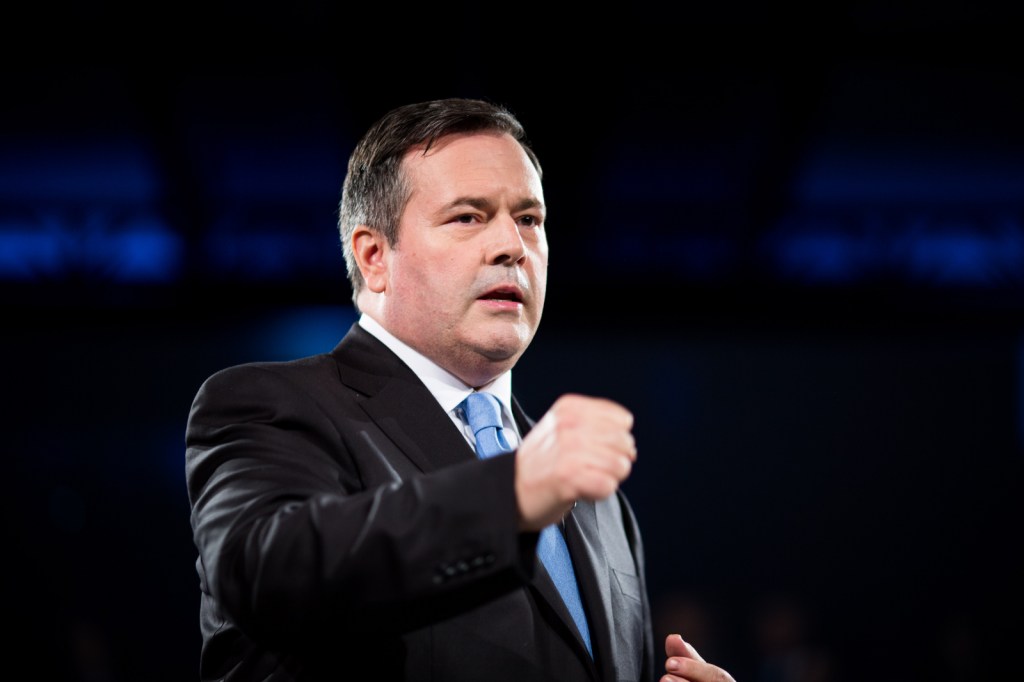
Mr Kenney going on about something
Good news isn’t really good news because…
The TMX press release contains just one word that’s not critical or negative. It appears in this sentence: “The news that construction will restart on this project is positive; however there is still not reason to celebrate.”
The Keystone XL press release contains two words that aren’t critical or negative. They appear in these sentences: “Today’s approval is encouraging news for both Alberta and our nation as a whole. This court victory is another step forward for this vital pipeline project after far too many years of regulatory delays and hurdles.” No wait, there’s a third positive word, Mr Kenney expressed gratitude to the US administration (is he afraid to say the word “Trump”) for issuing the second permit for Keystone XL.
After offering those tepid “attaboys” the press releases
shift into campaign rhetoric and misleading information.
Mr Kenney promises his government will “fight” those who “obstruct
progress,” and who must not be allowed to “illegally block” construction and “essentially
veto a project.” He fails to mention that
TMX protestors (including Elizabeth May) who violated the injunction protecting
the TMX work site in Burnaby were arrested and fined and will be arrested and
fined if they violate injunctions in the future. And that Canada has no jurisdiction to fight
those who illegally block the construction of Keystone XL in the US.
In case his rhetoric isn’t persuasive enough, Mr Kenney ends both press releases with a demand that the federal government repeal what he calls the ‘No More Pipelines’ Bill (C-69) and the West Coast Tanker Ban (C-48), but neglects to mention that neither bill has any impact on TMX or Keystone XL whatsoever and may have minimal impact in the future because some oilsands executives say Canada will have enough takeaway capacity for quite some time if TMX, Keystone XL and Enbridge Line 3 are completed.
Mr Kenney’s references to Bills C-69 and C-48 are red
herrings intended to divert our attention from the fact his government had
nothing to do with TMX and Keystone XL achieving these milestones.
Mr Kenney may argue he’s just being realistic. If so, he should have mentioned Keystone XL
and Enbridge Line 3 (and Line 5) are facing additional legal challenges in the
US. If Mr Kenney wants to get in on the
action, perhaps he can aim the big guns in his $30 million War Room in the
Americans’ direction. (NOTE: “big guns”
is a metaphor, Ms Soapbox is not for a moment suggesting Mr Kenney take up arms
and declare war on the United States).
Where’s a stateman when you need one?
Even the former premier, Rachel Notley (NDP) and the former Natural
Resources Minister Jim Carr (Liberal) were able to overcome their lack of
affection for Donald Trump (nutbar) when he reissued the federal cross-border
permit through an expedited presidential order that allowed Keystone XL to
proceed. They issued press releases
welcoming the news.
Wouldn’t it be nice if Mr Kenney could rise to the level of
statesman instead of defaulting to cheap partisanship and misleading attacks on
the federal Liberal government?
It was a headline befitting the National Enquire, splashed
across the top of the newspaper in four different fonts and three different
colours: “The evidence abundantly shows that Mr Trudeau knowingly sought to
influence Ms Wilson-Raybould both directly and through the actions of his
agents.”
And boom, it turned into a media circus.
The fundamental problem with this headline is the Ethics Commissioner, Mr Dion, also said simply seeking to influence another’s decision is not enough to breach of section 9 of the Conflict of Interest Act.
A second element is required. Mr Dion had to find that “Mr.
Trudeau, through his actions and those of his staff, sought to improperly
further the interests of SNC-Lavalin.”
Mr Dion said both elements were satisfied; however Errol Mendes, a professor of constitutional and international law, says Mr Dion appears to have misinterpreted “his own act and his jurisdiction” and we need a “more in depth discussion of the accuracy of this report among government, the media and…the public.”
Mr Trudeau
Sadly, the media is not interested in a thoughtful discussion about the Report. It’s perfectly happy running amok, cherry picking its way through the Report and blasting out the juicy bits to boost readership.
Media Spin I: Improper interference in a criminal
proceeding
The media says Mr Trudeau breached the Act by trying to get JWR
to “interfere” with a criminal prosecution.
This ignores the fact the AG has the discretion to intervene and if she chooses
to exercise her discretion she’s not “interfering” with a criminal prosecution,
she’s “intervening.” (And remember Mr
Dion said Mr Trudeau trying to get JWR to do anything doesn’t violate the Act).
Media Spin 2: The women vs the old boys club
The media says JWR led a group of women (Ms Roussel, director of public prosecutions, Ms Prince, her chief of staff, Ms Drouin, her deputy minister, former Liberal MP Ms Philpott and maybe even former chief justice Beverly McLachlin who “had her own reservations”) in a fight to fend off the “Old Boys club” (comprised of Mr Trudeau, some SNC executives and senior government officials, and maybe even two former Supreme Court justices, Frank Iacobucci and John Major) who were trying to get JWR to “interfere” with a criminal prosecution.
Have they read the report?
Ms Drouin, JWR’s deputy minister, was the first to propose bringing
in an outside expert. She said the
Attorney General (JWR) could issue a directive instructing the Prosecution
Service to give the outside expert enough information to ensure the “public
interest criteria had been properly weighed”. JWR rejected
her deputy minister’s advice.
With respect to Ms McLachlin, JWR said she’d talk with the
former chief justice, then changed her mind.
Ms McLachlin was prepared to meet with JWR, Ms McLachlin’s so-called “reservations”
were that she was no longer a lawyer and couldn’t give legal advice, she needed
a proper briefing and she’d need to be retained by the AG not the
government.
No matter how the media spins it, this wasn’t a battle
between the women and the Old Boys club.
Media Spin 3: Rushed remediation agreements
Discussions about whether Canada should adopt remediation
agreements (also known as deferred prosecution agreements) had been ongoing since
May 2015 when SNC engaged in discussions with the Harper government. Talks stalled and were suspended pending the
outcome of the federal election in Oct 2015.
The Trudeau government revisited the idea in Feb 2016. It held public consultations from Sept 25,
2016 to Dec 8, 2016 and found the majority of the participants supported the
idea. It introduced amendments to the
Criminal Code in the omnibus Budget Bill that was tabled on Mar 27, 2017. The Budget Bill was reviewed by the House
Standing Committee and several Senate committees before receiving assent on
June 21, 2018. The Criminal Code amendments went into effect on Sept 19,
2018.
JWR complained that the consultation process was rushed and
refused to lead the memorandum on the Criminal Code amendments to Cabinet, speak
publicly or speak before parliamentary committees about it.
Was the consultation rushed?
There are no rules setting out how long public consultation should
last. Consultations range from three
weeks for input on national historic sites, to three months for input on the
agenda for Canada’s Sustainable Development Knowledge, to three years for input
on the implementation of the Species at Risk.
JWR didn’t say how long the consultation should have been, but she was
so unhappy with the process she boycotted it.
Media Spin 4:
It’s all about Quebec votes
Mr Trudeau had direct contact with JWR once, in a meeting
in Sept 2018 that included Mr Wernick, the Clerk of the Privy Council. Mr Trudeau said he understood the decision
was JWR’s to make and she’d made it. He said
he wanted to find a “solution” and when she agreed to talk further with Mr
Wernick and her own deputy minister (who’d suggested bringing in an outside
expert and reaching out to the Prosecution Service) he thought she was prepared
to revisit the issue.
During this meeting Mr Wernick mentioned the upcoming Quebec
election and Mr Trudeau said he was a Quebec MP. JWR asked Mr Trudeau if he was politically interfering
with her role. He said no and never
mentioned politics again, unfortunately some of his staff did in their meetings
with JWR and her staff.
Professor Mendes and others say the Shawcross doctrine precludes
an AG from considering political interests in a criminal prosecution. But here’s the kicker. Professor Mendes says the Shawcross doctrine
does not apply in a consideration of section 9 of the Act
and the Ethics Commissioner misinterpreted the Act and his jurisdiction when he
applied it.
Media Spin 5:
This is about ethics
Mr Dion said Mr Trudeau attempted to influence JWR’s decision
not to intervene in the SNC prosecution on four occasions:
At the Sept 2018 meeting when he said he was
an MP for Quebec. Professor Mendes
says the Commissioner inappropriately applied the Shawcross doctrine and
misinterpreted his jurisdiction when he did so.
When PMO and Privy Council staff asked whether
the AG could intervene in SNC’s application for judicial review to expedite the
hearing or get a stay pending the outcome of discussions about the remediation
agreement. Does staff asking the question
amount to “influence”?
Suggesting to JWR that she seek external advice
from “someone like” former chief justice Beverly McLachlin when SNC had legal
opinions from two former Supreme Court justices and shared them with the
government and these opinions were prepared for the “sole purpose of persuading
[JWR] to reconsider her opinion.” This
is highly insulting. Ms McLachlin is not
a puppet on a string. She would have
formed her own opinion which may or may not have agreed with that of the two former
Supreme Court justices.
The “final and most flagrant attempt to
influence” JWR was her conversation with Mr Wernick where he asked her to
reconsider. The irony here is palpable. The Ethics Commissioner is relying on a conversation
JWR secretly taped (most people would call that unethical, but the Ethics
Commission calls it an “audio recording”) to condemn Mr Trudeau for things Mr
Wernick said.
Mr Dion said these four instances tick the box for “seeking
to influence.” He then embarked on a mushy
discussion of the “national public interest” to demonstrate Mr Trudeau sought to improperly further SNC’s interests.
Mr Trudeau said he was trying to save 9,000 jobs. Mr Dion said this was improper because a prosecutor cannot consider the “national public interest.” Mr Trudeau’s lawyer argued “national public interest” as defined in the Criminal Code is modeled on the OECD Anti-Bribery Convention and the former Secretary-General of OECD said it was never intended to include job loss so a prosecutor can consider it . Mr Dion rejected this argument.
And Mr Trudeau was done.
When its all over
Yes, the Report contains evidence of discussions between
Mr Trudeau and his staff and JWR and her staff, but these discussions are not
enough to find Mr Trudeau in breach of the Act.
To cross that bridge Mr Dion applied the Shawcross doctrine, perhaps in
error, and relied on a definition of the national public interest which may be
incorrect. The Report requires more in
depth discussion.
Not that it matters to the media who are guided by the
maxim: what would the National Enquirer do?
Based on what we’ve seen so far, the National Enquirer would
be proud.
“Patriot: the person who can holler the loudest without knowing what he is hollering about.” Mark Twain
Last week Mr Kenney joined the patriot squad. On August 4 and August 7 he released two odious videos on social media. Let’s call them “Patriot Games One” and “Patriot Games Two.”
Patriot
Games One
The gist of Patriot Games One was that Mr Kenney is a Canadian patriot who comes from a long line of Canadian patriots and is descended from people who fought for Canada even before it became a country (um, wouldn’t that make them British patriots?). Mr Kenney said Alberta is getting a raw deal from the other provinces and the feds, Alberta is paying the bills and getting no respect, but fear not Mr Kenney will not let Justin Trudeau “push us out of our country”. Mr Kenney said instead of focusing on Alberta separating from Canada, Albertans should focus on “separating” Justin Trudeau from the prime minister’s office.
Message: Be a patriot.
Vote Conservative because Trudeau is trying to push Alberta out of
Confederation.
Patriot
Games Two
Patriot
Games Two came out three days later.
Apparently, Albertans continually ask Mr Kenney about separating. He says he’s a Canadian federalist, always
has been, always will be…but he understands Alberta’s angst. Alberta contributed $600 billion to Canada
over the last six decades and Trudeau “killed” and “surrendered to a veto” on
Northern Gateway (I guess killing it wasn’t enough), he “killed” Energy East,
he “bungled” Trans Mountain, he’s “threatening us with a punitive carbon tax,”
he brought in the “no more pipelines” law, he attacked Alberta oil exports off
the northwest coast and did other bad things to Alberta. But Albertans are “proud Canadians”, we
should fix the problems with the federation by electing a conservative federal
government.
Message:
Be a patriot. Vote Conservative because
Trudeau is hurting Alberta.
Here’s
where Patriot Games Two got really interesting.
Kenney said, “I believe we Albertans are patriotic Canadians we
believe in Canada even if we’re frustrated with how the current federal
government has been injuring our economy and I’m trying toisolatethefrustration on a series of federal government policies that
have injured our economy, the only alternative is for me to pretend that
this frustration doesn’t exist and when political leadership ignores that level
of frustration, that’s where things can go in the wrong direction. (Is
he going to “isolate the frustration” by magnifying it? If he ignores the
frustration what direction will it go? Car bombs and kidnapped politicians?)
The Patriot
He ends the clip by
repeating his claim that he’s a proud Canadian patriot who wants Alberta “to be
a key member” of federation, contributing to the rest of Canada.
Message: I’m not a separatist, I just sound like one because I’m isolating your frustration.
Patriot or Nationalist
There is so much
wrong with Patriot Games One and Two it’s hard to know where to begin.
Let’s start by
defining terms. Merriam Webster defines
“patriot” as someone who loves and supports his/her country.
Mr Kenney says he’s
a patriot, but his actions aren’t those of someone who loves and supports his
country.
A patriot does not spend years maligning federal institutions (like the equalization formula) or telling Albertans they’re getting a raw deal and “no respect” from other provincial governments and the federal government.
A patriot does not pretend the language of separatism is an effort to “isolate” frustration and he has no other alternative. Mr Kenney could try working with Mr Trudeau to gain his support like Ms Notley did when she convinced Mr Trudeau to buy Trans Mountain and increase unemployment insurance benefits for Albertans, or Mr Lougheed did when he engaged with Pierre Trudeau on changes to the 1982 Constitution Act. These fine premiers found an alternative that did not suggest the federal government was trying to throw Alberta out of the country.
(As an aside, why would Mr Trudeau push Alberta out of Canada when he just spent $4.5 billion on a pipeline to transport Alberta bitumen to tide water?)
Lastly, a patriot does not use the language of patriotism in a crass partisan pitch for the federal Conservatives coming to the people directly from the premier’s office and the lobby of the Alberta Legislature no less. Does Mr Kenney seriously think Albertans will vote for anyone else?
The historian, Timothy
Snyder, said a patriot sets a good example of what the country means for
generations to come.
George Orwell said a
nationalist, “although endlessly brooding on power, victory, defeat, revenge”
tends to be “uninterested in what happens in the real world.”
When Ms Soapbox read the “open letter” to Canadians published by three oil executives she was reminded of Sigmund Freud. Freud spent 30 years asking himself: what do women want?
After 70 years of riding the boom/bust roller coaster with
the energy industry Canadians are wondering the same thing: what do they want?
The answer is contained in the “open letter”.
Here’s the letter as it appeared in 30 newspapers. (Ms Soapbox’s comments appear in italics).
What do they want?
The Open
Letter
We have
big decisions to make as a country, and there is an opportunity for each of you
to influence the outcome. (How will
you vote in the federal election?)
Canadians
want to know what the energy sector is doing to address the global climate
change challenge while working to strengthen our economy. (True).
As energy
company leaders, we believe Canada is ideally positioned to do its part to both
positively impact climate change and ensure a strong and vibrant economy for
the future. (Good).
This is
not an ‘either’ ‘or’ conversation, it’s an ‘and’ conversation. (Got it).
The world needs more energy to sustain a growing global economy that is expected to lift three billion people out of poverty in the decades ahead. We need more wind, solar and hydro, but oil and natural gas remain a large part of the mix too. This is true in even the most optimistic scenarios for the worldwide adoption of renewable energy. (Lifting three billion people out of poverty involves geopolitical and macroeconomic issues as well as climate change, but okay).
The world also needs to significantly reduce greenhouse gas emissions. But shutting down Canada’s oil industry will have little impact on global targets. In fact, it could have the opposite effect, with higher carbon fuels replacing our lower emissions products. (This is not an excuse for doing nothing, Canada can set an example. It’s called moral leadership).
A healthy Canadian oil and natural gas industry is vital in leading the way to a lower carbon future. (Not if “healthy” means “profitable” and “profitable” means minimal GHG reduction).
Made-in-Canada
technologies that reduce emissions at our oil and natural gas operations could
be adapted for sharing with other industries worldwide. We are already making
meaningful progress developing those solutions.
(True).
We’ve
reduced the emissions intensity in the oil sands by about 30% over the past two
decades, and a number of oil sands operations are producing oil with a smaller
greenhouse gas impact than the global average. We’re working to get those
numbers even lower.
(Actually,
Suncor says it’s reduced emissions by 50%.
Is Suncor sharing its technologies with you, if so, why are you at 30%?)
And Canada’s
energy companies are the country’s single largest investors in clean tech.
Through organizations such as Canada’s Oil Sands Innovation Alliance (COSIA),
Petroleum Technology Alliance Canada (PTAC) and the Clean Resource Innovation
Network (CRIN) we are continuing to work on – and share – breakthrough
technologies. (Good, but you don’t
get brownie points for doing the right thing).
But we
can’t do it alone. (Here it comes…)
And
that’s why we are writing this letter. (Wait
for it…)
As we
head into the upcoming election, we are asking you to join us in urging
Canada’s leaders of all political stripes to help our country thrive by
supporting an innovative energy industry. One that can contribute to solving
the global climate change challenge and play a significant role in creating
future energy solutions by developing our resources in the cleanest most
responsible way possible today.
(So you want to elect a government that will support the industry. According to 80% of the investors and industry executives who attended the 2019 ScotiaBank Conference, the biggest issue facing the industry is lack of egress/takeaway capacity—only 10% thought regulatory issues were the biggest challenge—the Trudeau Liberals bought Trans Mountain to fix the egress problem. The holdup is Charter challenges in the courts. A change of government won’t “fix” the courts.
The Conservatives
say they’ll repeal the carbon tax. This will
put more cash in your pocket. How will
you invest it? 85% of the ScotiaBank
guys said they’d buy back shares or pay off debt (ie. give the money to shareholders
or banks), 0% said they’d invest in growth (ie. more jobs). So why should Canadians support the
Conservatives?
The choices we make will determine the quality of life we create for ourselves and future generations. These choices will impact our ability to fund schools, hospitals, parks and the social programs that we as Canadians so deeply value. (Canadians also value the environment).
This
isn’t about any particular pipeline, policy or province. This is about the
future of Canada.
(So let’s talk politics. The ScotiaBank guys were asked who’d win in the fall election: 11% predicted a Conservative majority, 5% predicted a Liberal majority and 75% predicted a minority government of some sort. A CBC poll showed 35% of Canadians support the Conservatives, 31% support the Liberals, 13% support the NDP and 11% support the Greens—this foreshadows a non-Conservative minority government).
Signed by
the Presidents of CNRL, Cenovus, MEG Energy
(And not
signed by the presidents of industry giants like Suncor, Husky and Imperial and
mega pipelines like Enbridge and Trans Canada).
Instead of publishing an open letter asking Canadians to elect a government that won’t push the industry on GHG emissions and supports less regulation, these three executives should have paid attention to economist Peter Tertzakian who told the ScotiaBank crowd in order to succeed the industry must: (1) lower its costs, (2) pay more attention to environmental, social and governance (ESG) issues and (3) do the best job it can to get the highest value markets because politics in Canada and the world are unpredictable.
To paraphrase Freud’s question: What do these industry executives want? Answer: a government that gives them everything.
Is this
what Canadians want? We’ll find out in
October.
To paraphrase Jane Jacobs, the majority of Calgary City Council regard Calgarians as “empty-headed young ladies whose main duties were to see that their nails were clean, their curves properly distributed and their behavior seemly.”
These councillors refuse to allow adequate public consultation
on their decision to spend $275 million on the new Flames hockey arena while at
the same time raising property taxes, wiping out small businesses and cutting
$60 million in public services including police and fire.
Only four city councillors, Evan Woolley, Jeremy Farkas,
Druh Farrell and Peter Demong, didn’t rubberstamp the Flames deal, which is described
by the Canadian Tax Federation as an example of “corporate welfare.” (Ms Soapbox and the CTF agree, did Hell just
freeze over?)
Flames CEO Ken King and Mayor Nenshi
The deal’s benefits
Mayor Nenshi and most councillors say investing $275 million
in public money will create $400 million in public benefit.
Really?
Let’s review the benefits set out on page 24 of the Facilities Update document:
Ticket tax revenues: Calgary will get $155 million over 35 years through
a ticket tax of 2%. If it had negotiated
the same 9.5% ticket tax deal Edmonton negotiated with the Oilers, it would have
gotten $736 million in revenue. To add
insult to injury, Calgary agreed to cap its share of ticket tax revenue at $3
million for the first 5 years, this represents a loss of $1.4 million/year
for five years.
Local community sports payments: $75
million over 35 years. Okay, that’s
nice. The $2 million/year will come in
handy when we cut $60 million in public services.
Naming rights: $2.5 million/year for 10
years. Ditto.
Retail property tax: $19.4 million over
35 years. It’s unclear where this number
comes from given that it’s dependent on development that has not yet taken
place and would be sensitive to economic downturns which depress business tax
revenue.
Indirect Rivers District Development: This pie in the sky number accounts for $138.7
million and is contingent on many things including whether the Flames exercise
two options to buy unspecified Rivers District Lands. If all goes well, this revenue yields a 1.4%
return on investment. If it goes pear
shaped, the City suffers a .6% loss.
The Facilities Update document also lists a number of soft benefits including Calgary remaining committed to economic recovery (well, I certainly hope so!), and the arena being a “catalyst” for future development and an “anchor” for arts, culture and entertainment.
Sigh, all these benefits are enough to make a girl swoon so
I’ll turn to economist Trevor Tombe who said the $400 million in benefits is “misleading”
and the real cost of the deal is a $47 million loss. Loss????
The deal’s downside
What the Facilities Update document doesn’t provide is an analysis
of the deal’s costs and risks. These
include:
Risk of demolition cost overruns: Demolition
is expected to cost $12.4 million. Calgary and the Flames will share this cost
90/10, but the Flame’s 10% is capped at $1.4 million. Some estimates show the cost of demolition
and reclamation at $25 million. This
means Calgarians could be on the hook for $23 million.
Cost overruns: The Saddledome was completed in 1983,
eight months late and $16 million (about 20%) over budget. A 20% overrun on this project will cost $110
million. Council says each party is responsible
for the changes it requests. Good luck
with that. It’s easy to request a change
order during construction, it’s much harder to figure out who should pay for it
after the fact. The operative phrase
here is “See you in court, buster!”
Free options:
The City gave the Flames two no-cost options on River District
Lands. One lets the Flames buy prime real
estate in 2024 at 2018 prices; the other lets them buy prime real estate at
fair market value any time up to 2034.
Because hey, why shouldn’t Calgarians subsidize the Flames’ desire to
become real estate moguls if the spirit moves them.
Liability: The City will own the arena. This means Calgarians are on the hook for
major structural improvements, the cost of City services, insurance, and any flood
mitigation costs in excess of $2 million (does “2013 Flood” ring a bell?) and by
2054 when the lease is up, the arena will be ready for demolition and we’ll
start all over again.
Stop carping
Of all the stupid reasons I’ve heard against public consultation,
these take the cake:
Councillors had 14 months to get public input: Excuse me??? The financial strategy and negotiation mandate weren’t approved until March 4, 2019. What were councillors supposed to discuss with their constituents…free rides on the zamboni?
Woolley and Farkas want to run for mayor: This fails to account for Farrell and Demong who also refused to rubber stamp the deal. Besides, who cares. Running a mayoral campaign on the promise that you’ll listen to the people is more convincing when you actually listen to the people.
It gives Calgary a shot in the arm: This reminds me of a couple I knew who were so depressed about maxing out their credit cards they bought themselves new skis (on credit) for Christmas. Good public services will enhance the quality of life for all Calgarians. Draining Calgary’s emergency fund down to 5% will not.
Don’t worry, be happy
Mayor Nenshi said public consultations is only necessary in
two cases: (1) changes are possible and politicians want to hear from their
constituents and (2) politicians haven’t made up their minds and they want to
hear from their constituents. He said neither
of these reasons apply here.
In other words, we’ve made up our minds and there will be no
more changes.
Silly Calgarians, clean your nails, make sure your curves
are properly distributed and your behavior is seemly. No one wants to hear from you.
I am a constituent living in your riding. Thank you
for bringing forward a motion to extend the time available for public
consultation on the proposed deal with the Calgary Flames. I am deeply
disappointed that the Mayor and most of Council rejected your motion.
The fundamental issue here is not whether this project is
good or bad—I don’t know, I haven’t been given enough time to make a reasoned
decision—it’s whether Council has the right to make this decision in the
absence of a fulsome public engagement process.
Councillor Jeff Davison says there’s been ample time for consultation with Calgarians, over 14 months. The Facilities Update document dated July 22, 2019 indicates otherwise. The Event Centre Exploration Committee was created and its mandate was approved on May 28, 2018. Its workplan was approved on Feb 20, 2019. The timeline ends on July 4, 2019. There is no record of any public consultation at any time between May 28, 2018 and July 4, 2019.
Councillor Evan Wooley
This is even more egregious considering the Committee’s mandate which requires it to “identify, consult and collaborate with key internal and external stakeholders.” Surely Calgarians who are being asked to foot the $275 million bill and trade off other public services in exchange for an arena would be considered “key external stakeholders.”
The Committee is required to conduct itself in accordance
with certain “principles” including “engagement with the public throughout the
process whenever possible to ensure transparency.” Councillor
Davison telling me to send a form to a City website by noon Friday does not
satisfy the principle of “engagement.”
Councillor Woolley, you moved a motion in March 2019
(unanimously adopted) directing city administration to work with the Committee
to develop a public engagement plan. The Committee failed to act on your
motion.
If this is as good a project as Councillor Davison says it
is and it makes sense on its own merits as Mayor Nenshi says it does, then it
will withstand public scrutiny in the form of a public engagement process that
outlines the benefits it will bring to Calgarians.
If Council approves this proposal on Tuesday July 30, 2019,
in the absence of meaningful public consultation it will violate our democratic
rights as citizens to participate in material decisions that affect our
wellbeing. We will not forget this breach of trust when we cast our
ballots in the next municipal election.
Ms Soapbox found herself organizing the sock drawer this morning.
She blames this burst of domesticity on Donald Trump.
She’ll explain how this ties back to Alberta politics in a
moment, but first a quick recap of the most recent Trump blowout.
The Tweet
Last week Mr Trump tweeted that Alexandria Ocasio-Cortez and
three other congresswomen should go back to where they came from, or words to
that effect. All four are American
citizens, three were “born and bred” Americans (why does everyone use that
phrase, it makes us sound like cattle), one immigrated to the US as a child.
The mainstream media and social media went nuts.
They debated three issues:
This proves/doesn’t prove Trump is a racist. Does it matter? His base and many swing voters don’t care if he’s racist or just plain nasty.
This demonstrates Trump is a savvy politician; he’s painting the Democratic Party as AOC “social democrats” in order to recapture the swing districts he lost in the mid-term elections. All the more reason for the Democrats to figure out who they are before Trump does it for them.
AOC should pipe down because she’s undermining Nancy Pelosi who’s done more for progressive causes than anyone. One journalist asked: where was AOC when Ms Pelosi was fighting to get Obamacare through Congress in 2010? Oh please, in 2010 AOC was in university completing a degree in economics and international relations. Furthermore, Ms Pelosi’s past achievements do not justify silencing AOC and other fresh thinkers who are in short supply in the Democratic Party at the moment.
AOC responded to Mr Trump with this: “Weak minds and leaders challenge loyalty in order to avoid challenging and debating the policy.”
This is why the Trump tweet and the ensuing media brouhaha are important in the context of Alberta politics where the UCP continue to demonize Rachel Notley, the NDP and their supporters as “social democrats” bent on destroying our way of life by undermining our capitalistic economy.
If the UCP and their supporters want to discuss capitalism, it
would help if they understood the meaning of the word and its history.
Capitalism
In his book, Economics for Everyone, Jim Stanford explains
that capitalism is just one form of economy.
He says homo sapiens have been around for approximately 100,000 years
and had an economy the entire time. Capitalism
has existed for 250 years. To put this
into context, if the history of man is represented by a 24-hour day, then
capitalism has been around for three-and-a-half seconds.
Three-and-a-half seconds.
Capitalism is defined by two crucial features: profit-seeking investment by private corporations and wage labour. Capitalism comes in many varieties.
Mr Stanford compares the key economic and social indicators of four capitalistic countries, the US, Germany, Japan and Sweden and demonstrates that the country with the highest GDP (US) performs much worse than the other countries on other important indicators including poverty rates, inequality, pollution, incarceration and premature death–leaving one to question the assumption that GDP is a good indicator of quality of life.
Mr Stanford points out “the strategy of incrementally
reforming capitalism, while preserving the system’s defining features, has
traditionally been the ideological core of the social-democratic movement.”
Or to put it another way, social democrats are trying to
make capitalism better.
Now that we’ve cleared that up
So, the next time someone tries to smear the NDP by calling them social democrats, tell them the NDP is working hard to make capitalism better and ask them what they and their UCP government are doing to achieve the same goal. After they’ve listed all their efforts to improve capitalism (not corporatism), feel free to engage in a healthy debate on the respective merits of their policy choices compared to yours.
Because whether weak leaders like it or not, we’re going to debate policy. We’re going to challenge the suitability of old economic policies that failed to address the problems of the last decade (does the financial crash of 2008 ring a bell?) and are now being touted by unimaginative conservatives as our economic salvation.
There is honour in being a social democrat.
I’ll take Alexandria Ocasio-Cortez and Rachel Notley over Donald Trump and Jason Kenney any day.
It’s also the last day for politicians to dress up as cowboys for one last photo-op before getting back to business of politics.
The issue we have with this photo isn’t that these men aren’t
real cowboys but that they’re not real conservatives.
Premier Kenney with premiers of NWT, New Brunswick, Saskatchewan and Ontario
Yes, Mr Kenney says he’s leading the charge to renew conservatism but unfortunately for conservatives he doesn’t represent traditional conservatism. He represents something The Economist calls the New Right, a movement created by a bunch of aggrieved pessimists and reactionaries who are shredding traditional conservatism to gain power.
Conservatism then and now
Traditional conservatives are cautious by nature. They expect the authority imbued in the family, church, and tradition to control and slow down change. Mr Kenney on the other hand promises to move with great haste because “speed creates its own momentum” and is more difficult to oppose.
Traditional conservatives are pragmatists, not zealots who play fast and loose with the truth. They don’t enflame wild-eyed western separatists with misinformation about the equalization formula, they don’t double down on allegations that the deficit was a billion dollars higher than the NDP said, when in fact it was $2 billion lower than the NDP had projected; or to put it another way $3 billion less than Mr Kenney alleged.
Traditional conservatives cherish institutions, they don’t abuse them. They don’t create $30 million taxpayer funded propaganda centres and call them “war rooms”. They don’t set up $2.5 million taxpayer funded witch hunts and call them public inquiries into foreign-funded conspiracies to kill the energy industry. They don’t disregard the rule of law by promising to rip up billion dollar contracts before they’ve laid eyes on them. They don’t make a mockery of democracy by running roughshod over the Opposition and plugging their ears and jumping into reflecting pools because no stunt is too juvenile for our elected representatives.
Most importantly, they don’t manipulate the population with
the promise of prosperity to gain power.
Wealth and prosperity
Mr Kenney described his Stampede breakfast as an “…informal get-together of some like-minded premiers to talk about jobs, growth and prosperity.” Mr Ford said it was the first time in a long time that “like-minded premiers that want their provinces to thrive” had a chance to get together. Mr. Moe said it wasn’t an ideological gathering but one of “mutual interest on how we can continue to create wealth in the communities we represent.”
In case you missed it, the common thread there was wealth not ideology. Prosperity in and of itself isn’t a bad thing, but under Mr Kenney’s New Right government it takes precedence over absolutely everything else.
Mr Kenney’s government moved quickly to ensure corporations were happy even if this required underfunding public services to prop up failing businesses. The government just announced a one-time 35% cut in property taxes for selected shallow gas companies. This translates into a $23 million hit to revenue earmarked for education and is in addition to corporate tax cuts that will reduce business taxes from 12% to 8% over the next four years.
All government ministries
understand the “economy first” priority.
Justice Minister Doug Schweitzer says increasing employment and restoring Alberta’s reputation as a place to do business will be a big part of his ministry’s “fight-back strategy”. If economic development is part of the Justice Minister’s mandate what are the premier and the ministers of economic development & trade, energy, natural gas, labour and treasury & finance doing…justice?
Traditional conservatives have always been small government, pro-business types, but the progressive ones like Peter Lougheed understood the need to balance economic development with funding public services through taxation.
Sadly, the Lougheed conservatives have been outflanked by New Right politicians like Mr Kenney and his cowboy cronies. They’ve discovered a two-pronged path to power: (1) fan the fear and insecurity created in the aftermath of 9/11 and the financial crisis and (2) promise prosperity through austerity (why that one works is beyond me).
Rhinestone cowboys are
fun, but New Right politicians masquerading as traditional conservatives are
dangerous.
Five “like-minded” premiers showed up for the Stampede this year, if a “like-minded” prime minister joins them next year we’re in big trouble.
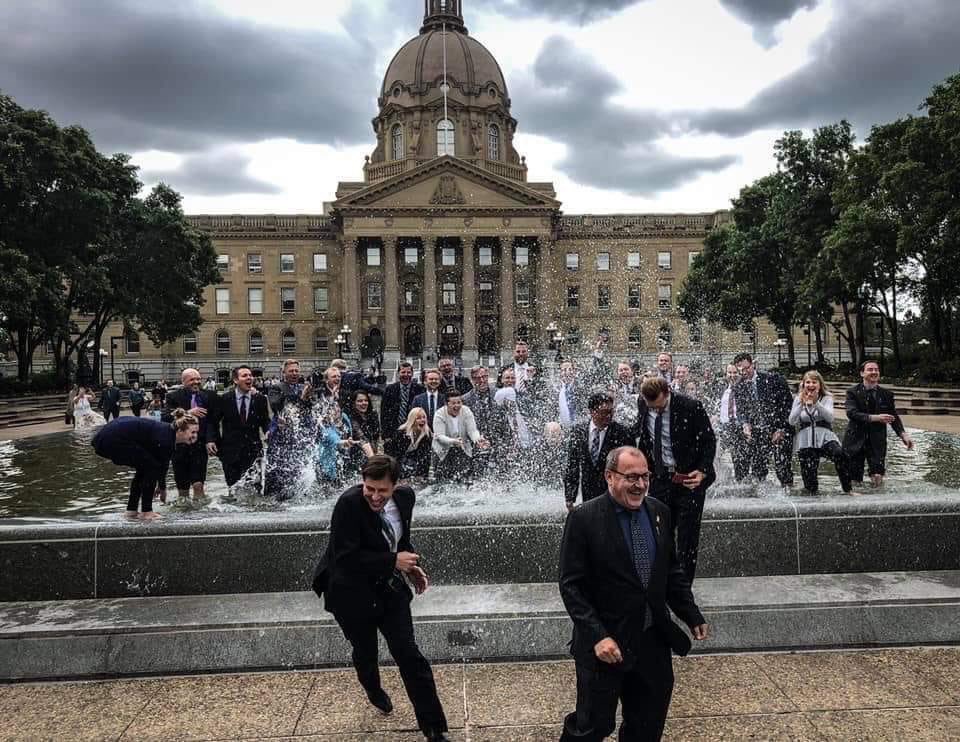
In a manner befitting the serious business of governing, the Alberta UCP caucus celebrated the end of the spring session by jumping into the reflecting pool in front of the Legislature.
Perhaps it was the strain of being held to account by the
NDP Opposition for seven whole weeks or maybe it was the joy of enacting legislation
that makes outing gay kids in schools optional, in any event it was an unseemly
start to the summer recess.
Image from @HandmaidAlberta
The laundry list
For a party that was quick to denounce the NDP government for
moving too fast, Mr Kenney made a big deal about passing 13 bills and fully or
partially implementing 55 platform commitments.
He described this effort in Trumpian terms. By repealing the carbon tax and cutting
corporate taxes he’d set the record for the most tax relief provided to Albertans
and businesses in a single legislative session. Another perspective would be he traded the
Alberta carbon tax for the federal carbon tax and blew the biggest hole in
Alberta’s budget ($4.5 billion) in a single legislative session.
But hey, let’s not quibble, more jobs and investment dollars are just around the corner, right?
Of the 55 commitments 24% are real (repealing the carbon tax, cutting corporate taxes, ending subsidies for renewables projects) and 11% damage the government’s relationship with business and/or Albertans by rolling back protections for LGBTQ students, unions and workers under 18, killing jobs by cancelling infrastructure projects, or revisiting settled issues like farm safety, the structure of electricity markets, supervised consumption sites and crude by rail leasing agreements.
The remaining 65% are a mishmash of:
public relations stunts—the public inquiry into
foreign funding for “anti-Alberta energy campaigns”, legislation to restrict
exports to BC and elect senatorial nominees and a referendum on equalization,
pre-emptive moves—the Blue Ribbon panel to
review Alberta’s fiscal framework will provide air cover when Mr Kenney cuts public
services in the fall,
organizational moves—appointing three new
associate ministers and one new minister and creating a new ministry to reduce
red tape
self-congratulatory pats on the back for
retaining NDP legislation relating to essential services, charitable tax credits, the 2% small business
tax and the $15/hr minimum wage,
brownie points for complying with the laws,
specifically the constitutional right to separate schools and compliance with environmental
impact assessments,
litigation—challenging the fed’s carbon tax
after the courts upheld it twice, and
doing what premiers and governments are supposed
to do like sitting in the Legislature (commitment #2), talking about the energy
industry (commitment #44), talking to the energy industry (commitment #24) and talking
to the other provinces (commitments #25 and #54).
Mr Kenney also introduced some small changes which are legitimate but raise
questions about why they were top priority and had to be addressed in the first
session (who knew the reclassification of service rigs as off road vehicles was
a burning issue for Albertans).
Is it enough?
Mr Kenney presented the laundry list as evidence Alberta was “on track to
become the most tax competitive jurisdiction for businesses and among the most
attractive investment destinations in North America.”
The business sector supports Mr Kenney’s laundry list, well at least the tax
reduction part, but thinks the premier could use more help.
Last week a new non-profit, non-partisan industry association, the Business
Council of Alberta, was founded to “create the right conditions where
Albertans, the economy and the environment can thrive without leaving anyone
behind.”
Hal Kvisle, the chair of BCA said its objective was “to improve prosperity
for all Albertans … not just economic prosperity, not just companies getting
richer, but employees doing better, improvements on the social side of things
and, of course, very careful attention to the environment.”
The BCA is a group of more than 40 CEOs and senior executives representing top
Alberta companies in every sector of the economy. It employs over 200,000 Albertans and invests
tens of billions annually in the economy.
It wholeheartedly endorsed Mr Kenney’s corporate tax cut which “in combination with the predictable reductions coming over the next 3 years, has a high potential to result in new projects and investments, and more Albertans working”.
Sadly it failed to mention whether its member companies would embark on a hiring spree or invest more capital in the economy any time soon.
The future
Between Mr Kenney’s 55 commitments and the BCA’s desire to improve prosperity for all Albertans not just companies, we’ve got nothing to worry about.
Excuse me while I take a celebratory dip in the goldfish pond.
PS: You may have heard some silly talk to the
effect that Alberta wants to separate from Canada because Albertans don’t think
Canada appreciates their contribution to Confederation. They’re being egged on by a silly little man,
our Premier, who’s issued warnings about rising western separatism and threatened
to use “every tool in the legal and political tool box” to defend Alberta’s
interests.
(When did politicians turn into mechanics ready to whip out the old tool box when they don’t have anything concrete to say?)
Anyway,
it’s your birthday, feel free to ignore this nonsense.
Naïvety
It’s
true that a recent Angus Reid poll found 50% of Albertans would support
separation.
While
this sounds alarming, what it really means is if the separatists are successful,
the rest of Alberta would be heading for the lifeboats. For every Albertan leaving Canada, there
would be another Albertan leaving Alberta, effectively reducing the population
of Indie AB to that of Vancouver.
This puts
Indie AB in a precarious position when it comes to negotiating separation from
Canada.
The western
separatist dream is based on the naïve assumption that Indie AB would come out
on top in its negotiations with Canada, the US and the rest of the world in resolving
the problems it created by turning itself into a land-locked country totally
dependent on foreign countries to get its goods and services to market. Some would call this shooting oneself in the
foot.
As
Britain discovered with Brexit it’s easier to say “Leave!” than it is to actually
leave.
The
challenges facing Indie AB would be formidable as it negotiates the repayment
of Alberta’s share of the federal debt (roughly $71 billion), national defence,
currency, border policy (open or closed) as well as replicating international
trade and security agreements under NAFTA 2.0, WTO, NATO etc.*
Hubris
The
hubris of the Premier and his western separatists is staggering.
They’ve
assumed the 45 First Nations in Alberta and other western provinces would join them
in this frolic, and if full independence became too difficult, everyone would
be agreeable to a bait-and-switch that results in Indie AB joining the United States.
Really?
Are the separatists ready to trade the political influence that comes with being the richest province in Canada for the influence, such as it is, that comes with being the 25th richest state in the US with a population somewhere between that of New Mexico and Oklahoma depending on how many Albertans agree to become Americans.
More
importantly, have the separatists figured out how to replace key public
services, particularly access to universal healthcare, that would go poof when Indie
AB becomes the 51st state?
Investment
Western
separatists assume the economy would boom if they freed themselves from Ottawa’s
interference. They’ve forgotten that
capital markets want certainty.
Investors won’t stick around for two or more years while Indie AB sorts itself
out. They’ll shift their investments to
other jurisdictions that offer certainty in the laws and policies governing resource
development, interprovincial and international trade, environment, health,
safety, taxation and labour.
Reality
Canada,
here’s the last thing you should know.
Albertans
wonder whether their premier really has their best interests at heart or if he’s
just posturing to pump up his political profile.
Mr
Kenney had plenty of opportunities to protect Alberta’s interests when he was a
federal MP in the Harper government but failed to do so. Now that he’s no longer in Parliament he’s telling
Albertans they’re being victimized by Ottawa.
Unbridled anger is dangerous and difficult to control. It results in billboards like the one in
Edmonton that said, “Is Trudeau Leading Us to Civil War?”
Mr
Kenney may be fine with this, but most of us know that if anyone is leading us
astray it’s Mr Kenney, not Mr Trudeau.
So
this Albertan wants to wish Canada a Happy Birthday and tell her fellow
Canadians that she, like most Albertans, is grateful to be a citizen in the
country ranked on the World Index as the best country in the world for quality
of life.**




/https://www.thestar.com/content/dam/thestar/politics/provincial/2019/07/09/ford-brings-open-for-business-message-to-premiers-meeting-in-saskatoon/premiers.jpg)



 Susan on the Soapbox